Application of Differential Equation (original) (raw)
Last Updated : 23 Jul, 2025
Differential equations have a wide range of applications across various fields due to their ability to model dynamic systems and processes. In this article, we have covered in brief about differential equation, their application, and others.
Table of Content
- What are Differential Equations?
- Application of Differential Equations
- FAQs on Application of Differential Equations
What are Differential Equations?
Differential equations, mathematical equations that relate some function with its derivatives, are fundamental in expressing how quantities change over time or space. They play a crucial role in engineering, physics, economics, and beyond, providing a framework for modeling the dynamics of various systems.
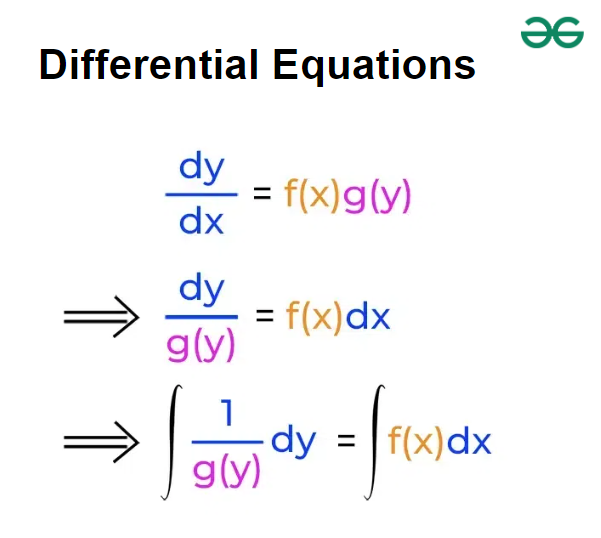
Differential Equations
By understanding and solving differential equations, we can predict behaviour, optimize processes, and solve complex problems in real-world situations.
People Also Read:
Application of Differential Equations
Vpplications of differential equations include:
**In Physics
Used to model motion, heat flow, and wave propagation, enabling the study of phenomena from planetary orbits to quantum mechanics.
- **Newton's Second Law: Describes the motion of a particle under the influence of forces. The equation ?=??F=ma (force equals mass times acceleration) can be written as a differential equation: **m.d 2 x/dt 2 = F(x, t)
- **Simple Harmonic Motion: Models oscillatory systems like springs and pendulums: **d 2 x/dt 2 + ω 2 x=0
**In Engineering
Essential for designing and analyzing electrical circuits, mechanical systems, and structures, ensuring reliability and efficiency.
- **PID Controllers: Used in feedback control systems to maintain the desired output. The behavior of such systems can be modeled by differential equations describing the relationship between input and output.
- **RLC Circuits: Describes the behavior of electrical circuits consisting of resistors (R), inductors (L), and capacitors (C):
**In Biology
Applied in modelling population dynamics, disease spread, and ecological interactions, offering insights into natural processes and their management.
**Logistic Growth Model: Models population growth with a carrying capacity:
dt/dP = rP(1 - KP)
**Predator-Prey Models: Describes the interaction between two species, such as the Lotka-Volterra equations: ????=??−???
- dt/dx = αx−βxy
- dt/dy = δxy−γy
**In Economics
Helps in modelling economic growth, interest rates, and market dynamics, informing policy and investment decisions.
**Financial Modeling:
**Black-Scholes Equation: Used for option pricing in financial markets:
**∂V/∂t + 1/2 σ 2 S 2 **∂ 2 V/∂S 2 **+ rS∂V/∂S - rV=0
**Growth Models:
**Solow Growth Model: Describes long-term economic growth:
**dk/dt = sf(k) - (n+δ)k
Through these applications, differential equations prove to be an invaluable tool in advancing knowledge and technology, enabling precise predictions and innovative solutions across various fields.
Conclusion
In conclusion, differential equations are indispensable in various fields, providing critical insights and solutions to complex problems by modeling dynamic systems. From physics and engineering to biology and economics, their applications drive advancements in technology and knowledge. Understanding and solving these equations enable us to predict behaviors, optimize processes, and address real-world challenges effectively.