Catalan Numbers (original) (raw)
Last Updated : 18 Jul, 2025
**Catalan numbers are a sequence of natural numbers that appear in various counting problems, often related to recursive structures. They are named after the French-Belgian mathematician Eugène Charles Catalan.
These numbers have applications in combinatorial mathematics, such as counting paths, tree structures, and polygon triangulations.
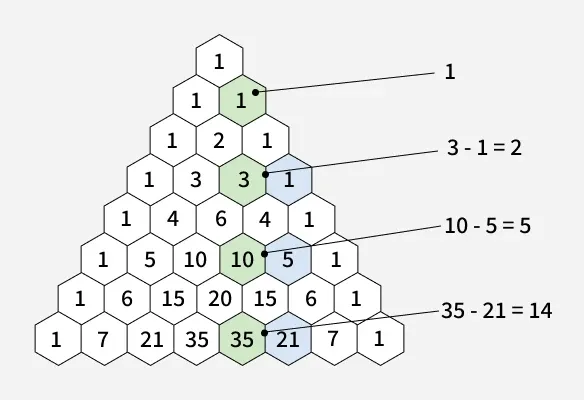
Catalan Numbers in Pascal's Triangle
The first few Catalan numbers are given here,
1, 1, 2, 5, 14, 42, 132, 429, 4862, 16796, .....,
Formula for Catalan Numbers
The n-th Catalan number **C n can be calculated using the following formula:
C_n = \frac{(2n)!}{(n+1)!n!}
Where n is a non-negative integer, and the factorial symbol "!" represents the product of all positive integers less than or equal to that number.
Alternatively, you can use the binomial coefficient:
C_n = \frac{1}{n+1} \binom{2n}{n}
Catalan Numbers Examples
Let's calculate the first few Catalan numbers:
- C_0 = \frac{(2 \times 0)!}{(0+1)!0!} = \frac{1}{1} = 1
- C_1 = \frac{(2 \times 1)!}{(1+1)!1!} = \frac{2}{2} = 1
- C_2 = \frac{(2 \times 2)!}{(2+1)!2!} = \frac{24}{6 \times 2} = 2
- C_3 = \frac{(2 \times 3)!}{(3+1)!3!} = \frac{720}{24 \times 6} = 5
So, the first few Catalan numbers are: 1, 1, 2, 5, 14, 42, ….,
**Applications of Catalan Numbers in Computer Science
Catalan numbers arise in several combinatorial problems, including:
- **Parenthesization: The number of ways to correctly parenthesize **n + 1 factors (e.g., for multiplying expressions like (a⋅b)⋅(c⋅d)).
Application: Used in compilers, syntax checking, and expression evaluation. - **Binary Trees: The number of distinct binary trees with n internal nodes.
Application: In data structures like AVL trees, Red-Black trees, and splay trees. - **Triangulations: The number of ways to triangulate a polygon with **n + 2 sides.
Application: Computer graphics, mesh generation, and computational geometry. - **Paths: The number of paths along the edges of a grid that do not pass above the main diagonal.
Application: Compiler theory, token matching, context-free grammars. - **Generating Combinations: Catalan numbers are used in combinatorial generation algorithms for generating combinations, partitions, and tree structures.
Application: Used in AI, automated testing, and combinatorial optimization problems. - **Matrix Chain Multiplication Orderings: The number of ways to fully parenthesize a product of n + 1 matrices is given by the n-th Catalan number.
Application: Optimizing matrix multiplication in dynamic programming algorithms.
**Related Articles
Solved Questions on Catalan Numbers
**Question 1. How many valid parentheses, expressions can be formed with 4 pairs of parentheses?
**Solution:
The number of valid parenthesis expressions for nnn pairs of parentheses is given by the n-th Catalan number, C_n
The formula for the n-th Catalan number is:
C_n = \frac{1}{n+1} \binom{2n}{n} = \frac{(2n)!}{(n+1)!n!}
For 4 pairs of parentheses, n = 4.
C_4 = \frac{1}{4+1} \binom{8}{4} = \frac{1}{5} \times \frac{8 \times 7 \times 6 \times 5}{4 \times 3 \times 2 \times 1} = \frac{1}{5} \times 70 = 14
So, there are 14 valid parenthesis expressions that can be formed with 4 pairs of parentheses.
**Question 2. How many distinct binary search trees can be formed with 3 nodes?
**Solution:
The number of distinct binary search trees (BSTs) that can be formed with n nodes is the n-th Catalan number.
For n = 3, we can use the Catalan number formula to find the solution.
C_3 = \frac{1}{3+1} \binom{6}{3} = \frac{1}{4} \times \frac{6 \times 5 \times 4}{3 \times 2 \times 1} = \frac{1}{4} \times 20 = 5
Thus, there are 5 distinct binary search trees that can be formed with 3 nodes.
Practice Problems Based on Catalan Numbers
**Question 1. Find the 5th Catalan number?
**Question 2. How many distinct binary search trees can be formed with 4 nodes?
**Question 3. Calculate the 3rd Catalan number?
**Question 4. How many valid parentheses expressions can be formed with 2 pairs of parentheses?
**Answer:-
**1) 42
**2) 14
**3) 5
**4) 2