Fibonacci Sequence (original) (raw)
Last Updated : 10 Dec, 2025
The Fibonacci Sequence is a series of numbers starting with 0 and 1, where each succeeding number is the sum of the two preceding numbers. The sequence goes on infinitely. So, the sequence begins as:
0, 1, 1, 2, 3, 5, 8, 13, 21, 34, 55, 89, …
Fibonacci Sequence Formula
The Fibonacci formula is used to find the nth term of the sequence when its first and second terms are given.
The nth term of the Fibonacci Sequence is represented as Fn. It is given by the following recursive formula,
**F n = F n-1 + F n-2
where,
- n > 1
- The first term is 0,... i.e., F0 = 0
- The second term is 1Sequence, i.e., F1 = 1
Using this formula, we can easily find the various terms of the Fibonacci Sequence. Suppose we have to find the 3rd term of this Sequence, then we would require the 2nd and the 1st term according to the given formula, then the 3rd term is calculated as,
- The F3 = F2 + F1 = 1 + 1 = 2
Thus, the third term in the Fibonacci Sequence is 1, and similarly, the next terms of the sequence can also be found as,
- F4 = F3 + F2 = 2 + 1 = 3
- F5 = F4 + F3 = 3 + 2 = 5
and so on.
**Below are the first 10 Fibonacci numbers in the sequence List.
| **F n | F0 | F1 | F2 | F3 | F4 | F5 | F6 | F7 | F8 | F9 |
|---|---|---|---|---|---|---|---|---|---|---|
| **n | 0 | 1 | 1 | 2 | 3 | 5 | 8 | 13 | 21 | 34 |
- Fibonacci Sequences have infinite terms.
- By closely observing the table, we can say that Fn = Fn-1 + Fn-2 for every n > 1.
**Note: The Fibonacci Sequence can start in two ways:
- **0 and 1: This is the most common convention, where the sequence begins as 0, 1, 1, 2, 3, 5, 8, 13, …
- **1 and 1: In some contexts, the sequence starts with 1, 1, 2, 3, 5, 8, 13, …
**Fibonacci Sequence in Nature
Many natural patterns follow a spiral structure that aligns with Fibonacci numbers:
- **Sunflowers: The number of spirals in the center of a sunflower often corresponds to Fibonacci numbers.
- **Pinecones: The scales of a pinecone form spiral patterns that match Fibonacci numbers.
- **Shells (Nautilus, Snails, etc.): Their growth follows a logarithmic spiral, which is closely related to the Fibonacci sequence.
- **Galaxies: Many spiral galaxies, such as the Milky Way, follow Fibonacci-like spirals.
These spirals are examples of logarithmic spirals, which maintain the same shape as they expand.
Properties of the Fibonacci Sequence
Important properties of the Fibonacci Sequence are:
- We can easily calculate the Fibonacci Numbers using theBinet Formula:
**F n = (Φ n - (1-Φ) n )/√5
**Using this formula, we can easily calculate the nth term of the Fibonacci sequence to find the fourth term of the Fibonacci sequence.
F4 = (Φ4 - (1-Φ)4)/√5 = ({1.618034}4- (1-1.618034)4)/√5 = 3
- For larger terms,the ratio of two consecutive terms of the Fibonacci Sequence converges to the Golden Ratio.
- Multiplying a term of the Fibonacci Sequence with the Golden Ratio gives the next term of the Fibonacci sequence as,
F7 in the Fibonacci Sequence is 13, then F8 is calculated as,
F(n) = F(n−1)+F(n−2)
F(8) = F(7) + F(6)
F(8) = 13 + 8 = 21
Thus, the F8 in the Fibonacci Sequence is 21.
- We can also calculate the Fibonacci Sequence for negative numbers as,
F-n = (-1)n+1Fn
For example, F-2 = (-1)2+1F2 = -1
- Fibonacci Numbers are used to define other mathematical concepts, such as Pascal's Triangle and Lucas numbers.
Golden Ratio and Fibonacci Sequence
The golden ratio (Φ) is a special mathematical constant approximately equal to 1.618. It is often represented by the Greek letter phi (Φ) and is also known as the golden number, golden proportion, or the divine proportion.
**Formula:
**Φ = F n /F n-1
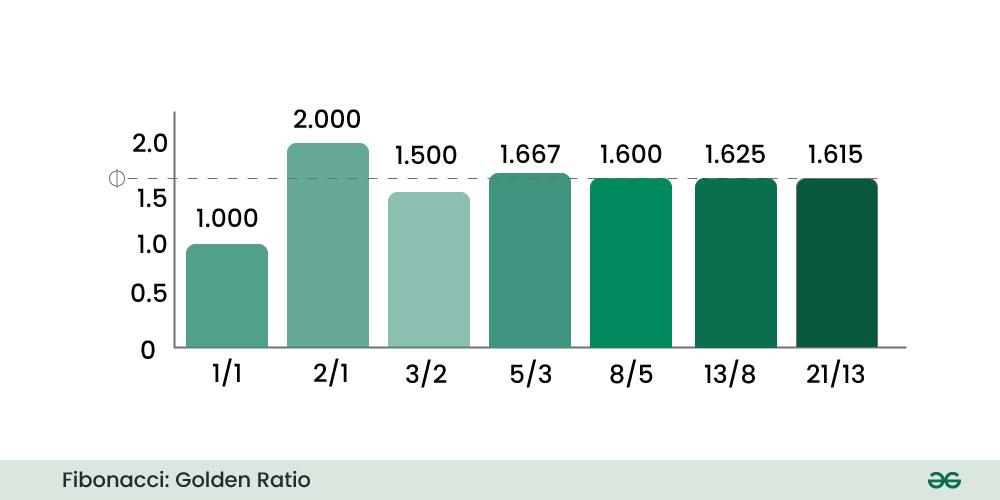
As you divide two consecutive terms in the Fibonacci sequence, the resulting ratio approaches the golden ratio. The ratio gets closer to 1.6180339887 as the Fibonacci numbers increase.
- **X-axis: The ratio F(n+1)/F(n), where F(n) denotes the Fibonacci number at position n.
- **Y-axis: The value of the ratio for each Fibonacci pair.
Fibonacci & Golden Ratio
As you move along the x-axis, the value of the ratio F(n+1)/F(n) gets closer to the golden ratio, Φ. This relationship is a visual representation of how Fibonacci numbers converge to this constant as the sequence progresses.
History of the Fibonacci Sequence
The Fibonacci sequence is named after Leonardo of Pisa, who is more commonly known as Fibonacci. He was an Italian mathematician born around 1170 and died around 1250.
Fibonacci introduced the sequence to Western mathematics in his book "Liber Abaci" (The Book of Calculation), published in 1202. In "Liber Abaci", Fibonacci posed a problem involving the growth of a population of rabbits. The problem was stated as follows:
Suppose a pair of rabbits is placed in an enclosed area. How many pairs of rabbits will be produced in one year if every month each pair produces a new pair that becomes productive from the second month on?
This problem led to the formation of the Fibonacci sequence: **0, 1, 1, 2, 3, 5, 8, 13, 21, 34,...
Also Check
Practice Problem Based on Fibonacci Sequence
**Question 1. Write the recursive formula for the Fibonacci sequence and calculate the 6th term of the sequence, starting with 0 and 1.
**Question 2. If the 7th term of the Fibonacci sequence is 13 and the 8th term is 21, calculate the ratio of the 8th term to the 7th term. How close is this ratio to the Golden Ratio (Φ ≈ 1.618)?
**Question 3. Calculate the 2nd negative Fibonacci number (F-2) and explain what the result represents.
**Answer:-
1. Fn=Fn-1+Fn-2 , 8
2. \frac{21}{13} \approx 1.615, Golden Ratio (Φ) ≈ 1.618, so the ratio is very close to the Golden Ratio.
3. F_{-2} = (-1)^{2+1} F_2 = (-1)^3 \times 1 = -1
**Interesting Problems Based on the Fibonacci
- **Climbing stairs to reach the top: There are **n stairs, and a person standing at the bottom wants to climb the stairs to reach the top. The person can climb either **1 stair or **2 stairs at a time. The task is to count the number of ways that a person can reach the top.
- **Dudeney’s Cow Problem: Cows in FooLand are interesting animals. One of their specialties is related to producing offspring. A cow in FooLand produces its first calf (female calf) at the age of two years and proceeds to produce other calves (one female calf a year).
Recommended Problems:
Implement the Fibonacci sequence in your preferred programming language.