Chords of a Circle (original) (raw)
Last Updated : 21 Apr, 2026
A circle is a perfect round shape consisting of all points in a plane that are placed at a given distance from a given point. They consist of a closed curved line around a central point. The distance to the center of a circle is called a radius.
The line segment that joins any two points on the circumference of the circle is known as the chord of a circle.
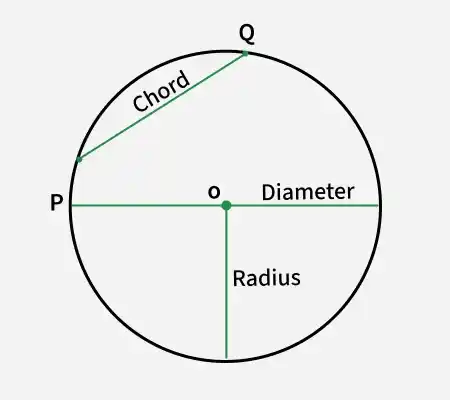
A circle can have various chords, and the largest chord of a circle is the diameter of the circle. We can easily calculate the length of the chord using the Chord Length Formula. As the diameter also joins the two points on the circumference of a circle, it is also a chord of a circle. In fact, the diameter is the longest chord of the circle.
Chord Length Formula
A chord length can be determined by using the perpendicular distance from the center of the circle as well as by the trigonometric method. Thus the length of a chord can be found
- Using the Pythagorean Theorem
- Using the Law of Cosines
Method 1: Using the Pythagorean Theorem
In the following diagram for a chord, as we know, the perpendicular drawn from the center of the circle to the chord bisects it in two halves.
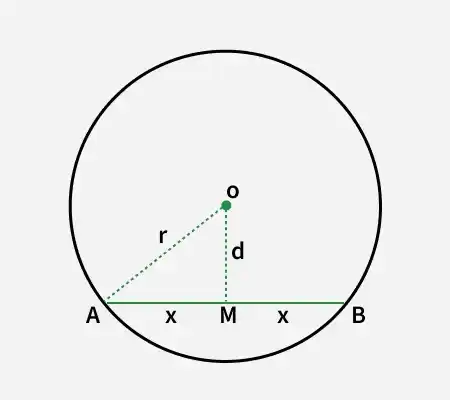
In triangles OAM, using Pythagoras Theorem,
r2 = x2 + d2
⇒ x2 = r2 - d2
⇒ x = √(r2 - d2)
As x is half the length of the chord,
Thus, the chord length for any circle with its perpendicular distance from the centre known is given as
Length of a Chord of a Circle = 2 \sqrt{(r^2 - d^2)}
Where,
- r is the radius of circle, and
- d is the perpendicular distance between center of circle and chord.
Method 2: Using the Law of Cosines
As we know for a triangle ABC, with sides a, b and c, the Law of cosine states,
c2 = a2 + b2 - 2ab cos C
Using this law in the following diagram of a chord subtending a θ angle at the center of the circle, we can find the length of the chord.
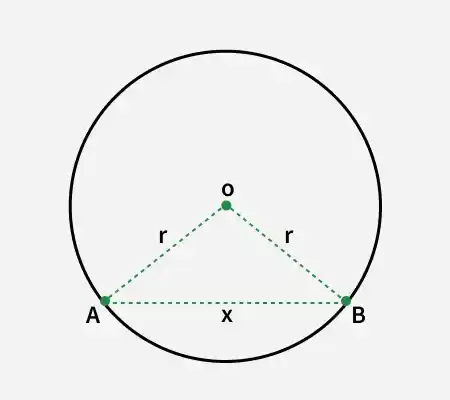
In triangle OAB, using the Law of cosine,
⇒ x2 = r2 + r2 - 2×r×r×cos θ
⇒ x2 = 2r - 2r2cos θ
⇒ x2 = 2r(1 - cos θ)
⇒ x = \sqrt{2r^2(1- \cos \theta)}
\Rightarrow x =r\sqrt{2(\sin^2 \theta/2 + \cos^2 \theta/2 - \cos^2 \theta/2 + \sin^2 \theta/2)}
\Rightarrow x =r\sqrt{4\sin^2 \theta/2 }
\Rightarrow x =2r\sin \theta/2
Thus, the Chord length is given by:
Chord Length = 2r × sin [θ/2]
Where,
- θ is the angle subtended by the chord at the center, and
- r is the radius of the circle.
Chord of a Circle Theorems
The chord of the circle subtends the angle at the center of the circle, which helps us to prove various concepts in the circle. There are various theorems based on the chord of a circle.
- **Theorem 1: Equal Chords Equal Angles Theorem
- **Theorem 2: Equal Angles Equal Chords Theorem (Converse of Theorem 1)
- **Theorem 3: Equal Chords Equidistant from Center Theorem
Theorem 1: Equal Chords Equal Angles Theorem
Equal chords subtend equal angles at the center of the circle, i.e., the angles subtended by the chords are equal if the chords are equal.
**Proof:
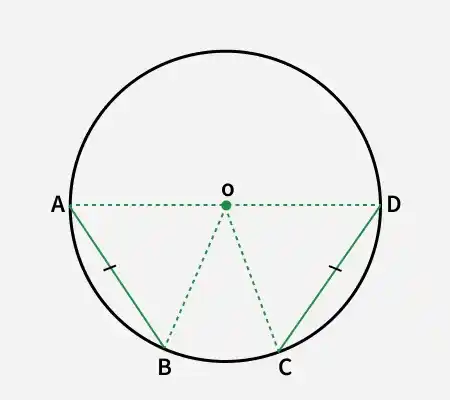
In ∆AOB and ∆DOC
- AB = CD ...eq(i) (Given)
- OA = OD ...eq(ii) (Radius of Circle)
- OB = OC ...eq(iii) (Radius of Circle)
Thus, by SSS congruency conditions, the triangles ∆AOB and ∆COD are congruent.
Thus,
∠AOB = ∠DOC (By CPCT)
Thus, the theorem is verified.
Theorem 2: Equal Angles Equal Chords Theorem (Converse of Theorem 1)
**Chords subtending equal angles at the center of a circle are equal in length. This is the converse of the first theorem.
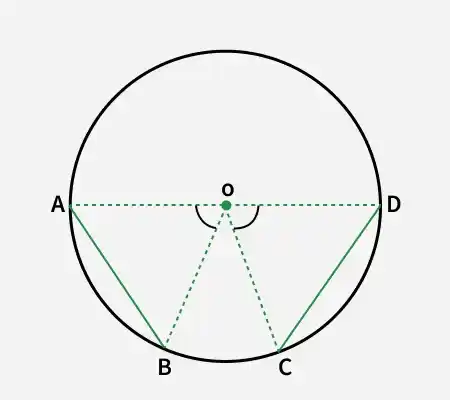
In ∆AOB and ∆DOC
- ∠AOB = ∠DOC --- eq. (i) Given)
- OA = OD --- eq. (ii) (Radius of Circle)
- OB = OC --- eq. (iii) (Radius of Circle)
Thus, by SAS congruency conditions, the triangles ∆AOB and ∆COD are congruent.
Thus,
AB = CD (By CPCT)
Thus, the theorem is verified.
Theorem 3: Equal Chords Equidistant from Center Theorem
Equal chords are equidistant from the center, i.e., the distance between the center of the circle and the equal chord is always equal.
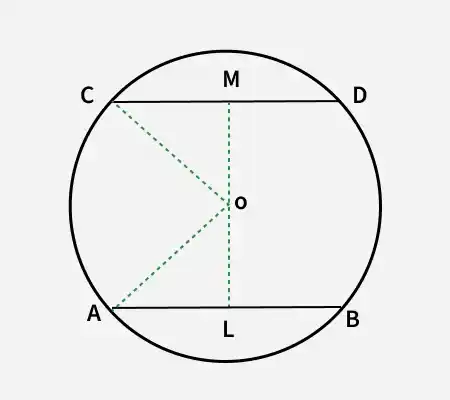
In ∆AOL and ∆COM
- ∠ALO = ∠CMO ...eq(i) (90 degrees)
- OA = OC ... eq. (ii) (Radius of Circle)
- OL = OM ...eq(iii) (Given)
Thus, by RHS congruency conditions, the triangles ∆AOB and ∆COD are congruent.
Thus,
AL = CM (By CPCT)... (iv)
Now, we know that the perpendicular drawn from the center bisects the chords.
From eq(iv)
2AL = 2CM
AB = CD
Thus, the theorem is verified.
**Properties of Chords of a Circle
- A chord passing through the center of a circle is called a diameter, and it is the longest chord.
- The perpendicular drawn from the center of a circle to a chord bisects the chord.
- Chords that are equidistant from the center of a circle are equal in length.
- Equal chords of a circle subtend equal angles at the center.
- The perpendicular bisector of a chord always passes through the center of the circle.
- If a radius is perpendicular to a chord, then it bisects both the chord and its corresponding arc.
- If two chords are equal in length, they subtend equal angles at the circumference (in the same segment).
- If two chords intersect inside a circle, then the product of the segments of one chord equals the product of the segments of the other chord.
- The angle subtended by a chord at the center is twice the angle subtended at the circumference.
**Also Check
Solved Problems
**Problem 1: In a circle of radius 5 cm, an arc subtends an angle of 70° at the center. Find the length of the corresponding chord.
Radius (R) = 5 cm
Angle (θ) = 70°Chord length = 2R × sin(θ/2)
= 2 × 5 × sin(70°/2)
= 10 × sin(35°)
≈ 10 × 0.5736
≈ 5.74 cm
**Problem 2: In a circle, the radius is 7 cm, and the perpendicular distance from the center of the circle to its chords is 6 cm. Calculate the length of the chord.
Given
- Radius = 7 cm
- Distance = 6 cm
Now, Length of the chord = 2 √r2 - d2
= 2 √72 - 62
= 2 √ 49- 36
= 2 √13cm
**Problem 3: A circle is an angle of 60 degrees whose radius is 12cm. Calculate the chord length of the circle.
Given
- Radius = 12 cm
- Angle = 60°
Now, chord length = 2R × Sin [angle/2]
⇒ 2 × 12 × sin [60/2]
⇒ 24 × sin30°
⇒ 24 × 0.5
⇒ 12cm
**Problem 4: In a circle, the radius is 16cm and the perpendicular distance from the center of the circle to its chords is 5 cm. Calculate the length of the chord.
Given
- Radius = 16 cm
- Distance = 5 cm
Now, Length of Chord = 2 √r2- d2
⇒ 2 √(16)2 - (5)2
⇒ 2 √ 256- 25
⇒ 2 √231
⇒ 2 × 15.1
⇒ 30.2cm
**Problem 6: Calculate the length of a common chord between the circles of radius 6 cm and 5 cm, respectively. And the distance between the two centers was measured to be 8 cm.
Given
Distance between the two centers = 8cm
Radius of the two circles is R1 and R2 with lengths 6cm and 5cm respectively
Now,
Length of a common chord of two circles = (2R1 × R2) / Distance between two centers of circles
⇒ 2 × 5 × 6/8
⇒ 60/8
⇒ 7.5 cm