Equation of a Circle (original) (raw)
Last Updated : 21 Apr, 2026
A circle is a geometric shape described as the set of all points in a plane that are equidistant from a fixed point called the center. The distance from the centre to any point on the circle is called the radius. Some key components of the circle are:
- Centrecentre**:** The fixed point in the middle of the circle.
- **Radius: The distance from the centre to any point on the circle.
- **Diameter: Twice the radius, the longest distance across the circle.
- **Circumference: The perimeter or boundary line of the circle.
The basic equation of a circle centred at the origin:
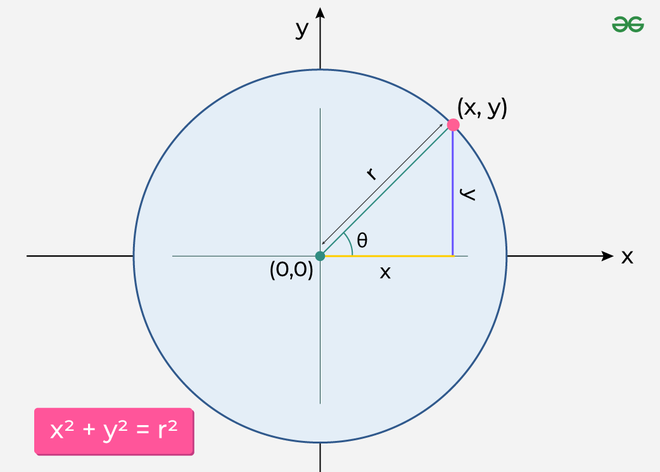
A circle at the origin typically refers to a circle whose center is at the point (0, 0) on a coordinate plane. The general equation for such a circle is:
x2 + y2 = r2
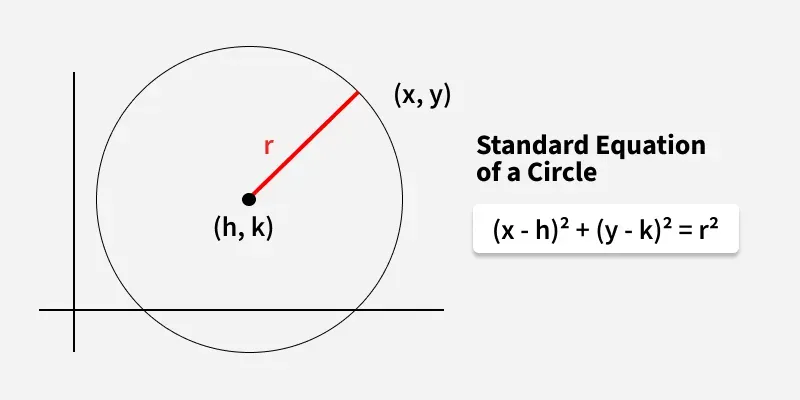
Standard Equation of a Circle
The standard equation of the circle is also the basic equation of the circle. It is the most common equation of a circle and is widely used. It gives the center and radius of the circle most easily and efficiently. The standard form of the equation of the circle is
(x-h)2 + (y-k)2 = r2
Derivation of the Equation of a Circle
To find the standard form of the circle, let us assume that the point '**A' with the coordinates (h, k) is the center of the circle, '**r' is the radius of the circle, and the point P with the coordinates (x, y) is any point on the circumference.
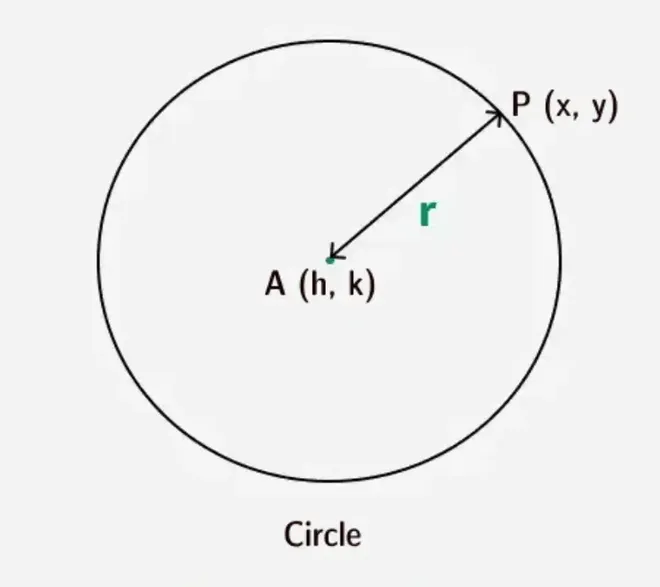
Then, AP = r ... (i)
Now using the distance formula we find the value of the AP
AP = \sqrt{(x-h)^2 + (y-k)^2}
Now put the value of AP in eq(i), and we get
\sqrt{(x-h)^2 + (y-k)^2} = r
Or squaring both sides we get
(x - h)2 + (y - k)2 = r2
This is the standard form of the equation of the circle.
**Example: If the center and the radius of the circle are (3, 5) and 7 units, respectively, then find the equation of the circle.
**Solution:
Centre of the circle is (3, 5) comparing with (h, k) we get h = 3 and k = 5
Similarly, radius of the circle is 7 = r
Equation of the circle is (x - h)2 + (y - k)2 = r2
(x - 3)2 + (y - 5)2 = 72This is the required equation of the circle.
General Equation of a Circle
The general form of the equation of a circle is represented as,
x2 + y2 + 2gx + 2fy + c = 0
Here g, f, and c are constant values.
Using this general form of the equation, we can easily find the center and radius of the circle.
Converting the general form of the equation x2 + y2 + 2gx + 2fy + c = 0, into the standard form
Adding f2, g2, and -c on both sides,
x2 + y2 + 2gx + 2fy + c + f + g2 - c = f2 + g2 - c
x2 + 2gx + g2 + y2 + 2fy + f2 = f2 + g2 - c
(x + g)2 + (y - f)2 = [√(f2 = f2 + g2 - c)]2
Comparing with (x - h)2 + (y - k)2 = r2
We get.
- centre = (h, k) = (-g, -f)
- radius = r = √(f2 = f2 + g2 -c)
**Features of General Equation of Circle
x2 + y2 + 2gx + 2fy + c = 0 represents the general equation of a circle with center (−g, −f) and radius (r): r2 = g2 + f − c.
Some of the important results which we deduce from the general equation of the circle are,
• If g2 + f2 > c, then the radius of the circle is real.
• If g2 + f2 = c, then the radius of the circle is zero which tells us that the circle is a point which coincides with the centre. Such type of circle is called a point circle.
• g2 + f2 < c, then the radius of the circle becomes imaginary. Therefore, it is a circle having a real centre and imaginary radius.
Special Forms of the Circle Equation
We can represent the equation of a circle using various forms. In each form, a different set of values is given, which is used to form the equation of the circle. All these forms can represent the same circle, but their initial parameters are different. In all these forms of equations of a circle, we can easily find the radius and center of the circle.
- Equation of a Circle with the Center as the Origin
- Parametric form
- Polar form
Equation of a Circle with the Center as the Origin
The Equation of a circle with its center at the origin (0, 0) and radius "r" is:
x2 + y2 = r2
Where r is the radius of the circle. This equation states that for any point on the circle, the sum of the squares of the coordinates x and y will equal the square of the radius, ensuring that every point is exactly r units away from the origin.
Parametric Equation of a Circle
The parametric form of the circle uses (h + r cos θ, k + r sin θ) as the general point on the circumference of the circle. The line joining the center of the circle to the general point makes an angle θ with the x-axis.
Thus, the parametric equation of a circle is
x = h + rcosθ
y = k + rsinθ
Polar Equation of a Circle
The polar form of a circle represents points using an angle θ measured from the x-axis. It is closely related to the parametric form.
For a circle with centre at the origin (0, 0) and radius _a, any point on the circle can be written as:
x = a cosθ ...(i)
y = a sinθ ...(ii)
**Conversion to standard form:
Squaring and adding equations (i) and (ii):
x² + y² = (a cosθ)² + (a sinθ)²
= a²cos²θ + a²sin²θ
= a² (cos²θ + sin²θ)
Using **Trigonometric Identity, cos2θ + sin2θ = 1,
x2 + y2 = a2
(x - 0)2 + (y - 0)2 = a2 comparing with (x - h) + (y - k)2 = r,2 we get
- **Centre = (h, k) = (0, 0)
- **Radius = r = a
**Example: Find the equation of the circle in polar if the equation of the circle in standard form is x2 + y2 = 16.
**Solution:
Equation of the circle in polar form is,
x = r cosθ
y = r sinθusing this in x2 + y2 = 16
(r cosθ)2 + (r sinθ)2 = 16
r2(cos2θ + sin2θ) = 16
r2 = 42
r = 4
Graphing Equation of Circle
As we know the standard equation of the circle is (x - h) + (y - k) 2 = r 2
Here, the center of the circle is (h, k), and the radius of the circle is r.
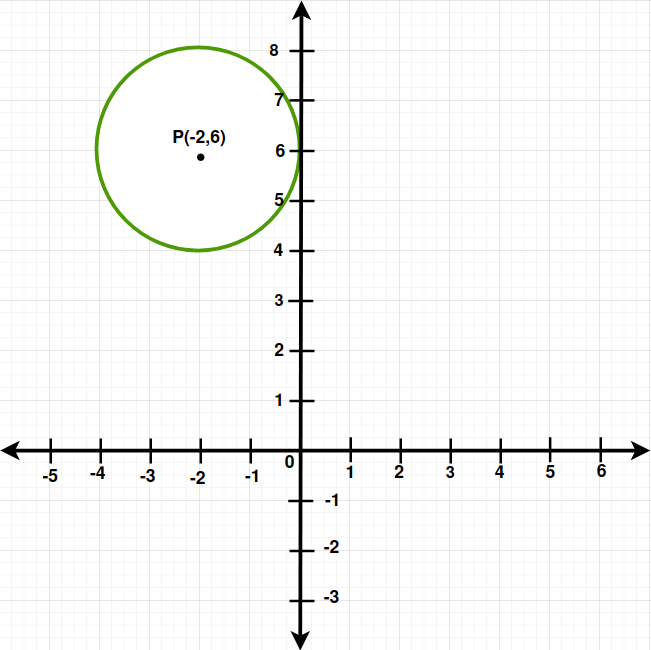
**For example, the Equation of the circle is (x + 2) + (y - 6)2 = 4
(x - (-2))2 + (y - 6)2 = 22
On comparing with the standard equation of the circle we get
Centre of the circle is (-2, 6) and the radius of the circle is 2.
Now we will draw a circle on the graph.
- **Step 1: Draw the x and y axes.
- **Step 2: Plot the center of the circle on the graph, which is (-2, 6)
- **Step 3: Take the radius of 2 units in the compass and draw the required circle.
How to Find the Equation of a Circle?
The equation of the circle can be easily found using the various parameters given in the questions. If we are given the conditions to find the center and the radius of the circle, then its cartesian equation can easily be written.
Equation of Circle when the Center is at (x1, y1)
For a circle with a center at (x1, y1) and a radius 'r,' the equation is
****(x - x** 1 ) 2 + (y - y 1 ) 2 = r 2
Equation of Circle With Center at Origin
If the centre of the circle is at its origin (0, 0) and its radius is 'r,' the equation becomes
****(x)** 2 + (y) 2 = r 2
Equation of Circle with a Center on the x-axis
For a circle with a center at (a, 0) and radius r, the equation is:
****(x - a)** 2 + y 2 = r 2
Equation of Circle with a Center on the y-axis
For a circle with a center at (0, b) and a radius r, the equation is:
**x 2 + (y - b) 2 = r 2
This is the required equation of a circle with a center on the y-axis.
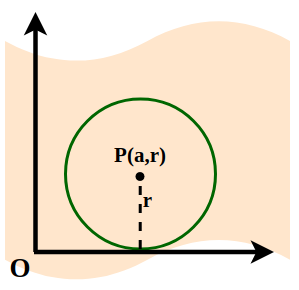
Equation of Circle Touching x-axis
If a circle touches the X-axis at point (a, 0) and its center is at (a, r), the equation is
This is the equation of the circle touching the y-axis: ****(x -a)** 2 + (y-r) 2 = r 2
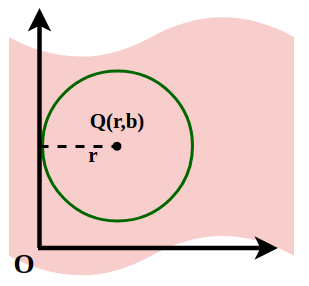
Equation of Circle Touching Y-axis
If a circle touches the Y-axis at point (0, b) and its center is at (r, b), the equation is
This is the equation of the circle touching the y-axis: ****(x - r)** 2 + (y - b) 2 = r 2
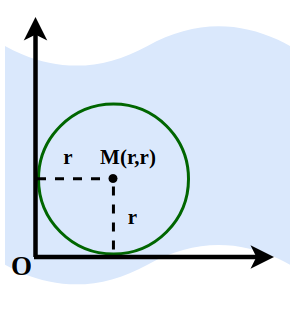
Equation of Circle Touching Both Axes
For a circle touching both axes at points (r, 0) and (0, r) with the center at (r, r), the equation is
This is the equation of the circle touching both the axes i.e. x-axis and y-axis: ****(x - r)** 2 + (y - r) 2 = r 2
Converting General Form to Standard Form
The general form of the circle, i.e., x2 + y2 + 2gx + 2fy + c = 0, can be easily converted to the standard form of the circle, i.e., (x - a)2 + (y - b)2 = r,2 using the steps discussed below.
**Step 1: Write the like terms together and take the constant on the other side of the equation, such as x2 + 2gx + y2 + 2fy = -c... (i)
**Step 2: Complete the square method by simplifying the left-hand side of the 'equal to' by adding g and f2 on both sides.
x2 + 2gx + y2 + 2fy + g2 + f2 = -c + g2 + f2
**Step 3: Simplify the above equation.
x2 + 2gx + g + y2 + 2fy + f2 = g2 + f2 - c
****(x+g)** 2 + (y-f) 2 = [√(g 2 + f 2 - c)] 2
Comparing the above equation with the standard equation of the circle, (x - a)2 + (y - b)2 = r2, we get
- **Center = (-g, -f)
- **Radius = √(g2 + f2 - c)
Thus, by using the above method, the general form of the equation is transformed into the standard form of the equation.
Converting Standard Form to General Form
The standard form of the circle, i.e., (x - a)2 + (y - b)2 = r, can be easily converted to the general form of the circle, i.e., x2 + y2 + 2gx + 2fy + c = 0, using the steps discussed below.
**Step 1: Use the algebraic identity formula, (a-b)2 = a2 + b2 - 2ab to simplify the given equation (x - a)2 + (y - b)2 = r2
x2 + a - 2ax + y2 + b2 - 2by = r2
**Step 2: Arrange the equation with variable terms together and constant together as,
x2 - 2ax + y2 - 2by + a2 + b2 - r2 = 0
Comparing with x2 + y2 + 2gx + 2fy + c = 0 we get,
g = -a, f = -b, and c = a2 + b2 - r2
This is the required form of the equation of a circle in a general form.
**Features of Equation of Circle
The general form of the equation of the circle is x²2 + y²2 + 2gx + 2fy + c = 0. Some of the features of the equation of the circle are,
- It is quadratic in both x and y.
- Coefficient of x2 = y2. (It is advisable to keep the coefficient of x and y2 unity.)
- There is no term containing xy, i.e., the coefficient of xy is zero.
- It contains three arbitrary constants, viz., g, f, and c.
Solved Examples
**Example 1: Find the centre and radius of the circle from the given equation: x2 + y2 + 6x - 4y + 4 = 0
**Solution:
We have,
(x2 + 6x) + (y2 - 4y) = - 4
To make it a perfect square identity, add and subtract 9 and 4,
(x2 + 6x + 9) + (y2 - 4y + 4) - 9 - 4 = - 4
(x + 3)2 + (y - 2)2 = - 4 + 4 + 9
(x - (-3))2 + (y - 2)2 = 9
(x - (-3))2 + (y - 2)2 = 32On comparing with the standard equation of circle, we have
h = -3, k = 2 and r = 3
So the centre of the circle is (-3, 2) and the radius of the circle = 3
**Example 2: Find the equation of a circle when the endpoints of the diameter are (3, 2) and (5, 8).
**Solution:
Given endpoints: (3, 2) and (5, 8)
Centre of the circle = midpoint of the diameter
= [(3 + 5)/2, (2 + 8)/2]
= (4, 5)Radius = distance from centre to any endpoint
= √[(4 − 3)² + (5 − 2)²]
= √(1 + 9)
= √10Equation of circle: (x − a)² + (y − b)² = r²
So, (x − 4)² + (y − 5)² = (√10)²
(x − 4)² + (y − 5)² = 10
**Example 3: Find the center and radius of the circle using the following equation: x2 + y2 - 4x + 6y = 12.
**Solution:
Given: x2 + y2 - 4x + 6y = 12
We can write as (x2 - 4x) + (y2 - 6y) = 12
By manipulating identity, we get
(x2 - 4x + 4) + (y2 - 6y + 9) - 9 - 4 = 12
(x2 - 4x + 4) + (y2 - 6y + 9) = 12 + 9 + 4
(x - 2)2 + (y - 3)2 = 25
(x - 2)2 + (y - 3)2 = 52On comparing with the standard equation of circle, we have
h = 2, k = 3 and r = 5.
**Example 4: Find the equation of a circle whose radius is 7 and whose center is at the origin.
**Solution:
Given : r = 7 and the centre = (0, 0)
Using the standard equation of circle,
(x - h)2 + (y - k)2 = r2
x2 + y2 = r2
x2 + y2 = 72Hence, the required equation is **x 2 + y 2 - 49 = 0