Class 10 NCERT Solutions Chapter 3 Pair of Linear Equations in Two Variables Exercise 3.4 (original) (raw)
Last Updated : 23 Jul, 2025
In this article, we will be going to solve the entire Miscellaneous Exercise 3.4 of Chapter 3 of the NCERT textbook. A pair of linear equations in two variables is a set of two linear equations involving the same two variables.
What is a Pair of Linear Equations in Two Variables?
**Linear Equation: An equation is called linear if the highest power of the variable(s) is one. In the context of two variables, a linear equation represents a straight line when plotted on a Cartesian plane.
**Two Variables: The equations involve two variables, typically denoted as x and y.
**System of Equations: A pair of linear equations in two variables is a system that consists of two equations that are considered simultaneously.
Question 1. Solve the following pair of linear equations by the elimination method and the substitution method:
(i) x + y = 5 and 2x – 3y = 4
**Solution:
Here, the two given eqn. are as follows:
x + y = 5 ..........(I)
2x – 3y = 4 ...........(II)
**ELIMINATION METHOD:
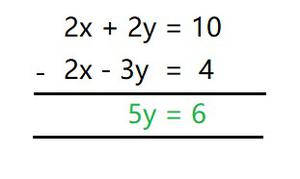
Multiply equation (I) by 2, and then subtract (II) from it, we get
5y = 6
y = 6/5
Now putting y=6/5 in eqn. (I), we get
x + 6/5 = 5
x = (5–(6/5))
x = 19/5
**SUBSTITUTION METHOD:
From (I), we get
y=5–x.......(III)
Now substituting the value of y in eqn. (II), we get
2x – 3(5–x) = 4
2x – 15+3x = 4
5x = 4+15
x = 19/5
As, putting x = 19/5, in eqn. (III), we get
y = 5 – 19/5
y = 6/5
Hence, by elimination method and substitution method we get,
**x = 19/5 and y = 6/5.
(ii) 3x + 4y = 10 and 2x – 2y = 2
**Solution:
Here, the two given eqn. are as follows:
3x + 4y = 10 ..........(I)
2x – 2y = 2 ...........(II)
**ELIMINATION METHOD:
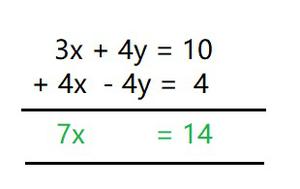
Multiply equation (II) by 2, and then add it to (I), we get
7x = 14
x = 14/7
x = 2
Now putting x = 2 in eqn. (I), we get
3(2) + 4y = 10
4y = 10 – 6
y = 4/4
y = 1
**SUBSTITUTION METHOD:
From (II), we get
x = (2+2y)/2
x = y+1 .......(III)
Now substituting the value of x in eqn. (I), we get
3(y+1) + 4y = 10
3y + 3 + 4y = 10
7y = 10 – 3
y = 7/7
y = 1
As, putting y = 1, in eqn. (III), we get
x = 1+1
x = 2
Hence, by elimination method and substitution method we get,
**x = 2 and y = 1.
(iii) 3x – 5y – 4 = 0 and 9x = 2y + 7
**Solution:
Here, the two given eqn. are as follows:
3x – 5y – 4 = 0
9x = 2y + 7
By rearranging we get,
3x – 5y = 4 ..........(I)
9x – 2y = 7 ...........(II)
**ELIMINATION METHOD:
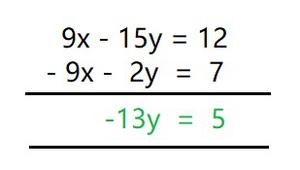
Multiply equation (I) by 3, and then subtract (II) from it, we get
–13y = 5
y = -5/13
Now putting y = – 5/13 in eqn. (I), we get
3x – 5(– 5/13) = 4
3x = 4 – (25/13)
3x = 27/13
x = 9/13
**SUBSTITUTION METHOD:
From (I), we get
3x – 5y = 4
x = (4+5y)/3 .......(III)
Now substituting the value of x in eqn. (II), we get
9((4+5y)/3) – 2y = 7
3(4+5y) – 2y = 7
12+15y – 2y = 7
13y = – 5
y = – 5/13
As, putting y = – 5/13, in eqn. (III), we get
x=(4+5(– 5/13))/3
x = 9/13
Hence, by elimination method and substitution method we get,
****x=9/13 and y=**– **5/13.
(iv) x/2 + 2y/3 = -1 and x - y/3 = 3
**Solution:
Here, the two given eqn. are as follows:
x/2 + 2y/3 = –1 ...........(A)
x – y/3 = 3 ...................(B)
by rearranging (multiply (A) by 6 and multiply (B) by 3) we get,
3x + 4y = – 6 ..........(I)
3x – y = 9 ...........(II)
**ELIMINATION METHOD:
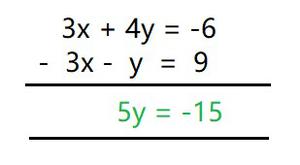
Subtract (II) from (I), we get
5y = – 15
y = – 3
Now putting y = -3 in eqn. (II), we get
3x – (– 3) = 9
3x = 9 – 3
x = 6/3
x = 2
**SUBSTITUTION METHOD:
From (II), we get
3x – y = 9
y = 3x – 9 .......(III)
Now substituting the value of y in eqn. (I), we get
3x + 4(3x – 9) = – 6
3x + 12x – 36 = – 6
15x = – 6 + 36
x = 30/15
x = 2
As, putting x = 2, in eqn. (III), we get
y = 3(2) – 9
y = – 3
Hence, by elimination method and substitution method we get,
****x=2 and y=**– **3.
Question 2. Form the pair of linear equations in the following problems, and find their solutions (if they exist) by the elimination method:
(i) If we add 1 to the numerator and subtract 1 from the denominator, a fraction reduces to 1. It becomes ½ if we only add 1 to the denominator. What is the fraction?
**Solution:
Let the fraction be p/q, where p is numerator and q is denominator.
Here, According to the given condition,
(p+1)/(q – 1) = 1 ....................(A)
and,
p/(q+1) = 1/2 .......................(B)
Solving (A), we get
(p+1) = q – 1
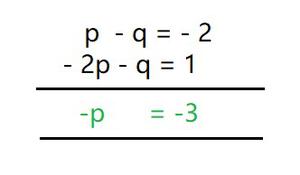
**p – q = – 2 ............................(I)
Now, solving (B), we get
2p = (q+1)
**2p – q = 1 ****............................(II)**
When equation (I) is subtracted from equation (II) we get,
p = 3
Now putting p = 3 in eqn. (I), we get
3 – q = – 2
q = 3+2
q = 5
So, p = 3 and q = 5.
**Hence, the fraction p/q is 3/5.
(ii) Five years ago, Nuri was thrice as old as Sonu. Ten years later, Nuri will be twice as old as Sonu. How old are Nuri and Sonu?
**Solution:
Let us assume, present age of Nuri is x
And present age of Sonu is y.
Here, According to the given condition, the equation formed will be as follows :
x – 5 = 3(y – 5)
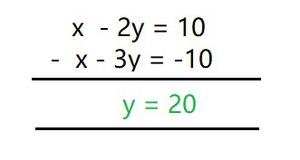
**x – 3y = – **10 …………………………………..(I)
Now,
x + 10 = 2(y +10)
**x – 2y = 10 …………………………………….(II)
Subtract eqn. (I) from (II), we get
y = 20
Now putting y = 20 in eqn. (II), we get
x – 2(20) = 10
x = 10+40
x = 50
Hence,
**Age of Nuri is 50 years
**Age of Sonu is 20 years.
(iii) The sum of the digits of a two-digit number is 9. Also, nine times this number is twice the number obtained by reversing the order of the digits. Find the number.
**Solution:
Let the unit digit and tens digit of a number be x and y respectively.
Then, Number = 10y + x
And, reverse number = 10x + y
**eg: 23
**x = 3 and y = 2
**So, 23 can be represented as = 10(2) + 3 = 23
Here, According to the given condition
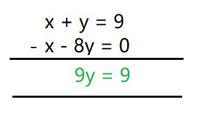
**x + y = 9 …………………….(I)
and,
9(10y + x) = 2(10x + y)
90y + 9x = 20x + 2y
88y = 11x
x = 8y
**x – 8y = 0 ………………………………………………………….. (II)
Subtract eqn. (II) from (I) we get,
9y = 9
y = 1
Now putting y = 1 in eqn. (II), we get
x - 8(1) = 0
x = 8
Hence, the number is 10y + x
=10 × 1 + 8
**Number = 18
(iv) Meena went to a bank to withdraw ₹ 2000. She asked the cashier to give her ₹ 50 and ₹ 100 notes only. Meena got 25 notes in all. Find how many notes of ₹ 50 and ₹ 100 she received.
**Solution:
Let the number of ₹ 50 notes be x and the number of ₹100 notes be y
Here, According to the given condition
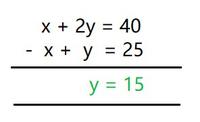
**x + y = 25 ……………………………….. (I)
**50x + 100y = 2000 ………………………………(II)
Divide (II) by 50 and then subtract (I) from it.
y = 15
Now putting y = 15 in eqn. (I), we get
x + 15 = 25
x = 10
**Hence, Manna has 10 notes of ₹ 50 and 15 notes of ₹ 100.
(v) A lending library has a fixed charge for the first three days and an additional charge for each day thereafter. Saritha paid ₹ 27 for a book kept for seven days, while Susy paid ₹ 21 for the book she kept for five days. Find the fixed charge and the charge for each extra day.
**Solution:
Let the fixed charge for the first three days be ₹ x and,
The charge for each day extra be ₹ y.
Here, According to the given condition,
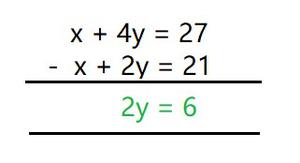
**x + 4y = 27 …….…………………………. (I)
**x + 2y = 21 ………………………………………….. (II)
Subtract (II) from (I), we get
2y = 6
y = 3
Now putting y = 3 in eqn. (II), we get
x + 4(3) = 27
x = 27 – 12
x = 15
**Hence, the fixed charge is ₹15
**And the Charge per day is ₹ 3
Summary
Exercise 3.4 focuses on solving word problems using pairs of linear equations in two variables. It covers various real-life scenarios that can be modeled using linear equations, such as age problems, number problems, and situations involving money or dimensions. Students learn to interpret word problems, formulate appropriate equations, and solve them using methods like substitution, elimination, or graphical representation.