Class 12 RD Sharma Solutions Chapter 21 Areas of Bounded Regions Exercise 21.3 (original) (raw)
Last Updated : 23 Jul, 2025
In this article, we will delve into the solutions for Exercise 21.3 from Chapter 21: Areas of Bounded Regions of the RD Sharma textbook for Class 12. This chapter is crucial for understanding how to calculate the area enclosed by the curves and lines a fundamental concept in integral calculus. The solutions provided here aim to guide students in solving the exercise problems accurately and efficiently helping them build a solid foundation in this topic.
Areas of Bounded Regions
The concept of Areas of Bounded Regions involves finding the area enclosed between the curves, lines or both using integration. This method is essential for calculating areas that are not easily measurable using basic geometric formulas. By setting up integrals based on the given curves and their intersections students can determine the area of the complex regions in a systematic manner.
**Question 1: Calculate the area of the region bounded by the parabolas y 2 **= 6x, x 2 **= 6y.
**Solution:
Given,
y2 = 6x, x2 = 6y
y2 = 6x
⇒ y = √(6x)
x2 = 6y
⇒ y = √(x2/6)
**Area of the region bounded by curve = Area under the curve y 2 =6x along x-axis - Area under the curve x 2 =6y along the x-axis
Required Area =\int_0^6(\sqrt{6x} - \frac{x^2}{6}) dx
= [\frac{\sqrt{6}x^\frac{3}{2}}{\frac{3}{2}}-\frac{x^3}{18}]^6_0
Putting the upper and lower limits we get,
Required Area = [\frac{\sqrt{6}(6^\frac{3}{2})}{\frac{3}{2}}-\frac{6^3}{18}]
=[\frac{2\times6^\frac{1}{2}(6^\frac{3}{2})}{3}-\frac{6^3}{18}] \\
=[\frac{2\times6^2}{3}-\frac{6^3}{18}]
= 24 - 12
= 12 sq. units

**Question 2. Find the area of the region common to the parabolas 4y 2 **= 9x, 3x 2 **= 16y.
**Solution:
Given,
4y2 = 9x, 3x2 = 16y
4y2 = 9x ⇒ y = √(9x/4)
3x2=16y ⇒ y = √(3x2/16)
**Area of the region bounded by curve = Area under the curve 4y 2 =9x along x-axis - Area under the curve 3x 2 =16y along x-axis
Required area = \int_0^4(\sqrt{\frac{3x}{2}} - \frac{3x^2}{16}) dx
= [x^\frac{3}{2}-\frac{x^3}{16}]^4_0
Putting the upper and lower limits we get,
Required Area = 43/2-43/16
= 8 - 64/16
= 4 sq. units

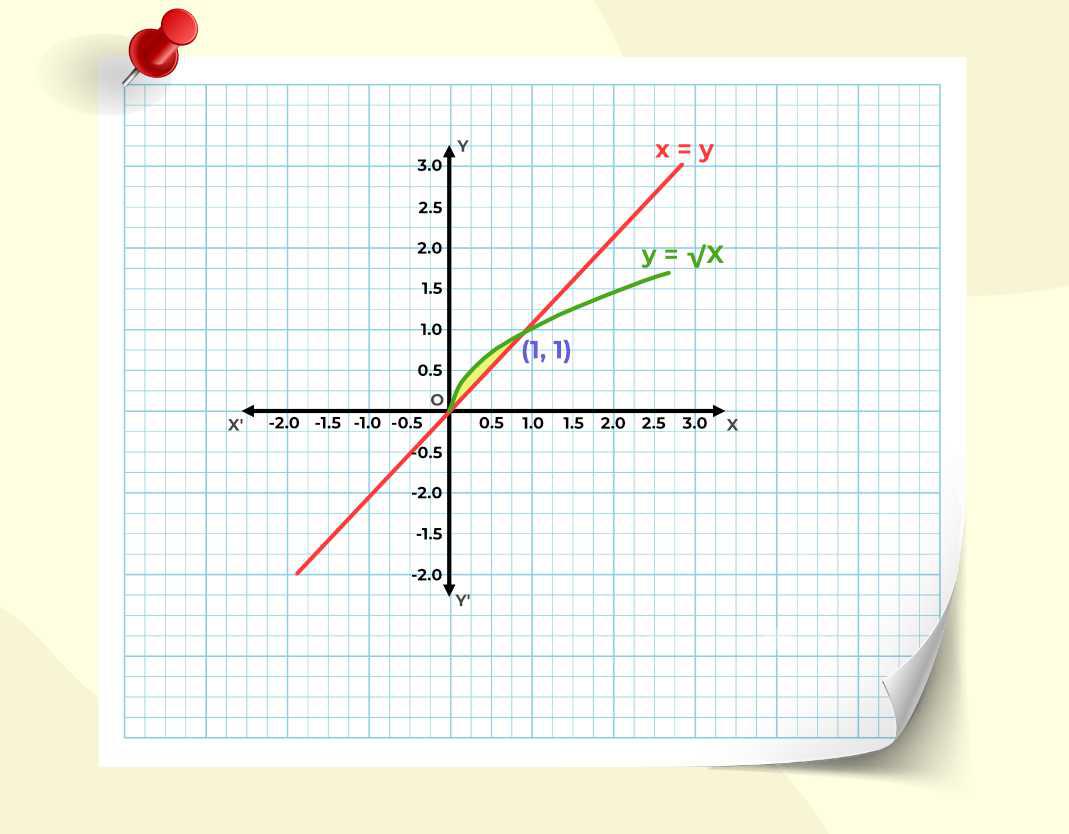
**Question 3. Find the area of the region bounded by y=√x and x=y.
**Solution:
Given,
y = √x, x = y
**Area of the shaded region = Area under the curve along the x-axis - Area under the line along the x-axis
= \int^1_0(\sqrt{x}-x)dx
= [\frac{x^{3/2}}{3/2}-\frac{x^2}{2}]_0^1
Putting the integration limits, we get:
Area of shaded region = = [\frac{1^{3/2}}{3/2}-\frac{1^2}{2} - 0]
= 2/3 -1/2
= 1/6 sq. units
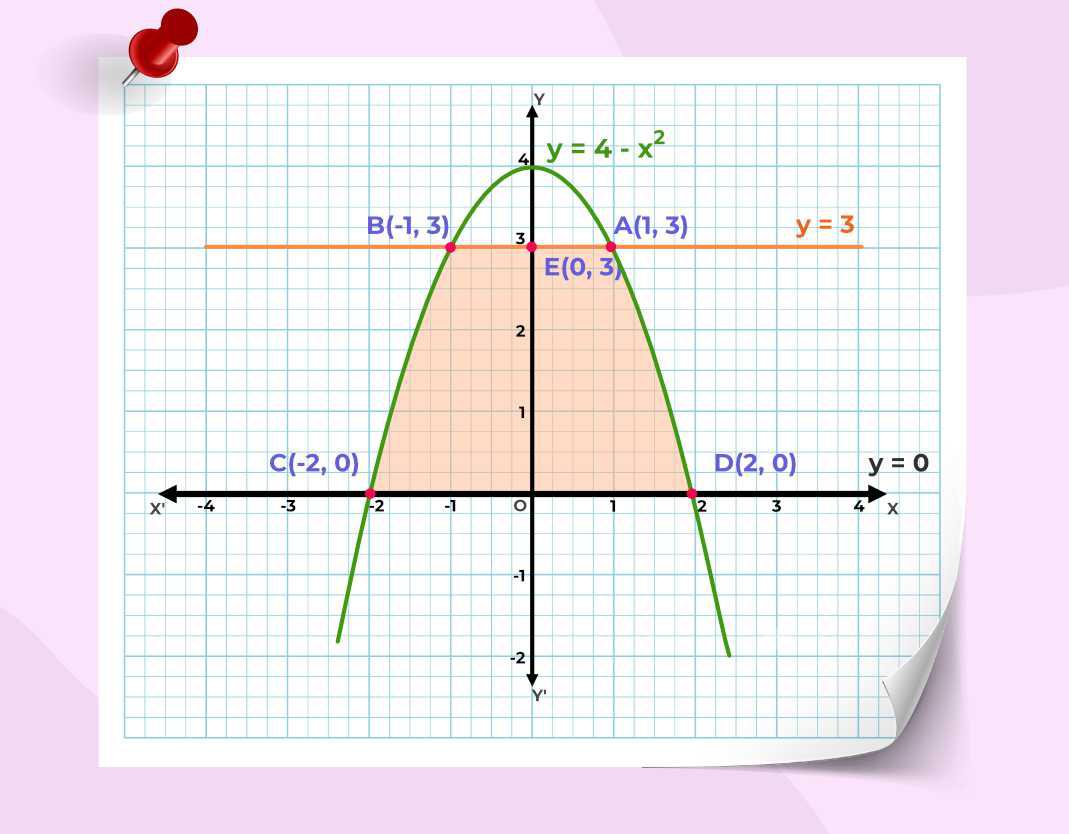
**Question 4. Find the area bounded by the curve y=4-x 2 **and the lines y=0 and y=3.
**Solution:
Given,
y = 4-x2, y = 0, y = 3
**Area of shaded region = Area of region OCBEO + Area of region ODAEO
As the Y-axis divides the parabola into two symmetrical regions, the area of OCBEO = area of ODAEO
So,
**Area of shaded region = 2 Area of ODAEO
= 2\int^2_0(4-x^2)dx
= 2[4x-x^3/3]^2_0
Putting the limits, we get
Area of shaded region = 2[4(2)-2^3/3-0]
= 2[8-8/3]
= 32/3 sq. units
**Question 5. Find the area of the region [(x,y):\frac{x^2}{a^2}+\frac{y^2}{b^2}\leq 1 \leq \frac{x}{a}+\frac{y}{b}]
**Solution:
Given
\frac{x^2}{a^2}+\frac{y^2}{b^2}=1 \implies y = \frac{b}{a}\sqrt{a^2-x^2}
\frac{x}{a}+\frac{y}{b}=1 \implies y=\frac{b}{a}(a-x)
**Area of shaded region = Area under the sector OAB - Area of triangle OAB
= \int^a_0(\frac{b}{a}\sqrt{a^2-x^2}-\frac{b}{a}(a-x))dx
= \frac{b}{a}\int^a_0(\sqrt{a^2-x^2}-(a-x))dx
\frac{b}{a}[\frac{x}{2}\sqrt{a^2-x^2}+\frac{a^2}{2}sin^{-1}(\frac{x}{a})-ax+\frac{x^2}{2}]^a_0
Putting the upper and lower limits, we get:
Area of shaded region = \frac{b}{a}[\frac{a}{2}\sqrt{a^2-a^2}+\frac{a^2}{2}sin^{-1}(\frac{a}{a})-a(a)+\frac{a^2}{2}]
=\frac{b}{a}[\frac{a}{2}*0+\frac{a^2}{2}(\frac{\pi}{2})-a^2+\frac{a^2}{2}]
=\frac{b}{a}[\frac{a^2\pi}{4}-\frac{a^2}{2}]
= \frac{b}{a}[\frac{a^2\pi}{4}-\frac{a^2}{2}]
= \frac{b}{a}*a^2[\frac{\pi}{4}-\frac{1}{2}]
=\frac{ab}{4}[\pi-2] sq. units
.png)
**Question 6. Using integration, find the area of the region bounded by the triangle whose vertices are (2,1), (3,4), and (5,2).
**Solution:
Given, A(2,1), B(3,4) and C(5,2). We need to find the area of triangle ABC. To calculate the area we need to find the equations of the lines AB, BC, and CA.
The equation of a line can be calculated as:
y-y_1=[\frac{y_2-y_1}{x_2-x_1}](x-x_1)
Equation of AB:
y-1=[\frac{4-1}{3-2}](x-2)
y-1=[\frac{3}{1}](x-2)
y-1 = 3x-6 ⇒ y=3x-5
Equation of BC:
y-4=[\frac{2-4}{5-3}](x-3)
y-4=[\frac{-2}{2}](x-3)
y-4= -x+3 ⇒ y=-x+7
Equation of CA:
y-1=[\frac{2-1}{5-2}](x-2)
y-1=[\frac{1}{3}](x-2)
y-1=\frac{x}{3}-\frac{2}{3}
y = x/3 + 1/3 ⇒ 3y = x+1
**Required Area = Area of Region I + Area of Region II..................(1)
**Area of Region I = Area under AB from x=2 to x=3 - Area under AC from x=2 to x=3
= \int^3_2(3x-5-\frac{1}{3}(x+1))dx
=\int^3_2(\frac{8x}{3}-\frac{16}{3})dx
=\int^3_2\frac{8}{3}(x-\frac{2}{3})dx
=\frac{8}{3}[\frac{x^2}{2}-2x]^3_2
=\frac{8}{3}[\frac{3^2}{2}-2*3 -\frac{2^2}{2}+2*2]
= \frac{8}{3}[\frac{9-4}{2}-2(3-2)]
= \frac{8}{3}[\frac{5}{2}-2] = \frac{4}{3}
Area of Region I = 4/3 sq. units .....................(2)
**Area of Region II = Area under BC from x=3 to x=5 - Area under AC from x=3 to x=5
= \int^5_3(-x+7-\frac{1}{3}(x+1))dx
=\int^5_3(\frac{-4x}{3}+\frac{20}{3})dx
=[\frac{-4x^2}{6}+\frac{20x}{3}]^5_3
= [\frac{-100}{6}+\frac{100}{3}-(\frac{-36}{6}+\frac{60}{3})]
= 8/3 sq. units
Area of Region II = 8/3 sq. units ............................(3)
Putting the value of (2) and (3) in (1), we get:
Required Area = Area of region I + Area of region II
= 4/3 + 8/3 = 4 sq. units

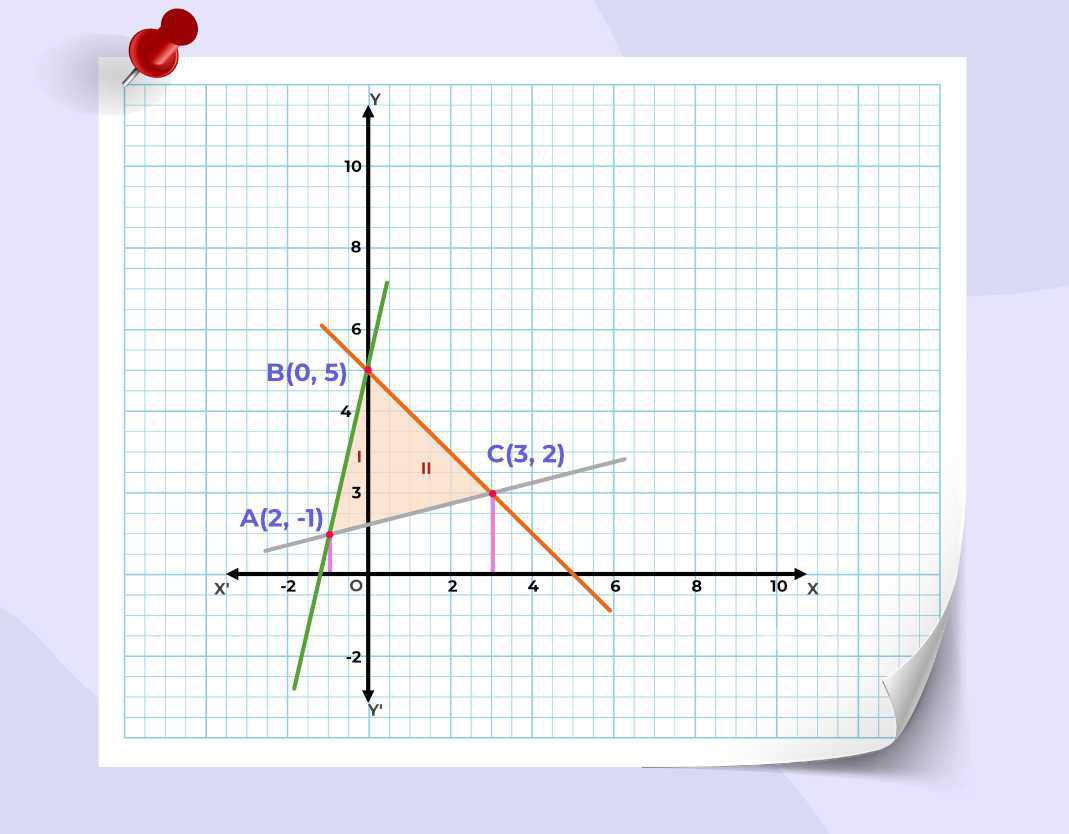
**Question 7. Using integration, find the area of the region bounded by the triangle whose vertices A, B, and C are (-1,1), (0,5), and (3,2).
**Solution:
Given, A (2,1), B (3,4) and C (5,2). We need to find the area of triangle ABC. To calculate the area we need to find the equations of the lines AB, BC, and CA.
The equation of a line can be calculated as:
y-y_1=[\frac{y_2-y_1}{x_2-x_1}](x-x_1)
Equation of AB:
y-1=[\frac{5-1}{0+1}](x+1)
y-1=[\frac{4}{1}](x+1)
y-1 = 4x+4
y = 4x+5
Equation of BC:
y-5=[\frac{2-5}{3-0}](x-0)
y-5=[\frac{-3}{3}](x-0)
y-5=-1(x-0)
y-5= -x
y = -x+5
Equation of CA
y-1=[\frac{2-1}{3+1}](x+1)
y-1=[\frac{1}{4}](x+1)
y-1=[\frac{x}{4}+\frac{1}{4}]
y = x/4 + 5/4
4y = x+5
**Required Area = Area of Region I + Area of Region II ..................(1)
**Area of Region I = Area under AB from x=-1 to x=0 - Area under AC from x=-1 to x=0
= \int^0_{-1}(4x+5-\frac{1}{4}(x+5))dx
=\int^0_{-1}(\frac{15x}{4}+\frac{15}{4})dx =\frac{15}{4}\int^0_{-1}(x+1)dx
= \frac{15}{4}[\frac{x^2}{2}+x]_{-1}^0
= \frac{15}{4}[0-(\frac{1}{2}-1)] = \frac{15}{8}
Area of Region I = 15/8 sq. units .....................(2)
**Area of Region II = Area under BC from x=0 to x=3 - Area under AC from x=0 to x=3
= \int^3_0(-x+5-\frac{1}{4}(x+5))dx
=\int^3_0(\frac{-5x}{4}+\frac{15}{4})dx
=\frac{5}{4}\int^3_0(-x+3)dx
= \frac{5}{4}[\frac{-x^2}{2}+3x]^3_0
\frac{5}{4}[\frac{-3^2}{2}+3(3)]
= \frac{5}{4}[\frac{-9}{2}+9-(0)]
= \frac{45}{8} sq.~units
Area of Region II = 45/8 sq. units ............................(3)
Putting the value of (2) and (3) in (1), we get:
Required Area = 15/8+ 45/8
= 15/2 sq. units
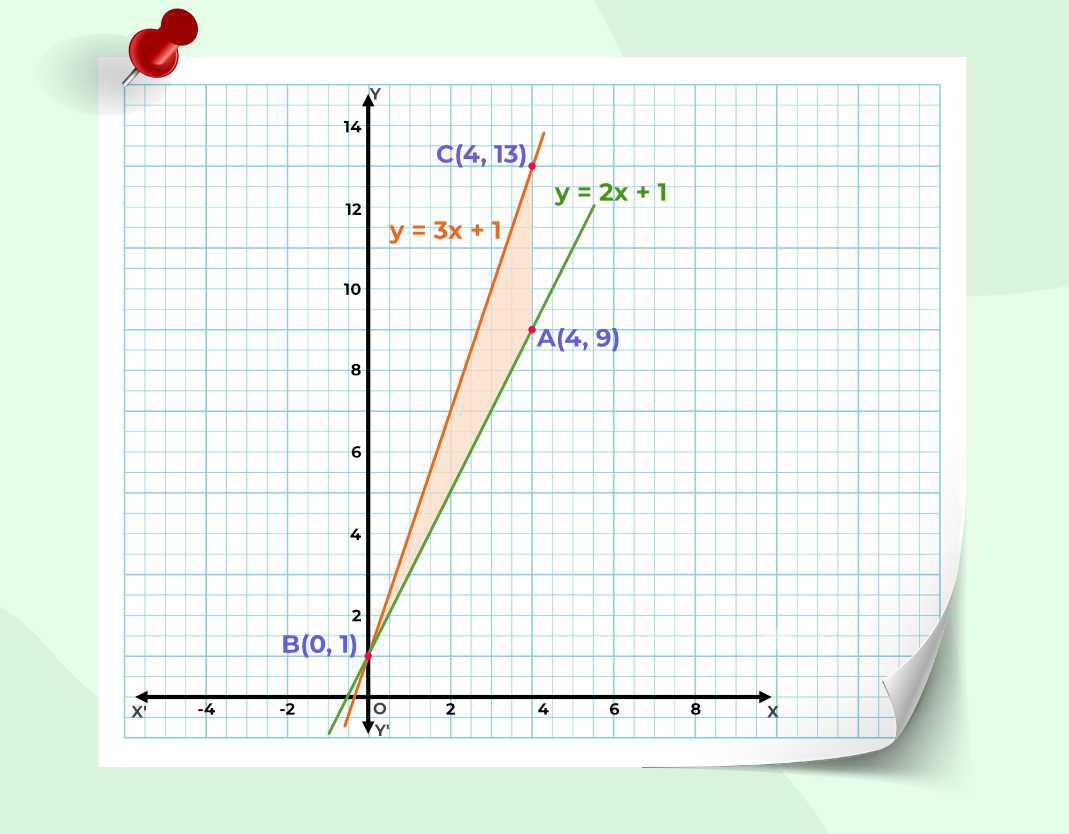
**Question 8. Using integration, find the area of triangular the region, the equations of whose sides are y = 2x+1, y = 3x+1, and x = 4.
**Solution:
Area of the shaded region in the above graph can be calculated as:
Required area = Area under line y=3x+1 from x=0 to x=4 - Area under the line y=2x+1 from x=0 to x=4
= \int_0^4(3x+1-2x-1)dx
= \int^4_0xdx
= [\frac{x^2}{2}]^4_0
= [\frac{4^2}{2}]
= 8 sq. units
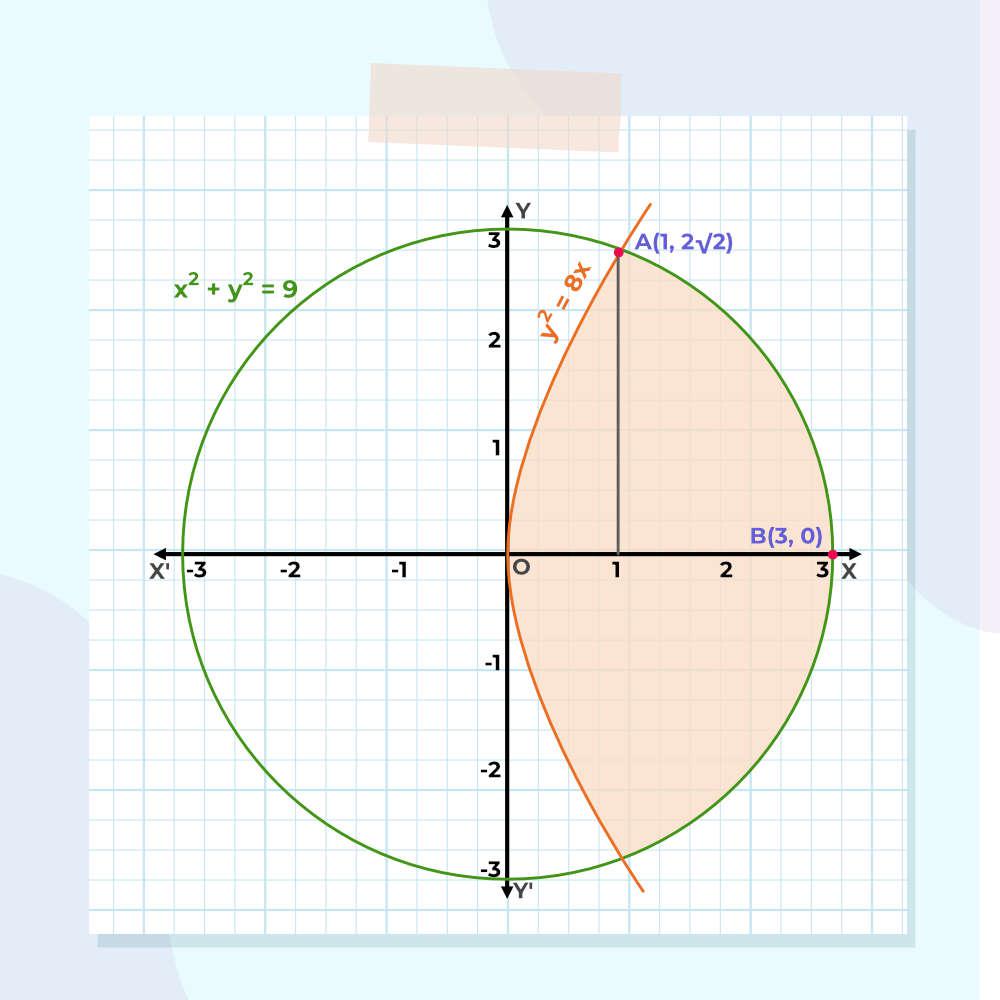
**Question 9. (x - a) 2 **+ (y - b) 2 **= r 2 . Find the area of the region {(x, y): y 2 ≤8x, x 2 +y 2 ≤9}
**Solution:
Given,
y2 = 8x ⇒ y = √8x
x2 + y2=9 ⇒ y = √(9-x2)
As the circle is divided by the parabola into two symmetrical halves,
Area of the shaded region = 2(Area under the parabola y2=8x from x=0 to x=1 + Area under the circle x2+y2=9 from x = 1 to x = 3)
= 2(\int_0^1\sqrt{8x}dx + \int^3_1\sqrt{9-x^2}dx)
= 2(\int_0^12\sqrt{2x}dx + \int^3_1\sqrt{3^2-x^2}dx)
= 2([\frac{2\sqrt{2}x^\frac{3}{2}}{3/2}]^1_0 + [\frac{x}{2}\sqrt{9-x^2}+\frac{9}{2}sin^{-1}(\frac{x}{3})]^3_1)
= 2(\frac{4\sqrt{2}}{3}+\frac{3}{2}\sqrt{9-9}+\frac{9}{2}sin^{-1}(1)-\frac{1}{2}-\sqrt{9-1}+\frac{9}{2}sin^{-1}(\frac{1}{3}))
= 2(\frac{4\sqrt{2}}{3}+\frac{3}{2}(0)+\frac{9}{2}(\frac{\pi}{2})-\frac{1}{2}\sqrt{9-1}+\frac{9}{2}sin^{-1}(\frac{1}{3}))
= 2[\frac{4\sqrt{2}}{3}+\frac{9\pi}{4}-\sqrt{2}-\frac{9}{2}sin^{-1}(\frac{1}{3})]
Required Area = 2[\frac{\sqrt{2}}{3}+\frac{9\pi}{4}-\frac{9}{2}sin^{-1}(\frac{1}{3})]~sq.~units
**Question 10. Find the area of the region bounded by the circle x 2 +y 2 =16 and the parabola y 2 =6x.
**Solution:
Given
y2 = 6x ⇒ y = √6x
x2 + y2=16 ⇒ y = √(16-x2)
As the circle is divided by the parabola into two symmetrical halves,
Area of the shaded region = 2(Area under the parabola y2=6x from x=0 to x=2 + Area under the circle x2+y2=16 from x = 2 to x = 4)
= 2(\int_0^2\sqrt{6x}dx + \int^4_2\sqrt{16-x^2}dx)
= 2([\frac{\sqrt{6}x^\frac{3}{2}}{3/2}]^2_0 + [\frac{x}{2}\sqrt{16-x^2}+\frac{16}{2}sin^{-1}(\frac{x}{4})]^2_4)
= 2([\frac{\sqrt{6}x^\frac{3}{2}}{3/2}]^2_0 + [\frac{x}{2}\sqrt{16-x^2}+8sin^{-1}(\frac{x}{4})]^2_4)
= 2(\frac{4\sqrt{12}}{3}+\frac{16}{2}\sqrt{16-16}+8\sin^{-1}(1)-\frac{1}{2}-\sqrt{12}-8\sin^{-1}(\frac{1}{2}))
= 2(\frac{4\sqrt{12}}{3}+\frac{16}{2}(0)+8(\frac{\pi}{2})-\frac{1}{2}-\sqrt{12}-8(\frac{\pi}{6}))
= 2[\frac{8\sqrt{3}}{3}+4\pi-2\sqrt{3}-\frac{4\pi}{3}]
= 2[\frac{2\sqrt{3}}{3}+\frac{8\pi}{3}]
= \frac{4}{3}(4\pi+\sqrt{3})
Required Area = \frac{4}{3}(4\pi+\sqrt{3}) sq.units
