Class 8 NCERT Solutions Chapter 4 Practical Geometry Exercise 4.3 (original) (raw)
Last Updated : 23 Jul, 2025
In this exercise, we will learn how to construct various quadrilaterals using specific measurements and angles. This process involves drawing and measuring with precision, which is a fundamental skill in geometry. These constructions are crucial for understanding the properties and relationships of quadrilaterals, which is an important topic in mathematics.
This chapter focuses on the properties and construction of different types of quadrilaterals. The ability to construct quadrilaterals accurately is essential, not only for solving geometric problems but also for understanding concepts that will be built upon in higher classes. This exercise is particularly important for exams, as it tests your understanding of angles, lengths, and the methods to construct various quadrilateral shapes.
**Construct the following quadrilaterals:
- **Quadrilateral MORE
MO = 6 cm, ∠R = 105°, OR = 4.5 cm, ∠M = 60°, ∠O = 105° - **Quadrilateral PLAN
PL = 4 cm, LA = 6.5 cm, ∠P = 90°, ∠A = 110°, ∠N = 85° - **Parallelogram HEAR
HE = 5 cm, EA = 6 cm, ∠R = 85° - **Rectangle OKAY
OK = 7 cm, KA = 5 cm
**Solutions:
**1. Quadrilateral MORE
**Given
MO = 6 cm, ∠R = 105°, OR = 4.5 cm, ∠M = 60°, ∠O = 105°
**Steps for Construction
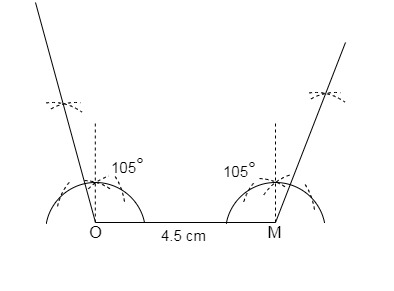
**Step 1: Draw a line 'OR' measuring = 4.5 cm.
**Step 2: Draw angles of 105° from both the points 'O' and 'R', as shown below
**Step 3: Open an arc of 6 cm then cut 'OM' of 6 cm, as shown in the figure below
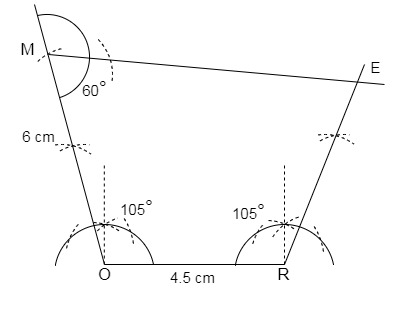
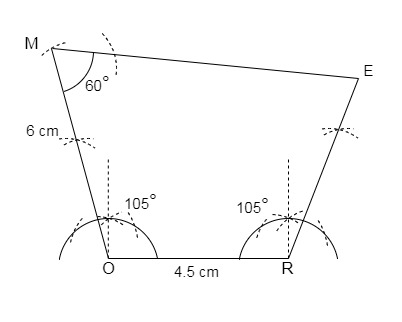
**Step 4: Now make an angle of 60° from point 'M' which will further join point 'E'.
**Step 5: We have the quadrilateral 'MORE'
**2. Quadrilateral PLAN
**Given
PL = 4 cm, LA = 6.5 cm, ∠P = 90°, ∠A = 110°, ∠N = 85°
First we will find angle L,
Sum of angles of a quadrilateral = 360°
∠P + ∠A + ∠N + ∠L = 360°
90° + 110° + 85° + ∠L = 360°
∠L = 360° - 285°
∠L = 75°
**Steps for Construction
**Step 1: Draw a line segment LA = 6.5 cm.
**Step 2: Draw an angle of 75° from point L.
**Step 3: Draw another angle of 110° from point A
**Step 4: From point L cut PL=4 cm.
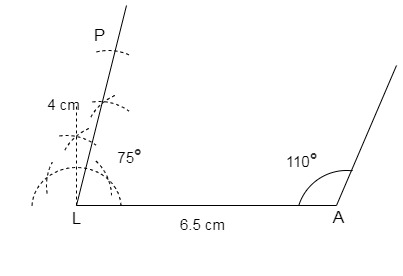
**Step 5: From point P draw an angle of 90° which intersect the angle line extended through A at N.
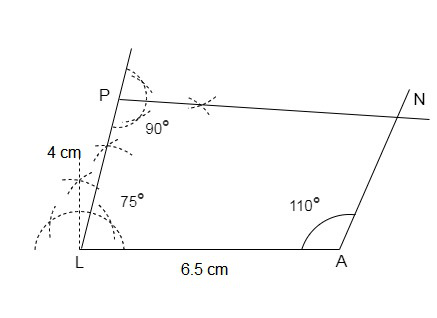
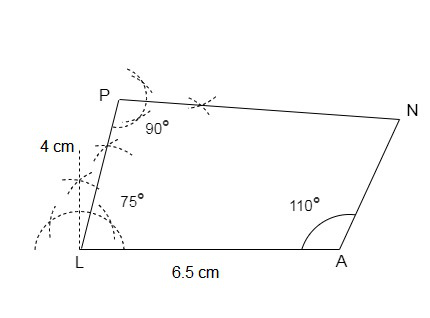
Hence, we have our required quadrilateral PLAN.
**3. Parallelogram HEAR
**Given
HE = 5 cm, EA = 6 cm, ∠R = 85°
**Steps for Construction
**Step 1: Draw a line segment HE = 5 cm
**Step 2: From point E draw an angle of 85°.
**Step 3: From point E cut EA = 6 cm
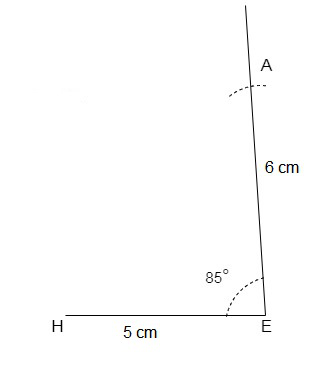
**Step 4: Draw an arc from center A of 5 cm, draw another arc of 6 cm with centre E, and further mark point R at the intersection of both the arcs. as shown below:
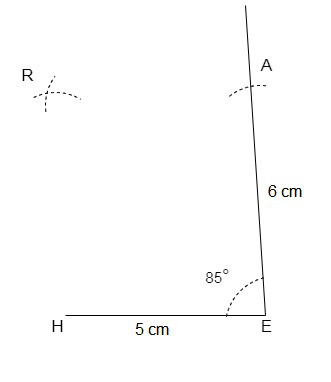
**Step 5: Join HR and AR respectively.
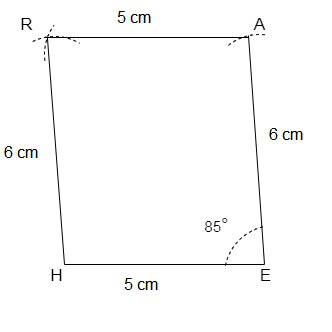
Thus, we have the required quadrilateral HEAR.
**4. Rectangle OKAY
**Given
OK = 7 cm, KA = 5 cm
All the angles of a rectangle are 90° and the opposite sides are equal.
**Steps for Construction
**Step 1: Draw a line segment OK = 7 cm.
**Step 2: Draw an 90° angle from point O.
**Step 3: Taking point O as radius draw an arc of 5 cm as shown, and mark the point Y.
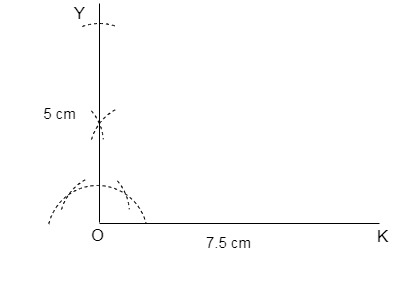
**Step 4: Taking Points K and Y as centre draw arcs of 5 cm and 7 cm respectively, intersect both the arcs at point A.
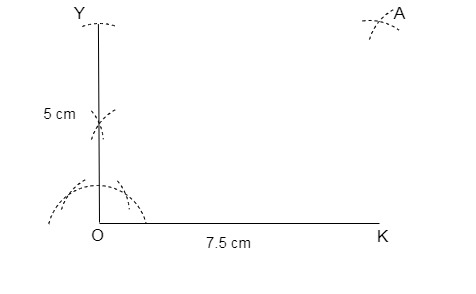
**Step 5: Join KA and AY.
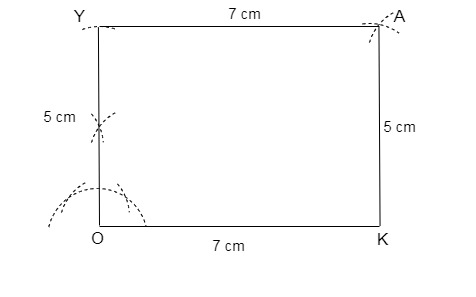
Thus, we have the required rectangle OKAY.