Class 9 NCERT Solutions Chapter 1 Number System Exercise 1.1 (original) (raw)
Last Updated : 23 Jul, 2025
Chapter 1 of the Class 9 NCERT Mathematics textbook, "Number System," introduces students to the different types of numbers and their properties. Exercise 1.1 focuses on identifying and classifying numbers as rational or irrational, understanding the decimal expansions of rational numbers, and working with these concepts through various problems.
NCERT Solutions for Class 9 - Mathematics - Chapter 1 Number System - Exercise 1.1
This section provides detailed solutions for Exercise 1.1 from Chapter 1 of the Class 9 NCERT Mathematics textbook. The exercise involves questions that help students explore the properties of rational and irrational numbers, with a focus on their decimal expansions and representation on the number line.
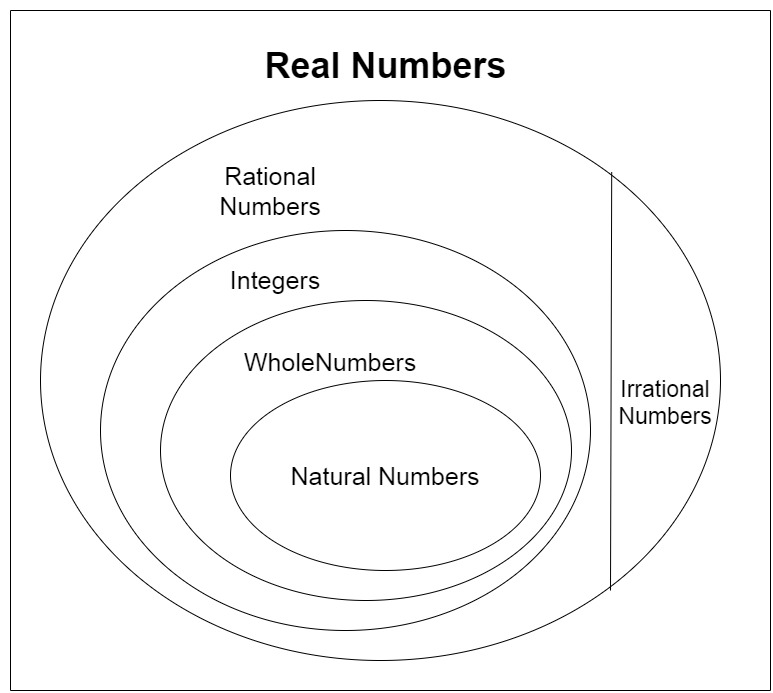
The number System chapter explains the different kinds of numbers present. The number system has been classified into different types of numbers like **natural numbers, whole numbers, integers, rational numbers, irrational numbers, etc. This will cover all the basics of the number system which is the foundation of mathematics.
What is a Number System?
Number system is a writing system for expressing numbers; it is a mathematical notation for representing numbers of a given set, consistently using digits or symbols. The number system serves as a foundation for arithmetic and mathematics. There are several types of number systems, each with its properties and uses.
Chapter 1: Number System - Exercise 1.1
**Question 1: Is zero a rational number? Can you write it in the form p/q, where p and q are integers and q ≠ 0?
**Solution:
A number is a rational number if it can be written in the form of p/q, where p and q are integers and q ≠ 0
- Therefore, we can write 0 in the form of 0/1, 0/2, 0/3, 0/4.
- As well as, q can be a negative integer also, 0/-1, 0/-2, 0/-3, 0/-4.
So we can see 0 can be written in p/q, form hence 0 is a rational number.
**Question 2: Find six rational numbers between 3 and 4.
**Solution:
We can find infinite rational numbers between 3 and 4.
Now we have to find 6 rational numbers between 3 and 4 we will multiply and divide both the numbers 3 and 4 by (6 + 1) 7.
- 3 = 3 × 7/7 = 21/7
- 4 = 4 × 7/7 = 28/7
Hence the 6 rational numbers are 23/7, 24/7, 25/7, 26/7, 27/7, and 28/7.
**Question 3: Find five rational numbers between 3/5 and 4/5.
**Solution:
We need to find 5 rational numbers between 3/5 and 4/5.
Multiply both numerator and denominator by (5 + 1) 6.
- 3/5 = 3/5 × 6/6 = 18/30
- 4/5 = 4/5 × 6/6 = 24/30
Hence, the 5 rational number between 3/5 and 4/5 are 19/30, 20/30, 21/30, 22/30 and 23/30.
**Question 4: State whether the following statements are true or false. Give reasons for your answers.
****(i) Every natural number is a whole number.**
****(ii) Every integer is a whole number.**
****(iii) Every rational number is a whole number.**
**Solution:
****(i) Every natural number is a whole number.**
True
**Explanation: The natural numbers starts from 1, 2, 3, 4 .....
The whole number starts from 0, 1, 2, 3 , 4 .....
Here it is clearly seen that whole number contains all the natural numbers and 0 also
Therefore, every natural number is a whole number but not every whole number is not a natural number as 0 is a whole number but not a natural number.****(ii) Every integer is a whole number.**
False
**Explanation: Integers are the numbers that have both positive and negative numbers including 0,
Example: .....-4, -3, -2, -1, 0, 1, 2, 3, 4 ......
Whereas whole numbers begin from 0 to infinite
Example: 0, 1, 2, 3, 4.....
Here we can see every whole number is an integer but not all the integers are the whole number.****(iii) Every rational number is a whole number.**
False
**Explanation: Rational numbers are the numbers that can be written in the form of p/q where q ≠ 0.
Example: 0, 2/5, 4/17, 7/15 .....
Whole numbers are that starts from 0 to infinity
As we know whole numbers can be written in the form of 0/1, 1/1, 2/1, ...Thus, every whole number is a rational number but every rational number is not a whole number.
Summary
Chapter 1 of Class 9 NCERT Mathematics, "Number System," covers the classification and properties of various types of numbers, including rational and irrational numbers. Exercise 1.1 focuses on identifying these numbers, understanding their decimal expansions, and representing them on the number line. Key concepts include the definition of rational and irrational numbers, their decimal forms, and methods for locating them on the number line.
**Related Articles:
- NCERT Solutions Class 9 Math
- RD Sharma Class 9 Solutions
- NCERT Chapter 1 - Number System Ex 1.2 Solutions
- NCERT Chapter 1 - Number System Ex 1.3 Solutions
- NCERT Chapter 1 - Number System Ex 1.4 Solutions
- NCERT Chapter 1 - Number System Ex 1.5 Solutions
- RD Sharma Chapter 1 - Number System Ex 1.2 Solutions
- RD Sharma Chapter 1 - Number System Ex 1.3 Solutions
- RD Sharma Chapter 1 - Number System Ex 1.4 Solutions