Coefficient (original) (raw)
Last Updated : 26 Mar, 2026
A coefficient is a number or symbol written before a variable in a mathematical expression that indicates how many times the variable is multiplied.
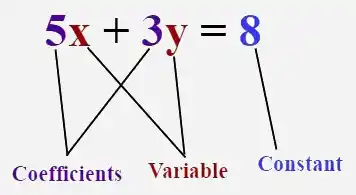
Coefficients can be positive, negative, or zero.
It is a scalar value that indicates the variable's impact on an expression. When a variable in an expression has no written coefficient, it is assumed to be one, because multiplying by 1 does not change its value.
**For example, in the given expression 10x + x2 + 7, it has two coefficients:
- **10, which is the coefficient of x.
- **1, which is the coefficient of x2, as it doesn't have a number with it, we automatically assume it to be one.
- 7 is the constant.
Types of Coefficients
Coefficients are grouped into different types based on their usage in expressions.
1. Numerical Coefficient
A numerical coefficient is the number part of a term that multiplies the variable.
- In 4x, the numerical coefficient is 4
- In −7ab, the numerical coefficient is -7
2. Leading Coefficient
The leading coefficient is the coefficient of the term with the highest degree in a polynomial.
- In 3x3 − 5x2 + 2x + 1, the leading coefficient is 3
Properties of Coefficients
- **Linearity: Coefficients exhibit linearity, meaning they distribute over addition and subtraction. For example, in (ax + by), the coefficient (a) multiplies (x), and (b) multiplies (y).
- **Commutativity: The order of coefficients and variables does not affect the result when multiplying. For example, 2 × y and y × 2 both represent the product of 2 and y.
- **Associativity****:** Coefficients are associative with multiplication. For instance, in (2 × 3x), the result is the same as (3 × 2x), yielding (6x) in both cases.
- **Identity Property: Coefficient (1) serves as the identity element in multiplication. Multiplying any variable by (1) leaves the variable unchanged.
- **Additive Identity****:** Adding (0) as a coefficient does not alter the value of the expression. For example, (3x + 0 = 3x).
- **Scalar Multiplication: Coefficients can be multiplied by scalars. For example, 2(3x) = 6x.
- **Zero Coefficient: A coefficient of (0) nullifies the variable's contribution to the expression. For instance, (0x = 0)
Related Articles:
Solved Examples
**Example 1: In the expression 5x-2y+3z, what are the coefficients of x, y, and z?
**Solution:
In the expression 5x - 2y + 3z, the coefficients are as follows:
- **Coefficient of x: Coefficient of x is the number directly multiplied by x, which is 5.
- **Coefficient of y: Coefficient of y is the number directly multiplied by y, which is -2. (Note: Coefficients can be negative.)
- **Coefficient of z: Coefficient of z is the number directly multiplied by z, which is 3.
So, coefficients of x, y, and z are 5, -2, and 3 respectively.
**Example 2: A company produces two types of products, A and B. The profit from selling each unit of product A is 3,andtheprofitfromsellingeachunitofproductBis3, and the profit from selling each unit of product B is 3,andtheprofitfromsellingeachunitofproductBis5. If the company sells x units of product A and y units of product B, write an expression to represent the total profit.
**Solution:
To represent the total profit, we need to multiply the number of units sold for each product by their respective profits and then sum the results.
Here's the expression:
Total profit = (3x + 5y)Expression represents the profit from selling (x) units of product A, each yielding 3profit,and(y)unitsofproductB,eachyielding3 profit, and (y) units of product B, each yielding 3profit,and(y)unitsofproductB,eachyielding5 profit.
Suppose the company sells 10 units of product A (x = 10) and 15 units of product B (y = 15).
Putting these values into the expression:
Total profit = (3 × 10 + 5 × 15)
= (30 + 75)
= 105So, if the company sells 10 units of product A and 15 units of product B, the total profit would be $105.
**Example 3: Solve the equation 2x + 4 = 10 to find the value of x.
**Solution:
To solve the equation 2x + 4 = 10 for x, follow these steps:
**Isolate the variable term: Subtract 4 from both sides of the equation to isolate the term containing x:
2x + 4 − 4 = 10−4
2x = 6**Solve for x: Divide both sides by 2 to solve for x:
2x/3 = 6/2
x = 3So, the value of x that satisfies the equation 2x + 4 = 10 is x = 3.
Practice Questions
**Question 1: The perimeter of a rectangle is 10x + 6, where x represents the length of one side of the rectangle. If the width of the rectangle is 2x, find the expression for the length.
**Question 2: Factor the expression 4x2 + 12x completely.
**Question 3: Temperature T in degrees Celsius is given by the formula T = 5x + 32, where x is the temperature in degrees Fahrenheit. If the temperature outside is 20°F, what is the corresponding temperature in degrees Celsius?
**Question 4: Evaluate the expression 2x3 - 3x2 + x - 4 for x = 2.
**Question 5: A charity organization collects donations from two sources: individuals and corporations. For every dollar donated by an individual, the charity receives 0.75,andforeverydollardonatedbyacorporation,thecharityreceives0.75, and for every dollar donated by a corporation, the charity receives 0.75,andforeverydollardonatedbyacorporation,thecharityreceives0.90. If x represents the amount donated by individuals and y represents the amount donated by corporations, write an expression to represent the total amount received by the charity.