Comparing Numbers (original) (raw)
Last Updated : 16 Feb, 2026
Comparing numbers means looking at two or more numbers to see which is bigger, smaller, or if they are equal.
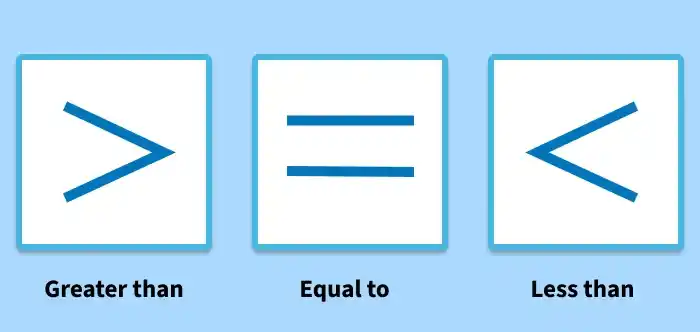
We use special symbols to compare numbers:
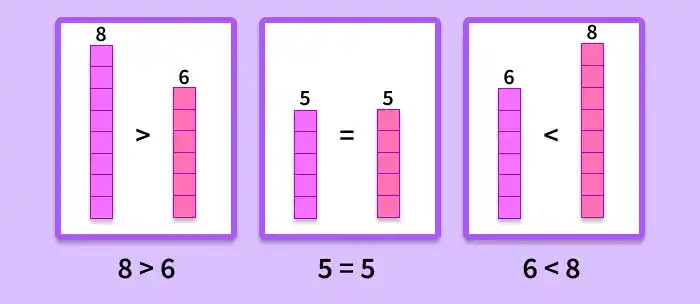
**Example:
- In the first part, 8 is greater than 6 because there are more blocks.
- In the second part, 5 is equal to 5 because both sides have the same number of blocks.
- In the third part, 6 is less than 8 because there are fewer blocks.
Comparing Numbers Exercise
You can check your understanding of the concept in the following quiz:
Rules for Comparing Numbers
To compare number we can use the following 2 rules to compare numbers:
Rule 1: Number of Digits
When you're comparing two numbers, first count the digits in each number. A number with more digits is always greater because each additional digit increases its place value.
**Examples:
345 > 89 (345 has 3 digits and 89 has 2 digits)
1000 > 999 (1000 has 4 digits and 999 has 3 digits)
Rule 2: Leftmost Digit
If two numbers have the same number of digits, compare their leftmost digits. The number with the greater leftmost digit is the greater number.
**Example: 323 > 232 (Both have 3 digits, but 3 > 2)
**Note: If the leftmost digits are the same, we move to the next digit to the right. This keeps going until we find digits that are different.
**Example: 5678 > 5612 (Both have 4 digits. Leftmost digits 5 = 5, next digits 6 = 6, compare next: 7 > 1)
Comparing Numbers on a Number Line
Steps to compare numbers on a number line are:
**Step 1: Draw a number line with positive and negative numbers, as well as zero.
**Step 2: Locate the numbers you want to compare.
**Step 3: Look at the positions of the numbers relative to each other on the line.
- The number to the right is greater.
- The number to the left is smaller.
- If both numbers are at the same position, they are equal.
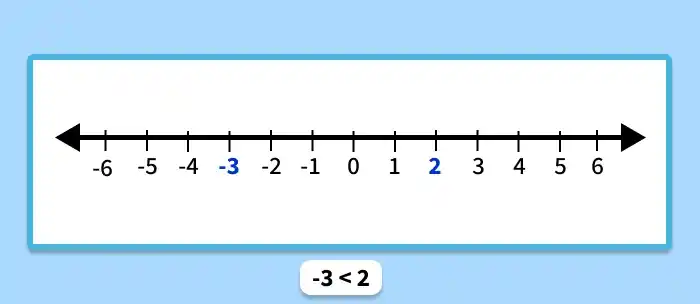
**Example: Compare the numbers -3 and 2 on a number line.
**Solution:
Since -3 is to the left of 2 on the number line, we can say that -3 is less than 2.
Comparing Integers
Integers are a set of numbers that include all whole numbers and their negatives. The set of integers is denoted by Z and includes ..., -3, -2, -1, 0, 1, 2, 3, ...
**Example: Compare -57 and -173.
57 has 2 digits.
173 has 3 digits.
The number with more digits is greater.
173 > 57
When we multiply -1 both sides, comparison sign reverse.
Therefore, -173 < -57.
Comparing Rational Numbers
A rational number is a number that can be expressed in the form p/q, where p and q are integers and q ≠ 0. Rational numbers include all integers, fractions, and terminating or repeating decimals.
**Example: Compare 3/5 and 4/7
L.C.M of 5 and 7 are 35.
3/5 = 21/35
4/7 = 20/35Since, denominator of rational numbers are same, We can compare numerators.
= 21 > 20 (Comparing Numerators)
= 21/35 > 20/35Therefore, 3/5 > 4/7
Comparing Decimals
Decimals are numbers that have a whole number part and a fractional part separated by a decimal point. For example, in the number 12.345, 12 is the whole number part, and 345 is the fractional part.
**Example: Compare 0.256 and 0.259.
Compare digit by digit from left to right:
First digits: 0 = 0
Second digits: 2 = 2
Third digits: 5 = 5
Fourth digits: 6 < 9
So, 0.256 < 0.259.