Decimals in Maths (original) (raw)
Last Updated : 26 Jan, 2026
Decimals are a way of representing numbers that are not whole numbers. They help us express values that lie between two integers and make calculations involving parts of a whole easier and more accurate.
- **3.25: The whole part is 3, and the fractional part is 0.25 (25 hundredths).
- **5.7: The whole part is 5, and the fractional part is 0.7 (7 tenths).
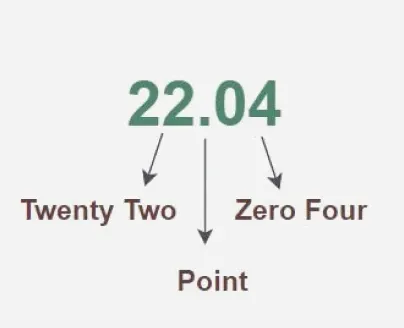
Decimal numbers are read by saying the whole number part first, then saying “point,” followed by reading each digit after the decimal point individually.
- Step 1: Read Whole Number Part
- Step 2: Read Decimal Part
- Step 3: Write Decimal in Words:
Decimals Place Value Chart
In the chart given below, you will see that from the tenth place, there is only 1 digit after decimal. Still, we count it as the tenth-place value. This is because decimals also take a place value.
| Ones | Tenths | Hundredths**7-tenths | Thousandths | Ten Thousandths |
|---|---|---|---|---|
| 1 | 0.1 | 0.01 | 0.001 | 0.0001 |
Place value in decimals refers to the position of a digit in relation to the decimal point. Each position represents a power of 10, determining the digit's value in the number.

For example, in the decimal 0.75:
- The 7 is in the "tenths" place because it's one-tenth of the whole.
- The 5 is in the "hundredths" place because it's one-hundredth of the whole.
In 0.75, you have 7 tenths and 5 hundredths.
Expanded Form of Decimals
Expanded form of decimals shows the value of each digit based on its place value.
**For example: The expanded form for 56.739,
First, we will write the digits of the given number in the place value chart of decimals, as shown below.
| Tens | Ones | Decimal point | Tenths | Hundredths | Thousandths |
|---|---|---|---|---|---|
| 5 | 6 | . | 7 | 3 | 9 |
56.739 = 5 × 10 + 6 × 1 + 7 × 0.1 + 3 × 0.01 + 9 × 0.001
OR
56.739 = 5 × 10 + 6 × 1 + 7 × 1/10 + 3 × 1/100 + 9 × 1/1000
Types of Decimals
There are three basic types of decimals in maths. These are:
Recurring Decimals
Recurring decimals are numbers that have a repeating pattern of one or more digits after the decimal point. The repetition is indicated by a bar placed over the repeating part.
The recurring decimal representation of 1/3 is 0.333..., denoted as 0.\bar{3}.
Non-Recurring Decimals
Non-recurring decimals are numbers where the decimal expansion does not repeat. The digits after the decimal point do not form a recurring pattern.
**An example is 0.274, where the digits 2, 7, and 4 do not repeat in a predictable manner.
Decimal Fractions
Decimal fractions are numbers that fall between two consecutive integers on the number line and are expressed in decimal form. These numbers have a finite number of digits after the decimal point.
**For example, in the decimal fraction 0.75, the digits 7 and 5 represent the fractional part, and there is no recurring or infinite pattern.
Arithmetic Operations on Decimals
Arithmetic operations on decimals involve addition, subtraction, multiplication, and division, following similar principles as whole numbers.
**Addition and Subtraction of Decimal Numbers
- To add or subtract decimals, align them based on the decimal point.
- Perform the operation as usual, treating the decimals as if they were whole numbers.
- Place the decimal point in the result directly below the aligned decimals.
**Multiplication of Decimal Numbers
- Multiply decimals as if they were whole numbers, disregarding the decimal points.
- Count the total decimal places in the factors.
- Place the decimal point in the product, counting from the right, equal to the total decimal places.
**Division of Decimal Numbers
- Similar to multiplication, perform division as if the decimals were whole numbers.
- Count the total decimal places in both the dividend and divisor.
- Move the decimal point in the quotient to make it a whole number, then adjust accordingly.
Rounding Decimals
Rounding decimals means approximating a decimal number to a specified place value. For example, rounding 3.78 to the nearest tenth results in 3.8, as it is closer to 3.8 than 3.7.
Rule of Rounding Decimals
To round a decimal, identify the desired decimal place, then look at the digit immediately to its right:
- If this digit is 5 or greater, round the identified place value up by 1.
- If the digit is 4 or less, leave the identified place value unchanged.
For example:
- Rounding 3.78 to the nearest tenth: Look at the hundredth place (8). Since 8 is greater than 5, round up, giving 3.8.
Rounding Decimals to Nearest Tenth
Rounding decimals to the nearest tenth means you're making the number simpler by keeping only one digit after the decimal point. For example:
In the decimal 4.72. To round it to the nearest tenth, look at the digit in the hundredth place, which is 2. Since 2 is less than 5, you round down the digit in the tenths place. So, 4.72 rounded to the nearest tenth is 4.7
Rounding Decimals Examples
Rounding decimals involves simplifying them to a specified place value. Here are examples and techniques:
**Rounding to Nearest Whole Number:
- For Example, 4.78 rounded to the nearest whole number is 5, as the digit in the tenths place is 8 (greater than 5).
**Rounding to Nearest Tenth:
- For example, 3.46 rounded to the nearest tenth is 3.5, considering the digit in the hundredths place, which is 6(greater than 5).
**Rounding to Nearest Hundredth:
- For example, 2.934 rounded to the nearest hundredth is 2.93, with the digit in the thousandths place being 4(less than 5).
Comparing Decimals
Comparing decimals involves determining which decimal is greater or smaller. Follow these steps:
**Step 1: Compare Whole Numbers
Start by comparing the whole number parts of the decimals. The decimal with the greater whole number is larger. If the whole numbers are the same, move to the decimal places.
**Step 2: Compare Decimal Places
Compare the digits in the decimal places from left to right. The first digit where the decimals differ determines the larger number.
**Note: If one decimal has fewer decimal places, consider the missing places as zeros when making comparisons.
**Example: Compare 3.25 and 3.15
**Solution:
- Whole numbers are same (3)
- Compare tenths place (2 vs. 1)
- 3.25 is greater than 3.15
Decimals to Fraction
The conversion of decimal to fraction or vice versa can be performed easily.
Decimal to Fraction Conversion
We can easily convert decimals to fractions by following the given steps:
Step 1: Identify Decimal: Begin by identifying the decimal you want to convert to a fraction.
Step 2: Write Decimal as a Fraction with a Denominator of 1: Express the decimal as a fraction with a denominator of 1. For example, if the decimal is 0.5, write it as 0.5/1
Step 3: Multiply to Eliminate Decimal Places: Multiply both the numerator and the denominator by 10, 100, 1000, or any power of 10 sufficient to eliminate the decimal places. For instance, for the decimal 0.5, multiply both numerator and denominator by 10 to get 5/10
Step 4: Simplify Fraction: If possible, simplify the fraction by finding the greatest common factor (GCF) and dividing both the numerator and denominator by it. In the example, 5/10 can be simplified to 1/2 by dividing both by 5.
Fraction to Decimal Conversion
To convert a fraction into a decimal, it needs a simple division of the numerator by denominator.
**For Example: To convert 3/4 into decimal we need to divide 3 by 4, this will give us 0.75.
Decimal Conversion Examples
Few examples of Decimal Conversion are as follows:
**Example 1: Convert 1/4 to decimal.
**Solution:
To convert the fraction 1/4 into a decimal, you can divide 1 by 4: 1/4 =0.25
Therefore, 1/4 as a decimal is 0.25
**Example 2: Express the percentage 25% as a decimal.
**Solution:
25% can be written as 25/100 in fraction on solving we get 1/2
1/2= 0.5
**Example 3: Convert the mixed number 2 \frac{1}{4} into a decimal.
**Solution:
Convert 2 \frac{1}{4} into whole fraction as [(4 × 2) + 1]/4
= 9/4
Now divide 9 by 4 we get
= 2.25
**Example 4. Represent the repeating decimal 1/3 as a fraction.
**Solution:
To convert the fraction 1/3 into a decimal, you can divide 1 by 3: 1/3 =0.3333....
Therefore, 1/3 as a decimal is 0.3333......, this is a non terminating repeating decimal representation.
Solved Examples of Decimals
**Example 1: Compare 4.67 and 4.678. Which decimal is greater, and by how much?
**Solution:
To compare 4.67 and 4.678:
Both decimals have the same whole number part (4), so we move to the decimal place. In the decimal place, 678 is greater than 67.
Therefore, 4.678 is greater than 4.67. The difference between them is 0.008.
**Example 2: Convert the fraction 3/5 into a decimal.
**Solution:
To convert fraction 3/5 into a decimal, you can divide 3 by 5: 3/5 =0.6
Therefore, 3/5 as a decimal is 0.6.
**Example 3: Express the decimal 4.267 in expanded form.
**Solution:
4.267= 4 × 100+ 2 × 10⁻¹+ 6 × 10⁻²+ 7 × 10⁻³
**Example 4: Add 0.25, 1.6, and 4.75.
**Solution:
0.25 + 1.6 + 4.75
= 0.25 + 1.60 + 4.75 = 6.60
**Practice Questions on Decimals
**Question 1: Compare 0.325 and 0.53. Determine the relationship between these decimals and express it using the symbols ">" or "<".
**Question 2: Express the ratio 7:9 as a decimal.
**Question 3: Write the expanded form of the decimal 0.825.
**Question 4: Add the decimals 2.34 and 1.89.
**Question 5: Subtract 0.56 from 3.72.
**Question 6: Multiply 0.25 by 4.