Compound Interest (original) (raw)
Last Updated : 7 Apr, 2026
Compound interest is the interest calculated on both the initial principal (the original amount) and the accumulated interest from the previous periods. In simple words, it means you earn "interest on interest," so the money grows faster compared to **simple interest (which is only calculated on the principal).
It is used in the banking and finance sectors and is also useful in other sectors. A few of its uses are:
- Growth of the population of a country
- Value of investment over a period of time.
- To find the inflated costs and the depreciated value of any article.
- For predicting the growth of any institution or country.
Compound Interest Formula
Compound interest is calculated by finding the total amount accumulated over a period of time, based on the initial principal, the rate of interest, and the frequency of compounding.
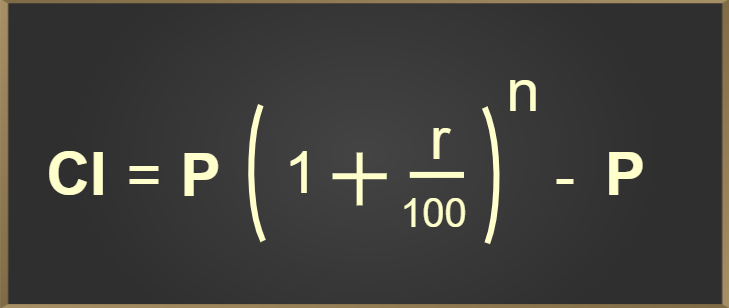
Where,
- **P = Initial Principal Amount
- **r = Annual Interest Rate
- **n = Number of Times Interest is Compounded
- **t = Number of Years
**Note : Compound Interest can be calculated yearly, half-yearly, quarterly, monthly, daily, etc; as per the requirement.
Derivation of Compound Interest Formula
We can derive the compound interest formula starting from the formula for simple interest.
Simple Interest (SI) = (P x R x T)/100
For the First Year
- SI1 = (P x R x 1)/100
- Amount after Year 1: A1 = P + SI1 = P + (P x R/100) = P(1 + (R /100))
For the Second Year
- P2 = A1 = P (1 + (R/100))
- Interest for Year 2: SI2 = (P2 x R)/100
- Amount after Year 2: A2 = P2 + SI2 = P(1 + (R/100)) (1 + (R/100)).
Generalizing for _n years
- An = P(1 +(R/100))n
- Compound Interest: CI = An − P = P[1 + (R/100)]n - P
Final Formula: CI = P[1 + (R/100))n - 1]
Compound Interest Calculator
Compound Interest is calculated at regular intervals like annually(yearly), semi-annually, quarterly, monthly, etc. It is like re-investing the interest income from an investment makes the money grow faster over time! It is exactly what compound interest does to money. Banks or any financial organization calculate the amount based on compound interest only.
**Compound Interest = Interest on Principal + Interest on Interest of Principal(From second year and onwards)
**Try it yourself:
What will $10000 be worth in 10 years?
Suppose you have $10,000 in a savings account with an annual interest rate of 10%, compounded yearly. Assuming you don’t withdraw any money for 10 years, your investment will have grown to:
| Year | Interest | Accrued Interest | Balance |
|---|---|---|---|
| 0 | - | - | ****$10,000** |
| 1 | 1,000∣1,000 | 1,000∣1,000 | ****$11,000** |
| 2 | 1,100∣1,100 | 1,100∣2,100 | ****$12,100** |
| 3 | 1,210∣1,210 | 1,210∣3,310 | ****$13,310** |
| 4 | 1,331∣1,331 | 1,331∣4,641 | ****$14,641** |
| 5 | 1,464.10∣1,464.10 | 1,464.10∣6,105.10 | ****$16,105.10** |
| 6 | 1,610.51∣1,610.51 | 1,610.51∣7,715.61 | ****$17,715.61** |
| 7 | 1,771.56∣1,771.56 | 1,771.56∣9,487.17 | ****$19,487.17** |
| 8 | 1,948.72∣1,948.72 | 1,948.72∣11,435.89 | ****$21,435.89** |
| 9 | 2,143.59∣2,143.59 | 2,143.59∣13,579.48 | ****$23,579.48** |
| 10 | 2,357.95∣2,357.95 | 2,357.95∣15,937.43 | ****$25,937.43** |
Your savings of 10,000atafixedinterestrateof1010,000 at a fixed interest rate of 10% for 10 years has grown to 10,000atafixedinterestrateof1025,937.43. This means your initial savings have increased approximately 2.5 times, showcasing the power of compound interest.
The Same Amount would have compounded to $67,275 after 20 years.
General Compound Interest Formulas
If P is compounded n times per year at an annual interest rate r, the interest rate r is divided by n and applied n times per year. So, after t years, the formula becomes:
**A = P(1 + r/n) nt
Where,
- **r/n- interest rate per compounding period.
- **nt - total number of compounding periods over t years.
Half-yearly Compound Interest Formula
The principal is compounded half-yearly; the principal will be changed at the end of 6 months, and interest earned till then will be added to the principal, and then this becomes the new principal. Similarly, the final amount is calculated as:
**A = P (1 + R/200) 2t
Quarterly Compound Interest formula
If the principal is compounded quarterly, the principal will be changed at the end of 3 months, and interest earned till then will be added to the principal, and then this becomes the new principal. Similarly, the final amount is calculated as:
**A = P(1 + R/400) 4t
Monthly Compound Interest Formula
If the interest is compounded monthly then the number of times compounding will be 12 and the interest each month will be 1/12 of the annual compound interest. Hence, the Compound Interest Formula is given as:
**A = P[1 + (R/1200)] 12t
**CI = A - P
Daily Compound Interest Formula
If interest is compounded daily, then. The new Rate of interest will be R/365% and n = 365
Hence, the Daily Compound Interest Formula is given as:
**A = P[1 + (R/36500)] 365t
**CI = A - P
Rule of 72
Rule of 72 is the formula that is used to estimate how many years our money gets double if it is compounded annually. For example, if our money is invested at r% compounded annually, then it takes 72/r years for our money to double.
The following formula is used to approximate the number of years for our investment to double.
**N = 72 / r
Where,
- **N - Approximate number of years it takes for our money to double.
- **r - Rate at which our money is compounded annually.
**Example: Suppose Kabir has invested 10,00,000 dollars in a debt fund that gives an 8% return. In how many years will his money double if it is compounded annually?
Using above formula:
N = 72/8 = 9 yearsThus, it takes 9 years for Kabir's money to get doubled.
**Compound Interest of Consecutive Years
If we have the same sum and the same rate of interest. The C.I. of a particular year is always more than C.I of the Previous Year. (CI of 3rd year is greater than CI of 2nd year). The difference between CI for any two consecutive years is the interest of one year on C.I of the preceding year.
**C.I of 3rd year - C.I of 2nd year = C.I of 2nd year × r × 1/100
The difference between amounts of any two consecutive years is the interest of one year on the amount of the preceding year.
**Amount of 3rd year - Amount of 2nd year = Amount of 2nd year × r × 1/100
**Key Results
When we have the same sum and the same rate,
**C.I for nth year = C.I for (n - 1)th year + Interest for one year on C.I for (n - 1)th year
Continuous Compounding Interest Formula
Continuous Compounding Formula is used in Finance to calculate the final value of an investment that undergoes continuous compounding over different periods, and the value is added over time. The formula for continuous compounding is given as
**Final Value = Present Value × e rt
Where,
- **e - Euler's number
- **r - Rate of interest
- **t - Time
**Interesting Fact:
Suppose you have 100andyouputitinasavingaccountwiththefixedinterestrateof10100 and you put it in a saving account with the fixed interest rate of 10%, so after 100 years, this amount will increased to 100andyouputitinasavingaccountwiththefixedinterestrateof101378061.23.
**Some Other Applications of Compound Interest
**Growth: This is mainly used for growth if industries are related.
**Production after n years = initial production × (1 + r/100) n
**Depreciation: When the cost of a product depreciates by r% every year, then its value after n years is
**Present value × (1 - r/100) n
**Population Problems: When the population of a town, city, or village increases at a certain rate per year.
**Population after n years = present population × (1 + r/100) n
Simple Interest vs Compound
The difference between Compound Interest and Simple Interest can be understood in the following table:
| Compound Interest (CI) | Simple Interest (SI) |
|---|---|
| CI is an interest that is calculated both on the principal and the previously earned interest. | SI is the interest that is calculated only on the principal. |
| For the same principle, Rate, and Time period, CI > SI | For the same principle, Rate, and Time period, SI < CI |
| Formula for CI is : A = P(1 + R/100) TCI = A - P | Formula for SI is : SI = (P × R × T) / 100 |
**Solved Examples of Compound Interest
**Example 1: Find the Compound Interest when principal = $6000, rate = 10% per annum, and time = 2 years.
**Solution:
Interest for first year = (6000 × 10 × 1)/100 = 600
Amount at the end of first year = 6000 + 600 = 6600
Interest for second year = (6600 × 10 × 1) / 100 = 660
Amount at the end of second year = 6600 + 660 = 7260Compound Interest = 7260 - 6000 = $1260
**Example 2: What will be the compound interest on $8000 in two years when the rate of interest is 2% per annum?
**Solution:
Given,
Principal P = 8000
Rate r = 2%
Time = 2 yearsby formula
A = P (1 + R/100)n
A = 8000 (1 + 2/100)2 = 8000 (102/100)2
A = 8323Compound interest = A - P = 8323 - 8000 = $323
**Example 3: Sam deposited $4000 with a finance company for 2 years at an interest rate of 5% per annum. What is the compound interest that John gets after 2 years?
**Solution:
Given,
Principal P = 4000
Rate r = 5%
Time = 2yearsBy formula,
A = P (1 + R/100)n
A = 4000 (1 + 5/100)2
A = 4000 (105/100)2
A = 4410Compound Interest = A - P = 4410 - 4000 = $410
**Example 4: Find the compound interest on $2000 at the rate of 4 % per annum for 1.5 years. When is interest compounded half-yearly?
**Solution:
Given,
Principal p = 2000
Rate r = 4%
Time = 1.5 ( i.e 3 half years )by formula ,
A = P (1 + R/200)2
A = 2000 (1 + 4/200)3
A = 2000 (204/200)3
A = 2122Compound Interest = A - P = 2122 - 2000 = 122