Simple Interest (original) (raw)
Last Updated : 21 Apr, 2026
Simple Interest (SI) is a method of calculating the interest charged or earned on a principal amount over a fixed period. It is calculated based solely on the principal amount, which remains unchanged throughout the calculation.
Simple Interest is widely used across industries such as banking, finance, and automotive sectors to determine interest on loans, investments, and financing options. This straightforward method enables consumers and businesses to easily understand the cost of borrowing or the returns on their investments.
Simple Interest Formula
The formula to calculate Simple Interest is:
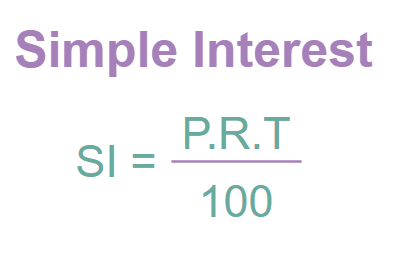
Where,
- P is the Principal amount
- R is annual Rate of Interest
- T is the Time for which principal is invested
In simple interest, the interest grows linearly over time. This means the amount of interest added each year is the same, forming a sequence in arithmetic progression (AP).
**For example:
- If the principal is ₹100, the rate is 10%, and the time is in years, the interest added each year will be ₹10.
- After 1 year: ₹10
- After 2 years: ₹20
- After 3 years: ₹30
- And so on...
When Time is given in Months
When the time is given in months instead of years, you just convert months into years in the formula.
T = Months/12
Then put this into the simple-interest formula: S.I. =\dfrac{P \times R \times T}{100}
Substituting T = M/12:
S.I. =\dfrac{P \times R \times M}{100\times 12}
Similarly, when time is given in days, the formula becomes: S.I. =\dfrac{P \times R \times d}{100\times 365}
Three basic terms related to simple interest are:
**Principal
The principal is the amount borrowed or invested. It is denoted by the letter "P". The principal remains constant while calculating simple interest.
It can be calculated as:
P =\dfrac{100 \times S.I.}{R \times T}
**Rate
The rate of interest at which the principal amount is invested or borrowed for a specific period is called the rate. For example, the rate of interest can be 5%, 10%, or 13%. Here, the interest rate can be represented by "R".
It can be calculated as:
R =\dfrac{100 \times S.I.}{P \times T}
**Time
The duration during which the principal is borrowed or invested is referred to as time. Time is symbolized by "T".
It can be calculated as:
T =\dfrac{100 \times S.I.}{P \times R}
**Amount
When a person acquires a loan from a bank, he or she is required to repay the principal borrowed plus the interest amount, and the total amount repaid is referred to as the Amount. It is denoted by the letter "A".
Thus,
A = P + SI
P = A - SI
A = P (1+\frac{R \times T}{100})
Simple Interest Calculator
Use this calculator to quickly calculate both the simple interest and the total amount.
How to Calculate Simple Interest
To understand the concept better, let's try finding the simple interest using an example.
Adam deposits $8,000 in a savings account at a simple interest rate of 7% per annum for 3 years. What will be the simple interest earned, and what will be the total amount after 3 years?
**Solution:
- P = $8,000
- R = 7% per annum
- T = 3 years
SI = (P × R × T/100)
SI = 8000 × 7 × 3 / 100
SI = 168000/100 = 1680
**Total Amount = Principal + Interest
Total Amount = 8000 + 1680 = $9680
Steps to Find Simple Interest
Simple interest is found by using the formula SI = (PRT)/100. Simple interest on any sum of money is calculated using the steps discussed below,
**Step 1: The principal(P), Rate of interest(R) and time(T) of loan amount is noted.
**Step 2: Use the formula SI = (P × R × T / 100) to calculate Simple Interest
**Step 3: Use all the values from Step 1 and substitute them in Step 2.
**Step 4: Simplify the value obtained in Step 3 to get required simple interest.
**Let's consider an example to understand the procedure better.
**Example: Find the SI on ₹10000 deposited for 3 years at 5% per annum.
**Solution:
Given,
- P = Rupees 10,000
- R = 5% per annum
- T = 3 years
Thus, SI = (P × R × T/100)
⇒ SI = (10000 × 5 × 3)/100 = 1500Thus the interest earned is ₹1,500
Simple Interest vs Compound Interest
The key differences between the two are highlighted in the table below:
| Simple Interest | Compound Interest |
|---|---|
| Simple interest is calculated on the original principal amount. | Compound interest is calculated on the accumulated sum of principal and interest. |
| Simple Interest can be calculated using the following formula: **SI = P × R × T | Compound Interest can be calculated using the following formula: **CI = P [(1 + R/100) T - 1] |
| The principal remains constant throughout the tenure. | The principal amount changes every year during the tenure. |
| It is equal for every year on a certain principle. | It is different for every span of the time period, as it is calculated on the amount and not the principal. |
Related Articles:
Solved Questions on Simple Interest
**Question 1: Sam takes a loan of $20000 from a bank for a period of 1 year. The rate of interest is 10% per annum. Find the simple interest and the total amount he has to pay at the end of a year.
**Solution:
Here,
- Loan Sum = P = $20000
- Rate of Interest per year = R = 10%
- Time (T) = 1 year
SI = (P × R ×T) / 100
= (20000 × 10 × 1) / 100
= $2000
Total Amount that Sam has to pay to bank at end of yearAmount = Principal + Simple Interest
= 20000 + 2000
= $22,000
**Question 2: A person borrowed $60,000 for 4 years at the rate of 2.5% per annum. Find the interest accumulated at the end of 4 years.
**Solution:
Given,
- Principal = $60,000
- Rate of Interest = 2.5 %
- Time = 4 years
SI = (P × R ×T) / 100
= ( 60,000 × 2.5 × 4 ) / 100
= $6000
**Question 3: A person pays 8000asanamountonthesumof8000 as an amount on the sum of 8000asanamountonthesumof6000 that he had borrowed for 3 years. What will be the rate of interest?
**Solution:
- A = $8000
- P = $6000
Amount = Principal + Simple Interest
SI = A – P
= 8000 – 6000
= $2000
Time (t) = 3 years
Rate (R) = ?SI = (P × R ×T) / 100
R = (SI × 100) /(P × T)
R = (2000 × 100 /(6000 × 3)
= 11.11 %Thus, rate of interest R is 11.11 %.