Continuous Probability Distributions (original) (raw)
Last Updated : 25 Jul, 2025
In mathematics, we often deal with uncertain or variable outcomes, like how long it will take for a server to respond, or how tall a randomly chosen person might be. These outcomes are not fixed values, but a part of a range. To model such a situation, we use a continuous probability distribution.
Continuous probability distributions (CPDs) are probability distributions that apply to continuous random variables. It describes events that can take on any value within a specific range, like the height of a person or the amount of time it takes to complete a task.
When a variable is continuous, it means:
- It can take any value within a range.
- The chance of getting one exact value is zero.
- We can find probability over ranges of values, like P(a ≤ X ≤ b)
Common Types of Continuous Probability Distributions:
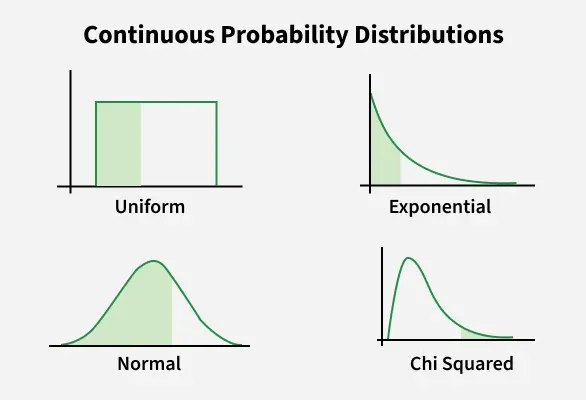
Types of Continous Probability Distributions
A probability distribution is a mathematical function that describes the likelihood of different outcomes for a random variable. Continuous probability distributions (CPDs) are probability distributions that apply to continuous random variables.
In continuous probability distributions, two key functions describe the likelihood of a variable taking on specific values:
Probability Density Function(PDF)
The PDF gives the relative likelihood that a continuous random variable takes on a value within a small interval.
- For a continuous random variable X, the PDF is denoted by f(x).
- The probability of any exact value is 0, and the total area under the curve(PDF) is 1.
It is defined as:
P(a \leq X \leq b) = \int_{a}^{b} f(x)\,dx
Cumulative Distribution Function
The CDF gives the probability that the random variable is less than or equal to a certain value.
- For a continuous random variable X, the CDF is denoted by F(x).
- The CDF gives the probability that X is less than or equal to a value. It always increases from 0 to 1 as x increases.
It is defined as :
F(x) = \int_{-\infty}^{x} \frac{1}{\sqrt{2\pi}} \, e^{-t^2/2} \, dt
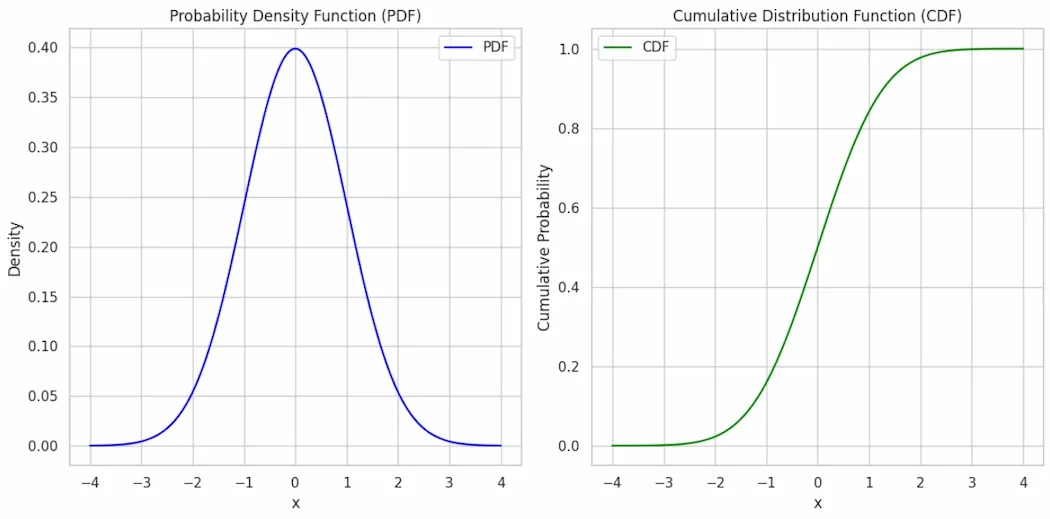
PDF vs CDF
Types of Continuous Probability Distribution
A continuous probability distribution describes variables that can take any value within a given range. Different types of distributions are used depending on the nature of the data and the problem being solved.
Normal Distribution or Gaussian Distribution
The Gaussian Distribution is a bell-shaped, symmetrical, basic continuous probability distribution. Two factors define it:
- The standard deviation (σ), which indicates the distribution's spread or dispersion,
- The mean (μ) which establishes the distribution.
For a random variable, x is expressed in
f(x) = \frac{1}{\sqrt{2\pi\sigma^2}} \, \exp\left( -\frac{1}{2} \left( \frac{x - \mu}{\sigma} \right)^2 \right)a
Uniform Distribution
The Uniform Distribution is a continuous probability distribution where all values within a specified range are equally likely to occur.
- Parameters: Lower bound (a) and upper bound (b).
- The mean of a uniform distribution is, \mu = \frac{a + b}{2}and the variance is \quad \sigma^2 = \frac{(b - a)^2}{12}
f(x) = \frac{1}{b - a}, \quad \text{for } a \leq x \leq b
Exponential Distribution
The exponential distribution is a continuous probability distribution that represents the duration between occurrences in a Poisson process, which occurs continuously and independently at a constant average rate.
- Parameter: Rate parameter (λ).
- The mean of the exponential distribution is 1/,_λ and the variance is 1/λ2.1/λ2.
For a random variable x, it is expressed as
f(x) = \lambda e^{-\lambda x}, \quad \text{for } x \geq 0
Chi-Squared Distribution
The Chi-Squared Distribution is a continuous probability distribution that arises in statistics, particularly in hypothesis testing and confidence interval estimation.
- It is characterized by a single parameter, often denoted as _k, which represents the degrees of freedom.
- The mean of the Chi-Squared Distribution is k, Continuous, and the variance is 2__k.
For a random variable x, it is expressed as
f(x) = \frac{1}{2^{k/2} \, \Gamma(k/2)} \, x^{(k/2 - 1)} \, e^{-x/2}, \quad \text{for } x \geq 0
Applications in CS
- **Modeling Uncertainty: They help represent uncertainty in predictions, allowing probabilistic outputs instead of fixed values.
- **Gaussian Distribution: Widely used in models like regression and Bayesian networks for error modeling and the assumption of normality.
- **Maximum Likelihood Estimation (MLE): Many algorithms rely on continuous distributions to estimate model parameters that maximize the likelihood of observed data.
- **Bayesian Inference: Continuous distributions are essential in Bayesian models to update beliefs about parameters based on new data.
- **Generative Models: Models like Gaussian Mixture Models and Variational Autoencoders use continuous distributions to learn and generate data.
Solved Question on Continuous Probability Distribution
**Question 1: The probability density function (PDF) of a continuous random variable X is given by: f(x) =\begin{cases}2x, & \text{for } 0 \leq x \leq 1 \\0, & \text{otherwise}\end{cases}. Find the probability that X lies between 0.25 and 0.75.
**Solution:
We use the formula for continuous probability:
P (0.25 \leq X \leq 0.75) = \int_{a}^{b} f(x) \, dx
Substitute the Values:
P(0.25≤X≤0.75) = \int_{0.25}^{0.75} 2x \, dx
= 2 \int_{0.25}^{0.75} x \, dx = 2 \left[ \frac{x^2}{2} \right]_{0.25}^{0.75} = \left[ x^2 \right]_{0.25}^{0.75} = (0.75)2 - (0.25)2 = 0.5625 - 0.0625 = 0.5
P(0.25 ≤ X≤ 0.75) = 0.5
**Question 2: Let the probability density function (PDF) be: f(x) = 2x, for 0 ≤ x ≤ 1. Find the Cumulative Distribution Function (CDF), F(x).
**Solution:
**Case 1: x<0
Since the support of f(x) is only from 0 to 1,
F(x) = 0
**Case 2: 0≤x≤10
F(x) = \int_{0}^{x} 2t \, dt = \left[ t^2 \right]_0^x = x^2
**Case 3: x>1
Since the total area under the PDF must be 1,
F(x)=1
So, F(x) = \begin{cases} 0, & x < 0 \\x^2, & 0 \leq x \leq 1 \\1, & x > 1 \end{cases}
Practice Questions on Continuous Probability Distribution
**Question 1: Let f(x) = 3x2 for 0 ≤ x ≤ 1. Find the value of P(0.2 ≤ X ≤ 0.8)
****Question 2.**PDF of a continuous random variable is given as f(x)=1/5, for 0 ≤ x ≤ 5. Find the **mean and **variance of the distribution.
**Question **3: Suppose the time (in hours) taken to complete a task is exponentially distributed with parameter λ = 2. What is the probability that the task takes less than 1 hour?
**Question 4: A random variable X has a normal distribution with mean μ = 50 and standard deviation σ = 10. What is the probability that X lies between 40 and 60?
**Answer Key:
- P(0.2 \leq X \leq 0.8) = \int_{0.2}^{0.8} 3x^2 \, dx = 0.488
- Mean μ = 2.5, Variance σ2 = 25/12
- P(X<1)=1−e−2(1)=1−e−2
- P(40 ≤ X ≤ 60) ≈ 0.6826