Cube Definition, Shape & Formula (original) (raw)
Last Updated : 23 Jul, 2025
A **cube is a 3D geometric shape with six square faces, twelve equal edges, and eight vertices. It is a special case of a cuboid where the length, breadth, and height are all equal. Each face of the cube is a square, and all the angles between the faces are right angles (90 degrees).
**Examples of cubes in daily life include sugar cubes, ice cubes, and the 3×3 Rubik’s Cube. The cube is also known as an equilateral cuboid, square parallelepiped, or right rhombic hexahedron, and it is one of the five Platonic solids.
A cube is a **polyhedron with equal length, breadth, and height, making it one of the simplest and most symmetrical 3D shapes in geometry.
The image added below shows a cube along with its faces, edges, and vertices.
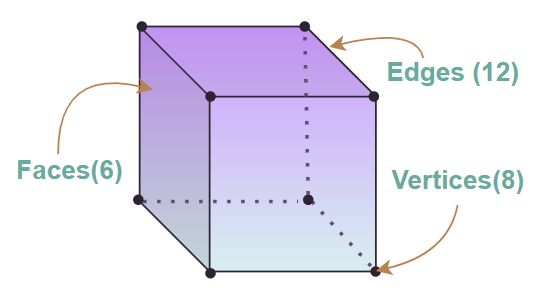
By studying the figure above, we conclude that two faces of the cube share a common boundary called an edge, and there are twelve edges in total. Similarly, upon closer inspection, we observe that a cube has six faces and eight vertices.
**Read More:**Polyhedron
We see various types of figures in our daily life that are shaped like cubes that include, boxes, ice cubes, sugar cubes, etc.
Cube Examples
Various Cube Examples are shown in the image below:

Cube Examples
Terms Related to Cube
There are Six Faces, Twelve Edges and Eight Vertices in a Cube.
- **Cube Faces
There are 6 faces in a cube and each faces are have same length and breadth. Hence, a cube has square faces.
- **Cube Edges
There are 12 edges in a cube. Cube Edges mark the boundary of the surfaces of cube.
- **Cube Vertices
There are 8 vertices in a cube. Cube Vertices are coners or the point of intersection of two or more edges.
**Read More: **Faces, Edges and Vertices of Cube
Euler's Formula in Cube
Euler's Formula gives the relation between Faces, Edges and Vertices of a Polyhedron. Let's verify the same for a cube. According to Euler's Formula we know that
**F + V = E + 2
where,
- F is Number of Faces,
- V is Number of Vertices
- E is Number of Edges
In a cube, F = 6, V = 8 and E = 12. Putting this value in above expression we get
LHS = F + V = 8 + 6 = 14
RHS = E + 2 = 12 + 2 = 14Hence, F + V = E + 2
Thus, cube satisfies Euler's Formula.
**Net of Cube
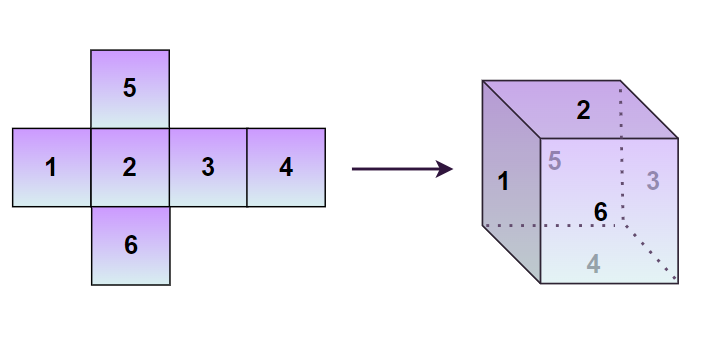
A cube is a 3D figure and a figure in 2D that can be folded easily to form the cube is called the net of a cube. Thus, we can say that the two-dimensional form of a cube that can be folded to form a three-dimensional form is called a net of a cube.
There are various ways to unfold a cube, i.e. a cube can have various nets one of nets of cube is discussed in image below,
Cube Formula
There are various formulas that are helpful to find various dimensions of cube, that include length of its diagonal, its surface area, its volume, etc. Various cube formulas discussed in article are,
Now let's learn about these formulas in detail.
**Diagonal of Cube
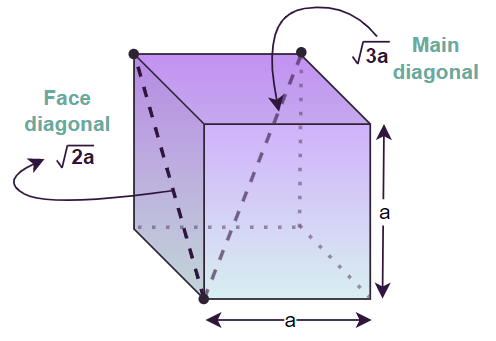
Diagonal of a cube is the line segment that joins the opposite vertices of the cube. A cube has two types of diagonals, i.e., a face diagonal and a main diagonal.
A face diagonal is a line that joins the opposite vertices of the face of a cube and is equal to the square root of two times the length of the side of a cube. As the cube has six faces, it has a total of 12 face diagonals. The formula to calculate the face diagonal of the cube is,
**Length of Face Diagonal of Cube = √2a units
Where, a is Length of Side of a Cube
While the main diagonal is the line segment that joins the opposite vertices, passing through the center of the cube, and is equal to the square root of three times the length of the side of a cube. **A cube has a total of four main diagonals.
**Length of Main Diagonal of Cube = √3a units
Where, a is Length of Side of a Cube
Below image represents main diagonal and face diagonal of cube.
**Surface Area of a Cube
Area of any object is space occupied by all the surfaces of that object. It can be defined as the total surface available for the painting. A cube has six faces and so its surface area is calculated by finding the area of the individual face and finding its sum.
There are two types of surface area associated with a cube that are mentioned below,
- Lateral Surface Area of Cube, also called LSA of Cube.
- Total Surface Area of Cube, also called TSA of Cube.
**Lateral Surface Area of Cube
**Lateral Surface Area of a cube is the sum of the areas of all the faces of a cube, excluding its top and bottom. In simple words, the sum of all four side faces of a cube is the lateral surface area of a cube. It is measured in square units such as (units)2, m2, cm2, etc.
**Formula for the lateral surface of a cube is
**Lateral Surface Area of Cube = 4a 2
where, **a is Length of Side of a Cube
**Total Surface Area of Cube
Total Surface Area of a cube is the space occupied by it in three-dimensional space and is equal to the sum of the areas of all its sides. It is measured in square units such as (units)2, m2, cm2, etc.
**Formula for the total surface of a cube is
**Total Surface Area of Cube = 6a 2
Where, a is the Length of Side of a Cube
**Volume of Cube
Volume of a cube is the amount of space enclosed by the cube. It is usually measured in terms of cubic units. It is measured in cube units such as (units)3, m3, cm3, etc.
Formula for the volume of a cube is
**Volume of a Cube = a 3
Where, a is the Length of Side of a Cube
We can also calculate the volume of the cube if its diagonal is given, by using the formula,
**Volume of Cube = (√3d 3 )/9
where****, d** is Length of Main Diagonal of Cube.
**Properties of Cube
A cube is a 3D figure with equal dimensions having various properties. Some of the properties of the cube are,
- All the faces of a cube are square-shaped. Hence the length, breadth, and height of a cube are equal.
- The angle between any two faces of a cube is a right angle, i.e., 90°.
- Each face of a cube meets the other four faces.
- Three edges and three faces of a cube meet at a vertex.
- Opposite edges of a cube are parallel to each other.
- Faces or planes of a cube opposite to each other are parallel.
Interesting Facts about Cube
The various important facts related to cube are mentioned below:
- All the faces of a cube are equal in dimension and is square shaped
- The length, breadth and height of a cube are same
- We can say that cube is a cuboid with equal dimension in all the three directions
- Cube is one of the simplest polyhedrons
- The volume of cube is calculated by side × side × side
- Lateral Surface Area of Cube is calculated by 4 × side2
- Total Surface Area of Cube is Calculated by 6 × side2
**People Also Read:
**Cube Examples
**Example 1: Find the total surface area of a cube if the length of its side is 8 units.
**Solution:
Given,
Length of side of Cube (a) = 8 unitsWe know that, Total Surface Area of Cube (TSA) = 6a 2
TSA = 6 × (8)
= 6 ×
= 384 square units.Hence, the surface area of the cube = 384 square units.
**Example 2: Find the volume of a cube if the length of its side is 5.5 inches.
**Solution:
Given,
Length of side of Cube (a) = 5.5 inches.We know that, Volume of Cube (V) = a 3
V = (5.5)
= 166.375 cubic inchesHence, the volume of the cube is 166.375 cubic inches.
**Example 3: Find the length of the diagonal of a cube and its lateral surface area if the length of its side is 6 m.
**Solution:
Given,
Length of side of Cube (a) = 6 mWe know that, Length of Diagonal of Cube(l) = √3 a
l = √3 × 6
= 6√3 m**Lateral Surface Area of Cube (LSA) = 4a 2
LSA = 4 × (6)
= 4 ×
= 144 m2
Hence, the length of the diagonal is 6√3 m, and its lateral surface area is 144 square meters.
**Example 4: Determine the length of the diagonal of the **cube if the volume of the cube is 91.125 cm 3 .
**Solution:
Given,
Volume of the cube (V) = 91.125 cm3Let length of side of a cube be "s"
We have****, Volume of Cube = s** 3
s3 = 91.125
s = ∛(91.125
= 4.5 cm**Length of diagonal of a Cube(l) = √3 s
l = √3 × 4.5 = 4.5√3 cm.Hence, the length of the diagonal is 4.5√3 cm