Euler's Formula (original) (raw)
Last Updated : 21 Feb, 2026
Euler’s formula establishes a fundamental relationship between exponential functions and trigonometric functions. It shows how complex exponentials can be expressed using sine and cosine.
e^{i\theta} = \cos\theta + i\sin\theta
**Where:
- θ is a real number (in radians)
- e is the base of the natural logarithm
- sinθ and cosθ are trigonometric functions
- i is the imaginary unit (i² = −1)
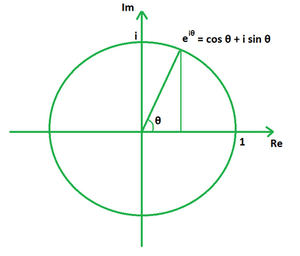
The complex exponential e^{i\theta} represents a point on the unit circle in the complex plane, where θ is a real number measured in radians.
**Derivation
Consider the power series expansion of the exponential function:
e^x = 1 + x + x²/2! + x³/3! + x⁴/4! + ...
Substituting x = iθ:
e^{iθ} = 1 + iθ + (iθ)²/2! + (iθ)³/3! + (iθ)⁴/4! + ...
Using i² = −1 and simplifying:
e^{iθ} = 1 + iθ − θ²/2! − iθ³/3! + θ⁴/4! + iθ⁵/5! − ...
Grouping real and imaginary parts:
e^{iθ} = (1 − θ²/2! + θ⁴/4! − ...)
- i(θ − θ³/3! + θ⁵/5! − ...)
Using the series expansions of cosine and sine:
cosθ = 1 − θ²/2! + θ⁴/4! − ...
sinθ = θ − θ³/3! + θ⁵/5! − ...Since the real and imaginary parts match the Maclaurin series of cosθ and sinθ respectively, therefore
e^{iθ} = cosθ + i sinθ
**Formula for Polyhedral
Euler’s polyhedral formula states that for any polyhedron that does not self-intersect, the numbers of faces, vertices, and edges are related in a specific way. According to the formula, the sum of the number of faces and vertices is two greater than the number of edges.
F + V - E = 2
where,
- F is the number of faces,
- V the number of vertices,
- E the number of edges.
**Derivation
Euler's formula can be proven for five platonic solids: cube, tetrahedron, octahedron, dodecahedron and the icosahedron.
**Solids **Number of faces (F) **Number of vertices (V) **Number of edges (E) **F + V - E **Cube 4 4 6 2 **Tetrahedron 4 6 4 6 **Octahedron 8 6 12 2 **Dodecahedron 12 20 30 2 Icosahedron 20 12 30 2
Applications
Euler’s formula is one of the most important equations in mathematics and has many useful applications. Some of the major applications are:
- Deriving the famous Euler’s identity
- Writing complex numbers in exponential form
- Providing alternative definitions of trigonometric and hyperbolic functions
- Extending exponential and logarithmic functions to complex numbers
- Giving alternative proofs of De Moivre’s theorem and trigonometric addition formulas.
**Euler’s Identity
Euler’s identity is considered one of the most beautiful equations in mathematics because it connects five fundamental constants in a single simple expression:
e^{i\pi} + 1 = 0
It combines:
- 0 — additive identity
- 1 — unity
- π — circle constant
- e — base of the natural logarithm
- i — imaginary unit (i² = −1)
Euler’s identity is obtained as a special case of Euler’s formula by substituting θ = π into
e^{i\theta} = \cos\theta + i\sin\theta
Since cosπ = −1 and sinπ = 0, we get
e^{i\pi}= -1which leads to
e^{i\pi} + 1 = 0
**Sample Problems
**Problem 1. Express eiπ/2 in the general form using Euler's formula.
**Solution:
We have,
x = π/2
Using the formula we get,
eix = cos x + i sin x
= cos π/2 + i sin π/2
= 0 + i (1)
= 0 + i
**Problem 2. Express e6i in the general form using Euler's formula.
**Solution:
We have,
x = 6
Using the formula we get,
eix = cos x + i sin x
= cos 6 + i sin 6
= 0.96 + i (-0.279)
= 0.96 - 0.279i
**Problem 3. Express e10i in the general form using Euler's formula.
**Solution:
We have,
x = 10
Using the formula we get,
eix = cos x + i sin x
= cos 10 + i sin 10
= -0.83 + i (-0.544)
= -0.83 - 0.544i
**Problem 4. Express eiπ/3 in the general form using Euler's formula.
**Solution:
We have,
x = π/3
Using the formula we get,
eix = cos x + i sin x
= cos π/3 + i sin π/3
= 0.5 + i (0.86)
= 0.5 + 0.86i
**Problem 5. Verify Euler's formula for a triangular prism.
**Solution:
We have a triangular prism. It is known that,
Number of faces (F) = 5
Number of vertices (V) = 6
Number of edges (E) = 9
Using the formula we have,
F + V − E = 5 + 6 − 9
= 11 - 9
= 2As the value of F + V − E is 2, the Euler's formula is verified.
**Problem 6. Verify Euler's formula for a square pyramid.
**Solution:
We have a square pyramid. It is known that,
Number of faces (F) = 5
Number of vertices (V) = 5
Number of edges (E) = 8
Using the formula we have,
F + V − E = 5 + 5 − 8
= 10 - 8
= 2As the value of F + V − E is 2, the Euler's formula is verified.
**Problem 7. Find the number of vertices of a polyhedral if the number of faces is 20 and the number of edges is 30.
**Solution:
We have,
F = 20
E = 30
Using the formula we get,
F + V − E = 2
=> V = E + 2 - F
= 30 + 2 - 20
= 32 - 20
= 12