Cylinder | Shape, Formula and Examples (original) (raw)
Last Updated : 23 Jul, 2025
A **cylinder is a 3D geometric shape with two parallel circular bases connected by a curved surface. The **height (h) is the distance between the two circular bases, while the **radius (r) is the distance from the center to the outer boundary of each base. The **axis of the cylinder is the line connecting the centers of the two bases.
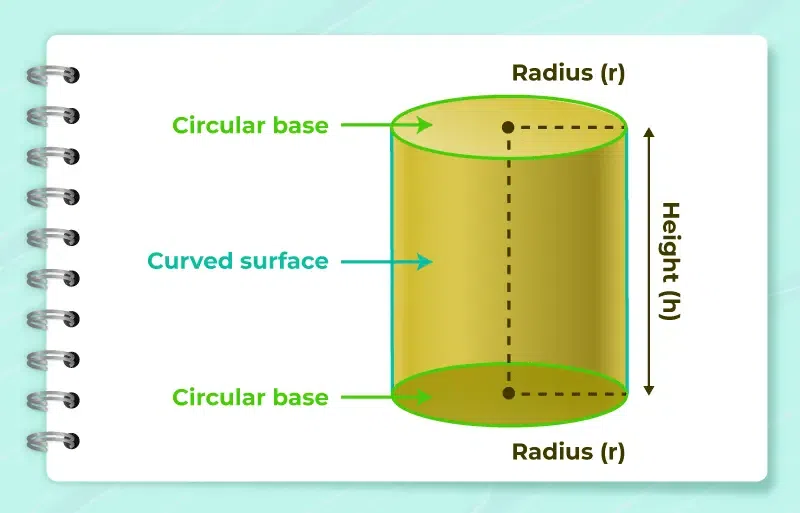
Concepts Related to Cylinders
Any 3-D figure has faces, vertices, and edges which define the features of that figure. The two circular faces of the cylinder are parallel to each other and the distance between them is the height of the cylinder.
- **Faces: In a cylinder, there are a total of 3 faces i.e. 2 flat circular faces + 1 curved face.
- **Edges: In a cylinder, there are 2 circular edges one at the top face and one at the bottom face.
- **Vertices: In a cylinder, there are 0 vertices.
Cylinders are classified into various types, such as **right circular cylinders, **Oblique Cylinders, **Elliptical Cylinders, and **Cylindrical shells or **Hollow Cylinders.
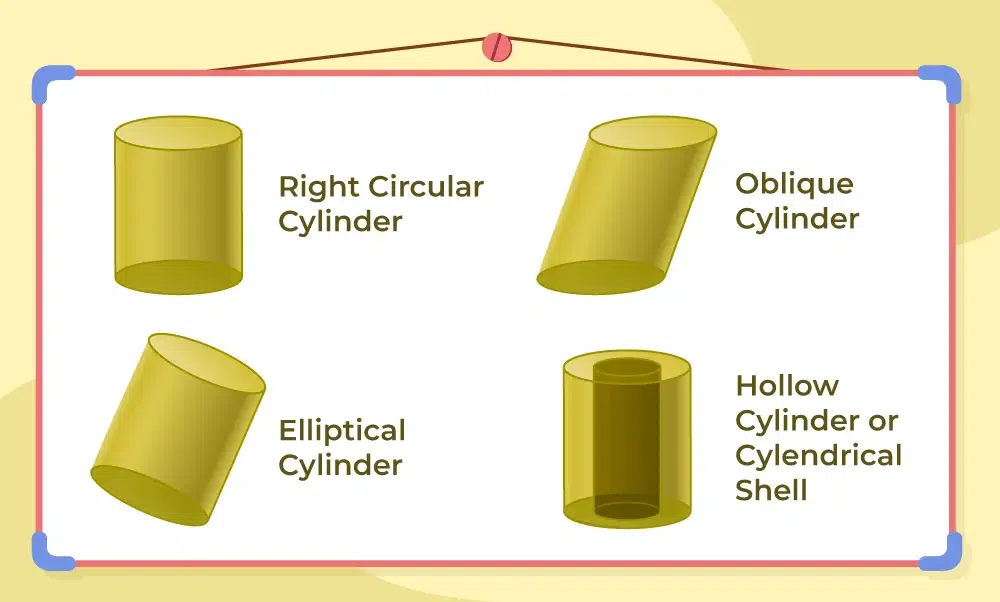
Illustration of Different Types of Cylinders
| **Type of Cylinder | **Description |
|---|---|
| Right Circular Cylinder | A cylinder where the axis is perpendicular to the center of the base. |
| Oblique Cylinder | A cylinder where the axis is not perpendicular to the center of the base, meaning the axis forms an angle other than a right angle with the center of the base. |
| Elliptical Cylinder | A cylinder with elliptical-shaped bases. |
| Cylindrical Shells or Hollow Cylinders | These are made of two right-circular cylinders, one inside the other, creating a hollow space. The axis is perpendicular to the central base and is common to both cylinders. Examples include hollow pipes and toilet paper rolls. |
Cylinder Formulas
A cylinder has two major formulae, i.e., surface area and volume. A cylinder has two kinds of surface areas: the curved surface area the lateral surface area, and the total surface area.
So, the three major formulae related to a cylinder are :
| **Property | **Formula |
|---|---|
| Volume (V) | V = πr²h |
| Curved Surface Area (CSA) | CSA = 2πrh |
| Total Surface Area (TSA) | TSA = 2πrh + 2πr² = 2πr(h + r) |
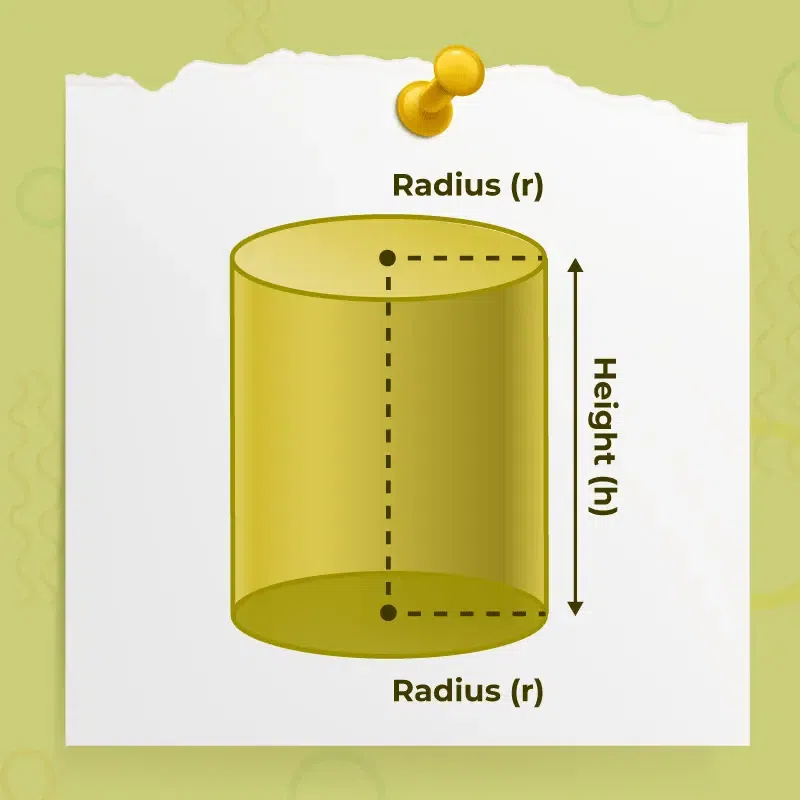
**Volume of Cylinder
The volume of a cylinder is the density or amount of space occupied by the cylinder.
Let us assume that a cylindrical-shaped container is filled with refined oil. Now, to calculate the amount of oil, we need to determine the volume of the cylindrical-shaped container.
Now, the volume of a cylinder = Area of a circle × height
Volume (V) = πr2 × h cubic units
**Volume of Cylinder Formula:
Volume of a cylinder = (πr2h) cubic units
Where,
- **r is the radius of the cylinder, and
- **h is the height of the cylinder.
**Read More On Volume of Cylinder
**Curved Surface Area (CSA) of Cylinder
The curved surface area, or lateral surface area of a cylinder, is the space enclosed between the two parallel circular bases.
The formula for the curved surface area, or lateral surface area, of a cylinder, is given as,
Curved Surface Area (CSA) = Circumference × Height
**Formula of CSA of cylinder :
Curved Surface Area (CSA) = 2πrh
Where,
- **r is the radius of the cylinder, and
- **h is the height of the cylinder.
**Read More On Surface Area of the Cylinder
**Total Surface Area (TSA) of Cylinder
The total surface area of a cylinder is the sum of the area of the curved surface or lateral surface and the areas of the two circular bases.
We know that,
Curved Surface Area (CSA) = (2 π r h) square units
Area of a Circle = πr2 square units
Total Surface Area (TSA) of cylinder = Curved Surface Area + 2(Area of a circle)
**The formula for the TSA of a cylinder :
Total Surface Area (TSA) = [2πr(h + r)] square units
where,
- **r is the radius of the cylinder, and
- **h is the height of the cylinder.
**Related Reads :
Solved Examples on Cylinder
Let's solve some example problems using the formulas related to **the.
**Example 1: Determine the curved surface area of the cylinder with a radius of 8 inches and a height of 15 inches.
**Solution:
Given,
Radius = 7 inches and
The height of the cylinder = 15 inches.We have,
The curved surface area of the cylinder = (2πrh) square units
⇒ CSA of Cylinder = 2 × (22/7) × 8 × 15
⇒ CSA of Cylinder = 754.285 sq. in**Hence, the curved surface area of the cylinder is 754.285 sq. in.
**Example 2: Calculate the volume of a cylindrical-shaped water container that has a height of 18 cm and a diameter of 12 cm.
**Solution:
Given: Height = 18 cm,
Diameter = 12 cmAs Diameter = 2 × radius,
⇒ 2 × radius = 12 cm
⇒ r = 6 cmWe have,
Volume of Cylinder = (π r2 h) cubic units
⇒ V = (22/7) × (6)2 × 18
⇒ V = 2,034.72 cm3**Hence, volume of the cylindrical-shaped water container is 2034.72 cm 3 .
**Example 3: Determine the height of the cylinder if its volume is 625 cubic units and its radius is 5 units.
**Solution:
Given: Volume = 625 cubic units, and Radius = 5 units
Let the height of the cylinder be h units.
We know that, Volume of a cylinder = π r2 h
⇒ 625 = (22/7) × (5)2 × h
⇒ h = (625/25) × (7/22)
⇒ h = 7.95 units**Hence, height of the given cylinder is 7.95 units
**Example 4: Find the radius of the cylinder if its curved surface area is 550 sq. cm and its height is 14 cm.
**Solution:
Given: Curved Surface Area of cylinder = 550 sq. cm, and Height of Cylinder = 14 cm
Let the radius of cylinder be r cm.
We know that, Curved Surface Area of the cylinder = 2πrh
⇒ 550 = 2 × (22/7) × r × 14
⇒ 88r = 550
⇒ r = 550/88
⇒ r = 6.25 cm**Hence, radius of the given cylinder is 6.25 cm.