Surface Area of a Cylinder (original) (raw)
Last Updated : 24 Mar, 2026
The surface area of a cylinder is the total area occupied by all its outer surfaces, including the curved surface and the two circular bases. It represents the complete exterior covering of the cylinder and is measured in square units.
The surface area of a cylinder is divided into two components:
**Curved Surface Area of a Cylinder (CSA)
The curved surface area (CSA) is the area covered by its curved outer surface, excluding the top and bottom circular bases. It represents the lateral covering of the cylinder.
For a cylinder with radius _r and height _h:
Curved Surface Area (CSA) = 2πrh square units
where
- _r = radius,
- _h = height,
- π ≈ 3.14 or 22/7
Total Surface Area of a Cylinder (TSA)
The total surface area is the sum of the areas of its two circular bases and its curved surface. It represents the complete outer covering of the cylinder.
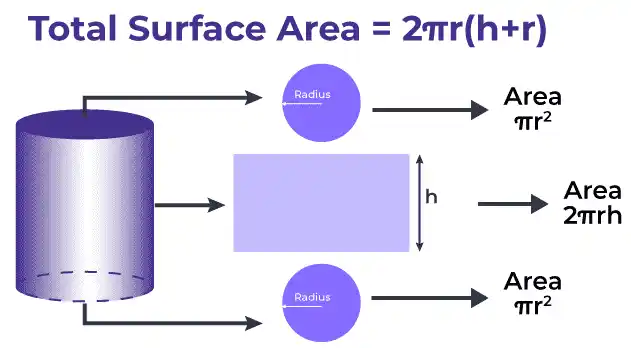
The above figure shows how a cylinder can be opened into a rectangle along with two circular bases.
- The rectangle represents the curved surface, where its length is equal to the circumference of the base (2πr) and its height is _h. Hence, the curved surface area is 2πrh.
- The two circles represent the bases, each having an area of πr². Adding these areas gives the total surface area of the cylinder as 2πr² + 2πrh.
For a cylinder with radius _r and height _h:
Total Surface Area (T.S.A) = 2πrh + 2πr2 = 2πr(h+r) square units.
Where,
- h is Height
- r is Radius of Cylinder
**Example: Find the total surface area of a cylinder with radius 5 cm and height 8 cm.
**Solution:
TSA = 2πr(r + h)
= 2 × 3.14 × 5 × (5 + 8)
= 408.4 cm² (approx.)
Related Articles
Sample Problems
**Problem 1: Compute the total surface area of the cylinder with a radius of 5 cm and a height of 10 cm.
**Solution:
Since, we know,
Total surface area of a cylinder, A = 2πr(r+h) square units
Therefore, A = 2π × 5(5 + 10) = 2π × 5(15)
= 2π × 75 = 150 × 3.14
= 471 cm2
**Problem 2: A cylinder has a radius of 7 cm and a height of 20 cm. A thin sheet is used to cover the entire outer surface of the cylinder. Find the total surface area required.
**Solution:
Given: r = 7 cm, h = 20 cm
TSA = 2πr(r + h)
= 2 × (22/7) × 7 × (7 + 20)
= 2 × 22 × 27
= 1188 cm²
**Problem 3: A cylindrical pipe has an inner radius of 5 cm and a height of 28 cm. Only the outer curved surface is to be painted. Find the curved surface area to be painted.
**Solution:
Given: r = 5 cm, h = 28 cm
CSA = 2πrh
= 2 × (22/7) × 5 × 28
= 2 × 22 × 5 × 4
= 880 cm²
**Problem 4: A water tank has a radius of 40 inches and a height of 150 inches. Find the area.
**Solution:
Water tank is cylindrical in nature.
Total Surface Area of a cylinder is given by, 2πr(h+r)
TSA = 2 × 22/7 × 40(150 + 40)
TSA = 2 × 22/7 × 40 × 190
TSA = 440/7 × 7600
TSA = 3344000/ 7
Area = 47,7142.857 sq.inches.
**Problem 5: The height of a cylinder is twice its radius. If the radius is 6 cm, find the total surface area of the cylinder.
**Solution:
Given: r = 6 cm, h = 2r = 12 cm
TSA = 2πr(r + h)
= 2 × 3.14 × 6 × (6 + 12)
= 2 × 3.14 × 6 × 18
= 2 × 3.14 × 108
= 678.24 cm²