Arithmetic Operations (original) (raw)
Last Updated : 13 May, 2026
Arithmetic Operations are the basic mathematical operations: Addition, Subtraction, Multiplication, and Division that are used for calculations.
These operations form the foundation of mathematics and are essential in daily life, such as sharing items, calculating bills, solving time and work problems, and interpreting data.
The term "Arithmetic" comes from the Greek word "arithmos," meaning "numbers." It is the branch of mathematics focused on the study of numbers and their operations.
Basic Arithmetic Operations
We can perform these four arithmetic operations for any kind of number including fractions, rational numbers, and complex numbers. These basic mathematical operations are mentioned below:
Addition
Addition is one of the basic arithmetic operations where two or more numbers (called addends) are combined to get a total (called the sum). When we combine two or more numbers or quantities we say are adding It is represented by the plus sign (****+**).
- Addition is helpful in totaling the bill at a shop, the amount of money you receive from different sources, the amount you spend at different places, and in the counting of numbers or quantities.
- In the counting of numbers, the next number is obtained by adding 1 to the previous number. We can say that Addition is the backbone of counting.
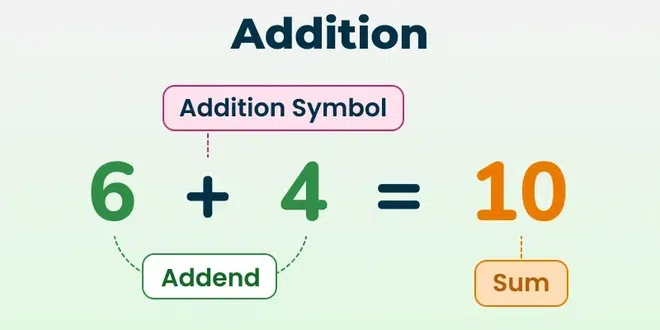
Addition
Subtraction
Subtraction is the process of finding the difference between two numbers. It is represented by the ****(-)** symbol and is the opposite of addition.
- Subtraction helps calculate things like how much change you get after paying more than a bill, how much bigger or smaller one number is compared to another, and how much money you save after expenses.
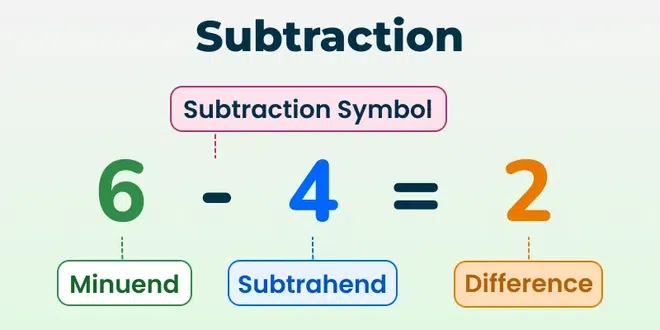
Subtraction
Multiplication
Multiplication is the process of adding a number to itself repeatedly for a specified number of times. Instead of lengthy addition, we multiply the number by the number of repetitions. Multiplication is represented by the cross (⨯) symbol.
For Example, 4 + 4 + 4 + 4 + 4 = 20, can write it as 4 ⨯ 5 = 20. Thus, multiplication is often referred to as **repeated addition.

Multiplication
Division
Division is the reverse operation of Multiplication. It is the method of reducing a number by continuous subtraction. Division is represented by the (÷) symbol. For Example, if we divide 8 by 2, i.e. 8 ÷ 2, it means we continuously subtract 2 from 8 until we get a number less than 2. We perform this as
**8 - 2 = 6
**6 - 2 = 4
**4 - 2 = 2
**2 - 2 = 0
Here, in the fourth step, we get 0 which is less than two. Now we will stop the process here, and the number of steps involved is 4, hence the result of division is 4. Division has got its application from distributing sweets among your friends equally to calculate the per capita income of a country. Let's learn about the components of division.
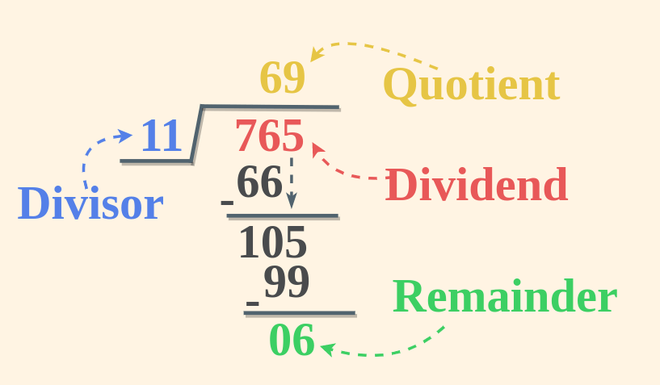
Division
Learn More, Long Division Method.
Arithmetic Properties
The properties followed by arithmetic operations are listed below:
- **Closure Property : Closure Property is followed by all four arithmetic operations however their meaning differ for different kinds of numbers.
- **Commutative Property : Commutative Property is followed by addition and multiplication. Commutative Property of Addition states ****(a + b) = (b + a)** and the Commutative Property of Multiplication states ****(a ⨯ b) = (b ⨯ a)**.
- **Associative Property : Associative Property is followed by addition and multiplication only. Associative Property of Addition states that **a + (b + c) = (a + b) + c and the Associative Property of Multiplication states that **a ⨯ (b ⨯ c) = (a ⨯ b) ⨯ c.
- Distributive Property : Distributive Property. is followed by multiplication over addition and subtraction. The distributive property of multiplication over addition is given by a ⨯ (b + c) = a ⨯ b + a ⨯ c and the Distributive Property over Subtraction is given as **a ⨯ (b - c) = a ⨯ b - a ⨯ c.
- **Additive Identity : The property of additive identity states that when zero is added to any number it results in the number itself. Additive Identity is given by **a + 0 = a
- **Multiplicative Identity : The property of multiplicative identity states that if any number is multiplied by 1 it results in the number itself.
- **Additive Inverse : The property of additive inverse states that if a number is added with the negative of itself, the sum is zero. It is expressed as **a + (-a) = 0.
- **Multiplicative Inverse : The property of multiplicative inverse states that if a number is multiplied by its reciprocal, the result is 1. It is expressed as **a ⨯ 1/a = 1.
Table of Arithmetic Properties
Let a, b be two integers.
| Property | Addition | Subtraction | Multiplication | Division |
|---|---|---|---|---|
| Closure Property | a + b ∈ Z | a - b ∈ Z | a ⨯ b ∈ Z | a / b ∉ Z |
| Commutative Property | (a + b) = (b + a) | (a - b) ≠ (b - a) | (a ⨯ b) = (b ⨯ a) | (a / b) ≠ (b / a) |
| Associative Property | a + (b + c) = (a + b) + c | a -(b - c) ≠ (a - b) - c | a ⨯ (b ⨯ c) = (a ⨯ b) ⨯ c | a / (b / c) ≠ (a / b) / c |
| Distributive Property | a ⨯ (b + c) = a ⨯ b + a ⨯ c | a ⨯ (b - c) = a ⨯ b - a ⨯ c | Not applicable | Not applicable |
| Identity | a + 0 = 0 + a = a | Not applicable | 1 ⨯ a = a ⨯ 1 = a | Not applicable |
| Inverse | a + (-a) = 0 | Not applicable | a ⨯ 1 / a = 1 | Not applicable |
Solved Example of Arithmetic Operations
**Example 1. The sum of the two numbers is 100, and their difference is 60. Find the numbers.
**Solution:
Let the two numbers be x and y
Now, according to the question
x + y = 100 . . . (i)
x - y = 60 . . . (ii)From equation (i)
⇒ x = 100 - yTherefore, putting the value of x
⇒ 100 - y - y = 60
⇒ 100 - 2y = 60
⇒ 2y = 40
⇒ y = 20Putting the value of y in equation (ii)
⇒ x - y = 60
⇒ x = 60 + 20
⇒ x = 80Therefore, the numbers are 80 and 20 respectively.
**Example 2: Simplify 50 + 10(9) - 9
**Solution:
50 + 10(9) - 9
⇒ 50 + 90 - 9
⇒ 140 - 9
⇒ 131
**Example 3: If the sum of two numbers x and a + 5 is 39. Find the value of x.
**Solution:
According to the question,
x + (x + 5) = 39
⇒ 2x + 5 = 39Subtracting 5 on both sides,
2x + 5 - 5 = 39 - 5
⇒ 2x = 34
x = 34/2 = 17Therefore, the value of x is 17.
**Example 4: The difference between the two numbers is given by finding the value of p.
**Solution:
According to the equation,
p - 4 = 11Adding 4 to the both sides,
p - 4 + 4 = 11 + 4
⇒ p = 15Therefore, the value of p is 15.
**Example 5: Find the valueof y in thegiven equation y - 9 = 3.
**Solution:
According to the question,
y - 9 = 3
⇒ y = 9 + 3
⇒ y = 12Therefore, the value of y is 12.
**Example 6: Simplify: -1[(3 - 28) ÷ 5] - 2 × 24 ÷ 6
**Solution:
-1[(3 - 28) ÷ 5] - 2 × 24 ÷ 6
⇒ -1 × [(-25) ÷ 5] - 2 × 24 ÷ 6
⇒ -1 × [-5] - 2 × 24 ÷ 6
⇒ 5 - 2 × 24 ÷ 6
⇒ 5 - 48 ÷ 6
⇒ 5 - 8
⇒ -3
**Example 7: Solve 2x = 10
**Solution:
According to question,
⇒ 2 × x = 10Dividing both sides with 2
2 × x/2 = 10/2
⇒ x = 5Therefore, the value of x is 5.
**Example 8: Solve the given equation 5x/4 + 1/2 = 2x - 1/2
**Solution:
5x/4 + 1/2 = 2x - 1/2
Multiplying both sides with 4
4(5x/4 + 1/2) = 4(2x - 1/2)
⇒ 5x + 2 = 8x - 2
⇒ -3x + 2 = -2Subtracting both sides with 2
-3x + 2 - 2 = -2 - 2
⇒ x = -4/-3
⇒ x = 4/3Therefore, the value of x is 4/3.
Arithmetic Operations - Practice Problems
**Question 1: A student purchased a copy for 20 rupees and a pen for 5 rupees then how much money did he spend in total?
**Question 2: There were 5 glasses on a table, 2 of them fell down and got broken. How many unbroken glasses are left?
**Question 3: In a stack of books there are 10 books, how many books are in total in 3 such stacks?
**Question 4: John has 20 dollars. He purchased toys worth 4 dollars each. How many toys can he purchase?
**Question 5: A farmer has 50 apples. He sold 15 apples at the market. How many apples does he have left?
**Question 6: Sarah had 30 candies. She gave 12 candies to her friend. How many candies does she have now?
**Question 7: A car travels 60 kilometers per hour. How far will it travel in 3 hours?
**Question 8: A store sells notebooks for 15 rupees each. If you buy 8 notebooks. How much will you spend in total?
**Question 9: A baker baked 24 cookies. If he packs them in boxes of 6. how many boxes will he need?
**Question10: Emily read 45 pages of a book on Monday and 30 pages on Tuesday. How many pages did she read in total?