Derivative of Sin x (original) (raw)
Last Updated : 23 Jul, 2025
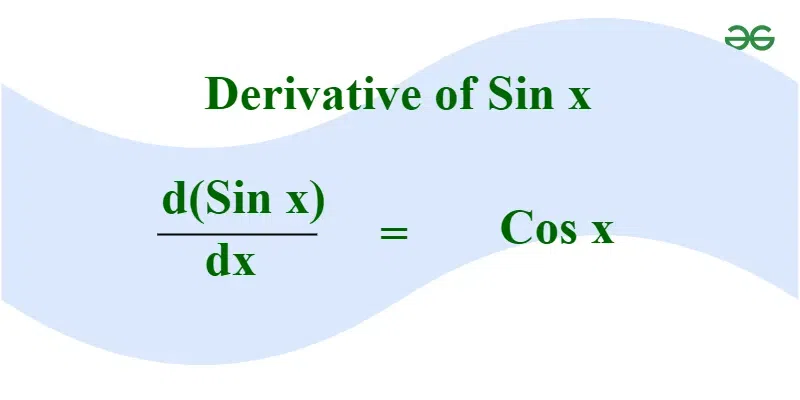
**Derivative of Sin x is Cos x. Understanding the **derivative of sin x is essential for mastering calculus and solving a range of mathematical problems. **Differentiation is a fundamental concept in calculus, which involves finding the rate of change of a function.
In this article, we will learn about the derivative of sin x and its formula including the proof of the formula using the first principle of derivatives, quotient rule, and chain rule as well. Other than that, we have also provided some solved examples for better understanding and answered some FAQs on derivatives of sin x as well. Let's start our learning on the topic Derivative of Sin x.
Table of Content
- What is Derivative of Sin x?
- Graphical Interpretation of Sin x and its Derivative
- Proof of Derivative of Sin x
- Applications of the Derivative of Sin x
- Solved Examples on Derivative of Sin x
- Practice Questions on Derivative of Sin x
What is Derivative of Sin x?
Among the trig derivatives, the derivative of the sinx is one of the derivatives. The derivative of the sin x is cos x. The derivative of sin x is the rate of change with respect to angle i.e., x. The resultant of the derivative of sin x is cos x.
Derivative of Sin x Formula
The formula for the derivative of sin x is given by:
****(d/dx) [sin x] = cos x**
**or
****(sin x)' = cos x**
Graphical Interpretation of Sin x and its Derivative
This visualization will help in understanding how the derivative of sin x behaves graphically.

Visually, the graph of sin x is a smooth wave that oscillates between -1 and 1. The derivative of sin x, which is cos x, represents the slope of the tangent line at any point on the sin x curve. At the peaks of the sin x graph, where the function reaches its maxima (π/2, 5π/2, etc.), the derivative is zero because the slope of the tangent line is horizontal.
Proof of Derivative of Sin x
The derivative of sin x can be proved using the following ways:
- By using the First Principle of Derivative
- By using Quotient Rule
- By using Chain Rule
Derivative of Sin x by First Principle of Derivative
To prove derivative of sin x using First Principle of Derivative, we will use basic limits and trigonometric formulas which are listed below:
- sin (x + y) = sin x cos y + sin y cos x
- lim x→0 [sin x/x] = 1
- lim x→0 [(cos x - 1)/x] = 0
Let's start the proof for the derivative of sin x
By the First Principle of Derivative
(d/dx) sin x = limh→0 [sin(x + h) - sinx]/[(x + h) - x]
⇒ (d/dx) sin x = limh→0 [sinx cosh + sinh cosx - sinx]/ h [By 1]
⇒ (d/dx) sin x = limh→0 [{sinx (cosh - 1)}/h + {(sinh/h) cosx}]
⇒ (d/dx) sin x = limh→0 {sinx (cosh - 1)}/h + limh→0{(sinh/h) cosx} [By 2 and 3]
⇒ (d/dx) sin x = sinx (0)+ (1)cosx
**⇒ (d/dx) sin x = cosx
Derivative of Sin x by Quotient Rule
To prove derivative of sin x using Quotient rule, we will use basic derivatives and trigonometric formulas which are listed below:
- sin x = 1/cosec x
- (d/dx) [u/v] = [u'v - uv']/v2
Let's start the proof of the derivative of sin x
y = sin x
y = 1/cosec x
⇒ y' = (d/dx) [1/cosec x]
Applying quotient rule
y' = [(d/dx) (1) cosec x - 1.(d/dx)(cosec x)]/(cosec x)2
⇒ y' = [(0) cosec x - (1) (-cosec x cot x)]/(cosec x)2
⇒ y' = (cosec x cot x)/(cosec x)2
⇒ y' = cot x/cosec x
⇒ y' = (cos x/sin x )/( 1/sin x)
**⇒ y' = cos x
Derivative of Sin x by Chain Rule
To prove derivative of sin x using chain rule, we will use basic derivatives and trigonometric formulas which are listed below:
- sin x = cos [(π/2) - x]
- cos x = sin [(π/2) - x]
Let's start the proof of the derivative of sin x
y = sin x
y = cos [(π/2) - x] {From Formula 1}
⇒ y' = (d/dx){cos [(π/2) - x]}
By applying chain rule
y' = (d/dx){cos [(π/2) - x]}(d/dx)[(π/2) - x]
⇒ y' = {-sin [(π/2) - x]}(0 - 1)
⇒ y' = {-sin [(π/2) - x]}(- 1)
⇒ y' = sin [(π/2) - x]
⇒ y' = cos x
**Also, Check
- Differentiation of Trigonometric Functions
- Derivative of Inverse Trigonometric Functions
- Differentiation Formulas
- Derivative of Sin x
- Differentiation of Trigonometric Functions
**Applications of the Derivative of Sin x
The **derivative of sin x has many applications across various fields:
- **Physics: In **simple harmonic motion, sin x represents oscillations, and the derivative, **cos x, gives the velocity of the oscillating object.
- **Engineering: **Signal processing often involves sinusoidal waveforms, where the derivative is used to analyze wave patterns.
- **Economics: **Cyclic models in economics, such as seasonal trends, are often modeled using trigonometric functions, and their rates of change are crucial for prediction.
Solved Examples on Derivative of Sin x
**Example 1: Find the derivative of sin 4x.
**Solution:
Let y = sin 4x
⇒ y' = (d/dx) [sin 4x]
Applying chain rule
y' = (d/dx) [sin 4x].(d/dx) (4x)
⇒ y' = (cos 4x)4
⇒ y' = 4cos4x
**Example 2: Evaluate the derivative f(x) = (x 3 + 5x 2 + 2x + 7)sinx
**Solution:
f(x) = (x3 + 5x2 + 2x + 7)sinx
⇒ f'(x) = (d /dx)[(x3 + 5x2 + 2x + 7)sinx]
Applying product rule
f'(x) = (d /dx)[(x3 + 5x2 + 2x + 7)]sinx + (x3 + 5x2 + 2x + 7)(d /dx)[sinx]
⇒ f'(x) = (3x2 + 10x +2)sinx + (x3 + 5x2 + 2x + 7)cosx
**Example 3: Find the derivative of p(x) = (4x 2 **+ 9)/sinx
**Solution:
p(x) = (4x2 + 9)/sinx
⇒ p'(x) = (d /dx)[(4x2 + 9)/sinx]
Applying quotient rule
p'(x) = [(d /dx)(4x2 + 9) sin x - (4x2 + 9)(d /dx)sin x]/ sin2x
⇒ p'(x) = [8xsin x - (4x2 + 9)cos x]/ sin2x
**Example 4: Find the derivative of the function (cosx) sinx
**Solution:
Let y = (cosx)sinx
Taking log
ln y = ln (cosx)sinx
⇒ ln y = (sin x) ln (cos x)
Differentiating the above equation, we get
(1/y) y' = (d/dx)[(sin x) ln (cos x)]
Applying product rule
(1/y) y' = (d/dx)(sin x) [ln (cos x)]+ (sin x)(d/dx)[ln (cos x)]
⇒ (1/y) y' = cos x [ln (cos x)]+ (sin x)[(-sinx)/(cos x)]
⇒ (1/y) y' = cos x {ln (cos x)} - sin x tan x
⇒ y' = y[cos x {ln (cos x)} - sin x tan x]
⇒ y' = (cosx)sinx [cos x {ln (cos x)} - sin x tan x]
**Example 5: Evaluate the derivative sin 5x + x.sinx
**Solution:
Let z = sin 5x + xsinx
Differentiating
z' = (d/dx) [sin 5x + xsinx]
⇒ z' = (d/dx) sin 5x + (d/dx)[xsinx]
Applying chain rule and product rule
z' = 5 cos 5x + (d/dx)(x)sinx + x(d/dx)(sinx)
⇒ z' = 5 cos 5x + sinx + xcosx
**Example 6: Find derivative of sin -1 x.
**Solution:
(d /dx) [sin-1 x] = 1/√[1 - x2] [From Formula]
**Example 7: Find derivative of sin x 2
**Solution:
By applying chain rule
(d/dx) [sin x2] = (d/dx) [sin x2](d/dx) [x2]
⇒ (d/dx) [sin x2] = [cos x2][2x]
⇒ (d/dx) [sin x2] = 2x cos x2
**Example 8: Find derivative of sin x. cos x
**Solution:
By applying product rule
(d/dx) [sin x. cos x] = (d/dx) [sin x] cos x + sin x (d/dx) [cos x]
⇒ (d/dx) [sin x. cos x] = cos x. cos x + sin x (-sin x)
⇒ (d/dx) [sin x. cos x] = cos2 x - sin2 x
⇒ (d/dx) [sin x. cos x] = cos 2x
**Example 9: Find derivative of x sin x
**Solution:
By applying product rule
⇒ (d/dx) [x sin x] = (d/dx) [x] sin x + x (d/dx) [sin x]
⇒ (d/dx) [x sin x] = (1) sin x + x cos x
⇒ (d/dx) [x sin x] = sin x + x cos x
**Example 10: What is derivative of sin x and cos x
**Solution:
(d/dx) sin x = cos x
⇒ (d/dx) cos x = -sin x
Practice Questions on Derivative of Sin x
**Q1. **Find the derivative of sin 7x
**Q2. Find the derivative of x 2 .sinx
**Q3. Evaluate: (d/dx) [sin x/(x 2 + 2)]
**Q4. Evaluate the derivative of: sin x. tan x
**Q5. Find: (tan x) sin x
Conclusion
The derivative of the sine function, sin(x), is the cosine function, cos(x). Mathematically, if f(x)=sin(x), then f′(x)=cos(x). This result comes from the limit definition of the derivative and the fundamental properties of trigonometric functions. The derivative of sin(x) is cos(x).The relationship is pivotal in calculus, especially in solving problems involving periodic motion, wave analysis, and oscillations. The fact that the derivative of sin(x) is cos(x) also reflects the intrinsic connection between these two functions, as they are phase-shifted versions of each other.Derivative of sin(x) tells you something about the rate of change of the sine function at any given point. If sine is a wave, cosine tells you whether the wave is rising, falling, or at a peak/trough at any given point. Imagine the sine function as a wave. The derivative, cosine, tells you if the wave is currently going up, down, or is flat (neither going up nor down).