Difference of Sets (original) (raw)
Last Updated : 1 Oct, 2025
The difference of sets is the operation defined on sets; it is a way to find elements which is present in one set but not in the other. It is also called the set-theoretic difference or complement of one set relative to another.
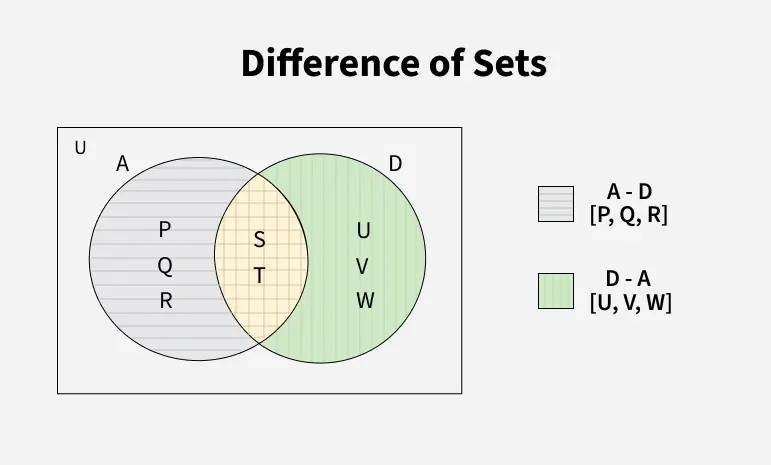
In the figure above, for two sets A and D, the difference of sets A−D is the set of all elements that are in A but not in D. Similarly, D−A is the set of elements in D but not in A.
**A– D = {x / x ∈ A and x ∉ D}: removing elements of A ∩ D from set A.
OR
**D **– A = {x / x ∈ D and x ∉ A}: removing elements of D ∩ A from set D.
How to Find the Difference of Sets?
The difference between sets can be found with the help of the following steps:
- **Step 1: Identify the given non-empty sets and write them in set-builder form.
- **Step 2: Identify the order of difference, i.e., if we are asked to find **P – Q or **Q – P.
- **Step 3: Express the difference in mathematical form.
- **Step 4: Strike off all the common elements present in both the given sets.
- **Step 5: All elements left in the first set after removing common elements are the difference of the two sets.
**Example: If P = {5, 10, 15, 20, 25, 30} and Q = {10, 20, 30, 40, 50, 60}, then find:
- P – Q
- Q – P
**Solution:
**P – Q implies all elements present in P and not in Q.
**Step 1. Express the difference in mathematical form.
P – Q = {5, 10, 15, 20, 25, 30} – {10, 20, 30, 40, 50, 60}**Step 2. Strike off all the elements present in both P and Q.
{5,10, 15,20, 25,30} – {10, 20, 30, 40, 50, 60}.
P – Q is the set of elements left in set P afterwards, i.e.,
**P – Q = ****{5, 15, 25}**.**Now, Q – P implies all elements present in Q and not in P.
**Step 1. Express the difference in mathematical form.
Q – P = {10, 20, 30, 40, 50, 60} – {5, 10, 15, 20, 25, 30}.**Step 2. Strike off all the elements present in both P and Q.
{10, 20, 30, 40, 50, 60} – {5,10, 15,20, 25,30}.
Q – P is the set of elements left in set Q afterwards, i.e.,
**Q – P = ****{40, 50, 60}**.
Order of Difference
While finding the difference of two sets, it is very important to keep the order of the difference in mind. Just like the subtraction of two numbers is not commutative (9 – 0 ≠ 0 – 9), the difference of any two sets is not commutative, i.e., P – Q ≠ Q – P. This means that changing the order of the sets while subtracting may alter the results.
**Example: If P = {4, 5, 6, 7, 8} and Q = {6, 7, 8, 10}, is P – Q = Q – P?
**Solution:
LHS = P – Q = {4, 5, 6, 7, 8} - {6, 7, 8, 10} = {4, 5}
RHS = Q – P = {6, 7, 8, 10} - {4, 5, 6, 7, 8} = {10}
LHS ≠ RHS**Thus, P – Q ≠ Q – P
Difference of Three Sets
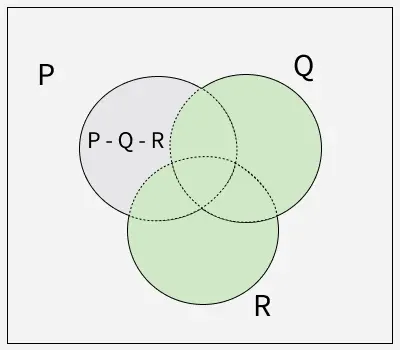
If P, Q, and R are three non-empty sets, then the difference between the three of them can be depicted as **P – Q – R.
This implies all the elements present in set P but not in sets Q and R. This is depicted in the Venn diagram below, where the pink-shaded region depictsP – Q – R and the blue-shaded portion is the area not included in the difference.
Symmetric Difference of Sets
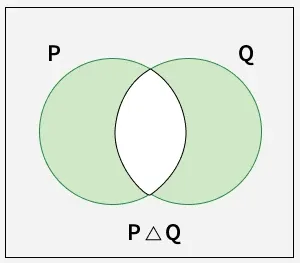
The symmetric difference of sets P and Q is expressed as P Δ Q and defined as
**P Δ Q = (P - Q) U (Q - P)
OR
**P Δ Q = (P ∪ Q) - (P ∩ Q)
Venn Diagram of Symmetric Difference of Sets
In the Venn diagram below, the pink-shaded portion represents P Δ Q.
**Example: If P = {4, 5, 6, 7, 8} and Q = {6, 7, 8, 10}, find P Δ Q.
**Solution:
- **Step - 1: Find P - Q.
P - Q = {4, 5, 6, 7, 8} - {6, 7, 8, 10} = {4, 5}- **Step - 2: Find Q - P.
Q - P = {6, 7, 8, 10} - {4, 5, 6, 7, 8} = {10}- **Step - 3: Find P Δ Q = (P - Q) U (Q - P).
P Δ Q = (P - Q) U (Q - P) = {4, 5} U {10} = ****{4, 5, 10}**
**Properties of Difference of Sets
If P and Q are two sets, then their difference has the following properties:
- P – Q = P ∩ Q'
- P – P = ∅
- P – ∅ = P
- ∅ – P = ∅
- P – Q = P, given that P ∩ Q = ∅
- P – Q = Q – P = ∅, if P = Q
- If P ⊂ Q, then P – Q = ∅
- n(P Δ Q) = n(P – Q) + n(Q – P)
- n(P Δ Q) = n(P U Q) – n(P ∩ Q)
**Related Articles
**Solved Problems on Difference of Sets
**Problem 1. Find the difference W _– N, where W is the set of whole numbers and N is the set of natural numbers.
**Solution:
Step 1. Write the given sets in set- builder form.
W = {0, 1, 2, 3, 4, 5,....,∞}
N = {1, 2, 3, 4, 5,....,∞}
W _– N implies all elements of set W and none of set N.Step 2. Write the difference in mathematical form: W _– N = {0, 1, 2, 3, 4, 5,....,∞} _– {1, 2, 3, 4, 5,....,∞}
Step 3. Strike out all the common elements in both W and N. {0,
1, 2, 3, 4, 5,....,∞} _– {1, 2, 3, 4, 5,....,∞}.All elements left in W represent the difference W _– N.
**Hence, W **– N = {0}.
**Problem 2. Prove P – (Q ∪ R) = (P – Q) ∩ (P – R), if P = {1, 2, 4, 5}; Q = {2, 3, 5, 6} and R = {4, 5, 6, 7}.
Solution:
Let us consider the LHS first.
(Q ∪ R) = {x: x **∈ Q or x **∈ R}
⇒ Q ∪ R = {2, 3, 4, 5, 6, 7}.Since P – (Q ∪ R) can be expressed as {x **∈ P: x ∉ (Q ∪ R)}.
⇒ P – (Q ∪ R) = {1}Let us consider the RHS now.
P – Q is defined as {x **∈ P: x ∉ Q}
P = {1, 2, 4, 5}
Q = {2, 3, 5, 6}
⇒ P – Q = {1, 4}Now, P – R is defined as {x **∈ P: x ∉ R}
⇒ P – R = {1, 2}(P – Q) ∩ (P – R) = {x: x **∈ (P – Q) and x **∈ (P – R)}.
= {1}
_∴ LHS = RHSHence verified.
**Problem 3. If S and T are two sets, prove that: (S ∪ T) – T = S – T.
**Solution:
Let us consider LHS first.
(S ∪ T) – T
= (S – T) ∪ (T – T)
= (S – T) ∪ ϕ (since, T – T = ϕ)
= S – T (since, x ∪ ϕ = x for any set)
= RHS_Hence proved.
**Problem 4. If n(S) = 69, n(T) = 55, and n(S ∩ T) = 10, then what is n(S Δ T)?
**Solution:
Since, n(S U T) = n(S) + n(T) - n(S∩ T)
= 69 + 55 - 10
= 114According to the symmetric difference of sets,
n(S Δ T) = n(S U T) - n(S ∩ T)
= 114 - 10
**n(S Δ T) **= 104
**Problem 5. If P, Q, R are three sets, such that P ⊂ Q, then prove that R – Q ⊂ R – P.
**Solution:
Given, P ⊂ Q
To prove: R – Q ⊂ R – P
Let us consider, x ∈ R – Q
⇒ x ∈ R and x ∉ Q
⇒ x ∈ R and x ∉ P
⇒ x ∈ R – PThus, x ∈ R – Q ⇒ x ∈ R – P
This is true for all x ∈ R – Q
_∴ R – Q ⊂ R – PHence proved.
Practice Questions on Difference of Sets
**Problem 1: Find the difference X – Y, where X is the set of all integers from 1 to 10, and Y is the set of all odd numbers from 1 to 10.
**Problem 2: Prove that A – (B ∪ C) = (A – B) ∩ (A – C), if A = {1, 2, 3, 4, 5}, B = {2, 4, 5}, and C = {3, 4, 6}.
**Problem 3: If U = {1, 2, 3, 4, 5, 6}, A = {1, 2, 3}, and B = {3, 4, 5}, find the set (A ∪ B) – A.
**Problem 4: If P = {2, 4, 6, 8}, Q = {1, 2, 3, 4, 5}, and R = {2, 3, 4, 5}, find P – (Q ∩ R).
**Problem 5: If M = {a, b, c, d}, N = {b, c, e, f}, and O = {c, d, g, h}, find (M – N) ∪ (M – O).