Divisibility Rule of 8 with Examples (original) (raw)
Last Updated : 23 Jul, 2025
**Divisibility rules can simplify complex calculations and problem-solving. This guide describes the specific rule for divisibility by 8, providing clear explanations and practical examples.
Divisibility Rule of 8 states that a number is divisible by 8 if the last three digits of the number form a number that is divisible by 8. This rule simplifies the process of determining whether larger numbers can be evenly divided by 8.
**For Example: Check **if 5128 is divisible by 8.
The last three digits are 128.
128 ÷ 8 = 16 (which is a whole number)
Since 128 is divisible by 8, **5128 is divisible by 8.
This article explains the **divisibility by 8 rule provides examples, and offers practice problems to help you understand and apply it effectively.
**The flow chart showing the divisibility rule of 8:
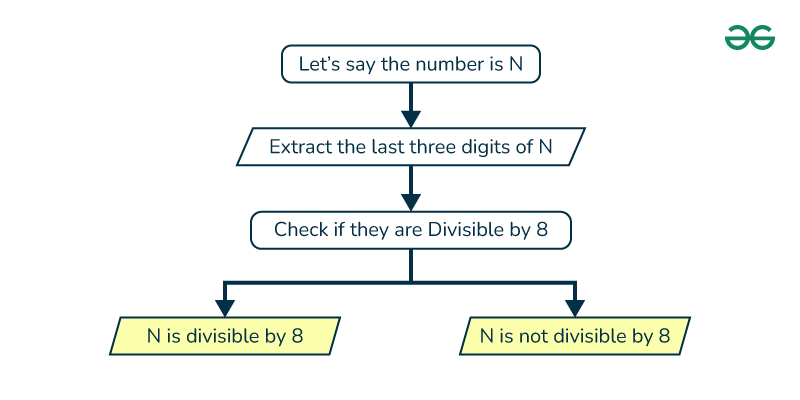
Divisibility Rule of 8
More Examples of Divisibility Rule of 8
**3896 : The last three digits of 3,896 are 896.
896 ÷ 8 = 112, with no remainder.
Therefore, **3,896 is divisible by 8.
**23419 : The last three digits of 23419 are 419.
419 ÷ 8 = 52.375 which is **not a whole number.
Therefore, **23419 is not divisible by 8.
Proof of Divisibility Rule of 8
N = 10n an + 10n-1 an-1 + 10n-2 an-2 + ..... + 102 a2 + 10 a1 + a0
Taking mod 8 of N, we get
N ≡ 0 + 0 + 0 + ⋯ + 102 a2 + 10 a1 + a0 (mod 8) (as 10k, where k ≥ 3, is always divisible by 8)
≡ 100a2 + 10a1 + a0 (mod 8)
Therefore, N ≡ 0 (mod 8) if 100a2 + 10a1 + a0 = \overline{a_2a_1a_0} ≡ 0 (mod 8).
Thus, if the hundreds, tens, and units places of a number taken in that order are divisible by 8, then the number is also divisible by 8.
Divisibility Test of 8 for Large Numbers
Divisibility rules are various rules that are used for making division easy and quick. Smaller numbers can be easily check for divisibility of 8 but for larger numbers divisibility rules are used to check whether they are divisible by 8 or not.
Divisibility rule of 8 states that for very large number check if the last three digits of the number are either 000 or divisible by 8 then the whole number is divisible by 8.
**Also, Check:
| **Divisibility Rule of 13 | **Factors of a Number |
|---|---|
| **Multiplication Table | |
| Divisibility Rule of 7 |
Divisibility Rule of 8 Solved Questions
**Example 1: Check divisible by 8 for 172896.
**Solution:
Given number 172896
To check its divisibility by 8 without performing division operations we checked whether its last three digits are divisible by 3 or not
We can see the last three digits of 172896 are 896
Since,
896/8 = 112 with no remainder
We can say that 172896 is divisible by 8
**Example 2: Check 262899 is divisible by 8 or not.
**Solution:
Given number 262899
To check its divisibility by 8 without performing division operations we checked whether its last three digits are divisible by 3 or not
We can see the last three digits of 262899 are 899
Since,
899/8 = 112.375 (with remainder)
We can say that 262899 is not divisible by 8
**Example 3: Check 5126 is divisible by 8 or not.
**Solution:
Given number 5216
To check its divisibility by 8 without performing division operations we checked whether its last three digits are divisible by 3 or not
We can see the last three digits of 5216 are 216
Since,
216/8 = 27 with no remainder
We can say that 5126 is divisible by 8
**Example 4: Check 9304 is divisible by 8 or not.
**Solution:
Given number 9304
To check its divisibility by 8 without performing division operations we checked whether its last three digits are divisible by 3 or not
We can see the last three digits of 9304 are 304
Since,
304/8 = 38 with no remainder
We can say that 9304 is divisible by 8
Divisibility Rule of 8 Worksheet
Try these problems to practice checking divisibility by 8:
**1. Is 745128 divisible by 8?
**2. Is 930475 divisible by 8?
**3. Is 123008 divisible by 8?
**4. Is 102400 divisible by 8?
**5. Is 123456 divisible by 8?
**6. Determine whether 7852 is divisible by 8.
**7. Check if the number 9340 is divisible by 8.
**8. Is the number 5600 divisible by 8?
**Also Check: **Practice Questions on Divisibility Rules