Divisors in Maths (original) (raw)
Last Updated : 23 Jul, 2025
**In Mathematics, Divisor is the number from which another number is divided, known as the dividend, to determine the quotient and remainder. In **arithmetic, **division is one of the four fundamental operations; other operations are addition, subtraction, and multiplication.
In this article, we will discuss both definitions of a divisor, including the general, and the definition in number theory. 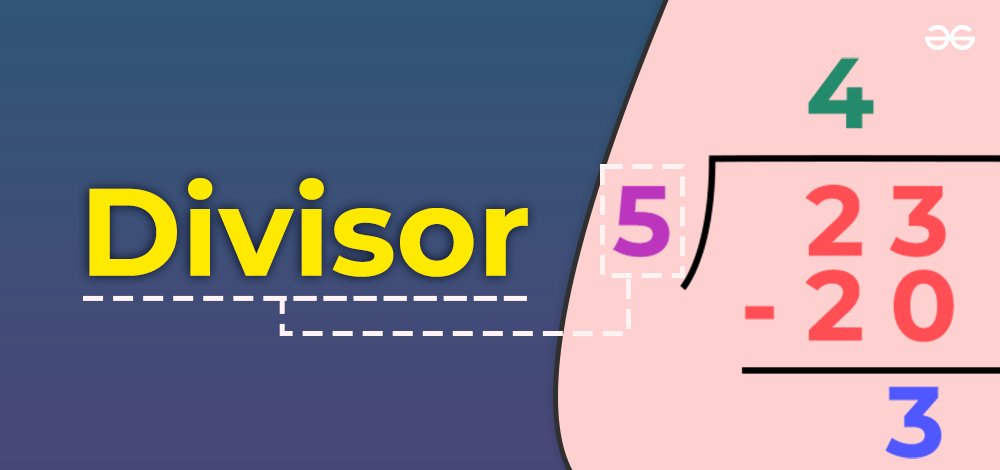
Table of Content
- Divisor Definition
- How to Find Divisors of a Number?
- Properties of Divisors
- Divisors and Dividends
- Divisors vs Factors
- Divisors Examples
- Sample Problems on Divisors
- Practice Problems on Divisors in Maths
Divisor Definition
Divisors are integers that are used to divide another number . For example, the 5 is dividing 16 then 5 will be the divisor , 16 willl be the dividend.
Divisors play a fundamental role that is frequently used in various areas of mathematics such as **number theory, **algebra, **arithmetic, and problem-solving situations.
In other words, a divisor is an integer that, when multiplied by a whole number, results in the original number without any fractional or remainder part.

How to Find Divisors of a Number?
There are a few ways to find out divisors of a number:
**Brute Force Method: List out all the factors of the number, beginning with 1 and itself. For example, the divisors of 20 are 1, 2, 4, 5, 10, and 20.
**Divisor Using Prime Factorization: Prime Factorization of a number involves expressing a positive integer as a product of its prime divisors. Prime numbers are those that have only 2 factors i.e. 1 and themselves.
For example, 20 can be written as follows:
**20 = 5 × 4
Here, 5 is a prime number and 4 is a composite number, which can have more factors.
Thus, 20 = 2 × 2 × 5
Hence, the prime factorization of 20 is 2 × 2 × 5.
Properties of Divisors
Here are some interesting properties of divisors:
- A divisor can never be 0 i.e., any number with 0 as its divisor is undefined. For example: If 2 is divided by 0 then the remainder will be 0 (2 ÷ 0 = not defined).
- A divisor can be positive or negative. However, if stated otherwise, the term is often restricted to positive integers.
- If a divisor has the same value as a dividend, the quotient will always be 1.
- An even number always has an even divisor. An odd number will always have an odd divisor.
- If a divisor is a decimal number, it should be converted into a whole number before dividing.
Divisors and Dividends
The key differences between both divisors and dividends are listed in the following table:
| Characterstics | Divisors | Dividends |
|---|---|---|
| Definition | The number that divides another number is known as a divisor. | The dividend is the number that is divided into equal parts |
| Expression | In x ÷ y, “y” is the divisor | In x ÷ y, “x” is the dividend |
In other words, a divisor is a factor of a dividend. For instance:
**For 12 ÷ 4 = 3
- The divisor in this expression is 4
- The dividend in this expression is 12
- The quotient/remainder in this expression is 3.
Read more: **Dividend, Quotient and Remainder.
Divisors vs Factors
The key difference between divisors and factors are:
| Characterstics | Divisors | Factors |
|---|---|---|
| Definition | The number that divides another number is known as a divisor.In maths, sometimes divisors refer to the integers that evenly divide the number without leaving a remainder. | Factors are numbers that can be multiplied together to obtain a given number. |
| Example for 12 | Divisors of 12: 1, 2, 3, 4, 6, 12 | Factors of 12: 1, 2, 3, 4, 6, 12, -1, -2, -3, -4, -6, -12 |
Let’s consider an example, 15 divided by 5 gives 3 ****(15 ÷ 5 = 3).** Similarly, if we divide 15 by 3 it gives 5 (15 ÷ 3 = 5).
The factors and divisors of 15 are 1, 3, 5 and 15 respectively.
However, if we divide 15 by 2 it will not completely divide the number. Thus, 2 is not the factor of 15 but will be considered a divisor.
Divisors Examples
As we already discussed in number theory, divisors are those positive integers that can evenly divide into another natural number without leaving a remainder. In other words, if you have an integer "n," its divisors are the integers that, when multiplied by another integer, result in "n" without a remainder. Some examples of divisors for various natural numbers are discussed as below:
Divisors of 60
A number is a divisor of 60 if it divides 60 completely. Thus, x is a divisor of 60 if 60 divided by x is an integer. We have:
| 60/1 = 60 | Pair 1: 1, 60 |
|---|---|
| 60/2 = 30 | Pair 2: 2, 30 |
| 60/3=20 | Pair 3: 3, 20 |
| 60/4=15 | Pair 4: 4, 15 |
| 60/5=12 | Pair 5: 5, 12 |
| 60/6=10 | Pair 6: 6,10 |
Thus all the divisors for 60 are 1, 2, 3, 4, 5, 6, 10, 12, 15, 20, 30 and 60. So, it is concluded that 60 has a total of twelve divisors.
Divisors of 72
A number is a divisor of 72 if it divides 72 completely. Thus, x is a divisor of 72 if 72 divided by x is an integer. We have:
| 72/1 = 70 | **Pair 1: 1, 70 |
|---|---|
| 72/2 = 36 | Pair 2: 2, 36 |
| 72/3 = 24 | Pair 3: 3, 24 |
| 72/6 = 12 | Pair 4: 6, 12 |
| 72/8 = 9 | Pair 5: 8, 9 |
Thus all the divisors for 60 are 1, 2, 3, 4, 6, 8, 9, 12, 24, 36 and 72. So, it is concluded that 60 has a total of eleven divisors.
Divisors of 18
A number is a divisor of 18 if it divides 18 completely. Thus, x is a divisor of 18 if 18 divided by x is an integer. We have
| 18/1 = 18 | Pair 1: 1, 18 |
|---|---|
| 18/2 = 9 | Pair 2: 2, 9 |
| 18/3 = 6 | Pair 3: 3, 6 |
| 18/6 = 3 | Pair 4: 6, 3 |
Thus all the divisors for 60 are 1, 2, 3, 6, 9 and 18. So, it is concluded that 18 has a total of six divisors.
Some other examples of divisors includes:
- The divisors of 12 are 1, 2, 3, 4, 6, and 12.
- The divisors of 20 are 1, 2, 4, 5, 10, and 20.
- The divisors of 7 are 1 and 7.
- The divisors of 16 are 1, 2, 4, 8, and 16.
- The divisors of 25 are 1, 5, and 25.
- The divisors of 9 are 1, 3, and 9.
- The divisors of 1 are 1.
- The divisors of 100 are 1, 2, 4, 5, 10, 20, 25, 50, and 100.
- The divisors of 33 are 1, 3, 11, and 33.
- The divisors of 50 are 1, 2, 5, 10, 25, and 50.
**Read More,
Sample Problems on Divisors
**Problem 1: Find all the Divisors of 14.
**Solution:
- 1 x 14 = 14
- 2 x 7 = 14
- 7 x 2 = 14
The divisors of the number 14 are 1, 2, 7 and 14
Therefore, the number of divisors of 14 is 4.
**Problem 2: Find all the Divisors of 24
**Solution:
- 1 x 24 = 24
- 2 x 12 = 24
- 3 x 8 = 24
- 4 x 6 = 24
- 6 x 4 = 24
The factors of the number 24 are 1, 2, 3, 4, 6 and 24
Therefore, the number of divisors of 24 is 6.
**Problem 3: Find prime divisors of 460
**Solution:
**Step 1: Take the number 460 and and divide it with the smallest prime factor 2
- 460 ÷ 2 = 230
**Step 2: Again divide 230 by the smallest prime factor 2 as 230 is divisible by 2
- 230 ÷ 2 = 115
**Step 3: Now, 115 is not completely divisible by 2 as it will give a fractional number. Let’s divide it with the next smallest prime factor 5
- 115 ÷ 5 = 23
**Step 4: As 23 is itself a prime number as it can only be divided by itself and 1. We cannot proceed further.
Therefore, the prime divisors of number 460 are 22 x 5 x 23
**Problem 4: Find the number of divisors of 48.
**Solution:
It is calculated using the following formula:
d(n) = (x1 + 1) (x2 + 1) . . . (xk + 1)
The prime factorization of 48 is 24 x 3. Therefore, the number of divisors of 12 are:
⇒ d(48) = (4 +1) (1+1)
⇒ d(48) = 5 x 2
⇒ d(48) = 10
Therefore, there are 10 divisors of 48
**Problem 5: Find the number of divisors of 1080
**Solution:
It is calculated using the following formula:
d(n) = (x1 + 1) (x2 + 1) . . . (xk + 1)
The prime factorization of 1080 is 23 x 33 x 5. Therefore, the number of divisors of 1080 are:
⇒ d(1080) = (3+1) (3+1) (1+1)
⇒ d(1080) = 4 × 4 × 2
⇒ d(1080) = 32
Therefore, there are 32 divisors of 1080
**Problem 6: Find the sum of divisors of 52
**Solution:
It is calculated using the following formula:
**σ(n) = 1 + n + ∑ d|n, d≠1, d≠n d
The divisors of 52 are 1, 2, 4, 13, 26, and 52
⇒ σ(52)=1+52+(2+4+13+26)
⇒ σ(52)=53+2+4+13+26
⇒ σ(52)=98
Therefore, the sum of divisors of 52 is 98
**Problem 7: Find the φ(60) using Euler's Totient Function formula
**Solution:
It is calculated using the following formula:
**ϕ(n) = n × (1 - 1/p 1 ) × (1 - 1/p 2 ) × . . . × (1 - 1/p k )
The prime factorization of 60 is 22 x 3 x 5
⇒ ϕ(60) = 60 x ( 1 - 1/2) x (1 - 1/3) x (1 - 1/5)
⇒ ϕ(60) = 60 (1/2) (2/3) (4/5)
⇒ ϕ(60) = 24
So, φ(60) = 24. There are 24 positive integers less than or equal to 60 that are relatively prime to 60.
Practice Problems on Divisors in Maths
**Problem 1: List all divisors of following.
- **12
- **20
- **48
- **42
- **144
**Problem 2: Find the sum of all the divisors of the number 28.
**Problem 3: Determine the number of divisors of 36.
**Problem 4: Calculate the sum of all the divisors of 120.
**Problem 5: How many divisors does the number 150 have?
**Problem 6: Find the sum of the divisors of 72.
**Problem 7: Determine the number of divisors of 144.
**Problem 8: Calculate the sum of the divisors of 210.
**Problem 9: How many divisors does the number 625 have?
**Problem 10: Find the sum of all the divisors of 90.
**Problem 10: Calculate the product of all divisors of a number 6.