Double Integral (original) (raw)
Last Updated : 29 Sep, 2025
A double integral is a mathematical tool for computing the integral of a function of two variables across a two-dimensional region on the xy plane. It expands the concept of a single integral by integrating the functions of two variables over regions, surfaces, or areas in the plane. In case two variables are present, we need to substitute the value of one variable in terms of the other.
This is very helpful in the case of functions where we are provided with only one function and no relationship between the variables is defined. In such cases, we cannot substitute the value of one variable from the relation. Thus, we use a double integral to integrate the function.
**Mathematical Definition of Double Integral
A double integral is defined as the integral of a function over an area represented as R2.
A double integral is represented as follows:
\int_R\int_R f(x,y) dx.dy
If the region R spans over an area of [a, b] and [c, d], then the above equation can be written as:
\bold{\int^a_b\int^c_d f(x,y)~dy~dx}
Here, f(x, y) is a function of x and y, and the two integration signs represent the double integral over areas [a, b] and [c, d].
How to Calculate a Double Integral?
In the case of double integrals, the inner integral is solved first, and then we proceed to solve the outer integral. The calculation of the integral proceeds in the normal way by treating one variable at a time. In this case, the equation is integrated w.r.t x first, and then the equation is integrated w.r.t y.
Steps to calculate the double integral are as follows:
**Step 1: Write down the function to be integrated with a double integral sign and mention the upper and lower limits of integration on the integral.
**Step 2: Integrate the function with respect to any one of the variables initially.
**Step 3: Now insert the lower and upper limits of the variable with respect to which we integrated the function in order to bring the left function into one variable.
**Step 4: Proceed similarly as above, integrate the function again with respect to the other variable.
**Step 5: Insert the lower and upper limits of the second variable to get the result.
Example: Consider the integration\bold{\int^2_1\int^2_1(x+y)dy~dx}.
**Solution:
In order to solve this integral, we will solve the inner integral first and integrate the function w.r.t x
Let I = \int^2_1\int^2_1(x+y)dy~dx
\Rightarrow I = \int^2_1[\frac{x^2}{2}+xy]^{x=2}_{x=1}
Putting the upper and lower limits for x, we get
⇒ I = \int^2_1[\frac{2^2}{2}+2y-(\frac{1^2}{2}+y)]dy
⇒ I = \int^2_1[2+2y-\frac{1}{2}-y]dy
⇒ I = \int^2_1(\frac{3}{2}+y)dy
Now integrating w.r.t y, we get
⇒ I = [\frac{3y}{2}+\frac{y^2}{2}]^{y=2}_{y=1}
⇒ I = [\frac{3(2)}{2}+\frac{2^2}{2}-(\frac{3(1)}{2}+\frac{1^2}{2})]
⇒ I = 3 + 2 - 2 = 3
Properties of Double Integral
Consider two functions f(x, y) and g(x, y) to be integrated over regions A and B respectively. Also, consider C and D to be sub-regions of A and B, then a double integral satisfies the following properties:
- **Linearity: \int \int_R[f(x,y)\pm g(x,y)] = \int \int_Rf(x,y)\pm\int \int_Rg(x,y)
- \int^b_a\int^d_cf(x,y)dy~dx = \int^d_c\int^b_af(x,y)dy~dx
- **Additivity: If R = S \cup T, S \cap T = \phi then, \int\int_Rf(x,y)dy~dx = \int\int_Sf(x,y)dy~dx + \int\int_Tf(x,y)dy~dx
- **Monotonicity: If f(x, y) ≥ g(x, y), then \int \int_R f(x,y)dy~dx \geq \int\int_Rg(x,y)dy~dx
- \int \int_R kf(x,y)dy~dx = k \int\int_R f(x,y)dy~dx
**Some other properties includes:
- The double integral is a linear operator, meaning that it satisfies the following properties: \int \int_R[f(x,y)\pm g(x,y)] = \int \int_Rf(x,y)\pm\int \int_Rg(x,y) and \int \int k.f(x, y)dA = k.\int \int f(x, y)dA
- The order of integration can be interchanged under certain conditions. This is known as Fubini's theorem. For a continuous function f(x, y) defined over a rectangular region R = [a, b] × [c, d]. According to Fubini's Theorem \int\int_R f(x, y)dA = \int_a^b\int_c^df(x, y)dydx = \int_c^d\int_a^bf(x, y)dxdy
Applications of Double Integral
The applications of double integral are mentioned below:
- Double integrals are used to calculate the area of regions bordered by curves or surfaces in the xy plane.
- Double integrals can be used to calculate the volume of solid objects or regions in three-dimensional space.
- Double integrals are used to calculate the mass and density distribution of objects with varying density.
- In probability theory, double integrals are used to determine probabilities for events in two-dimensional probability density functions.
- Double integrals are used to calculate electric field strength and electric flux over surfaces in electrostatics.
- Double integrals are used in fluid dynamics to determine fluid flow rates and fluxes over surfaces.
Volume using Double Integral
Volume using Double Integral is the geometric interpretation of the double integral, to calculate the volume using double integral, let's consider a region R over [a × b] and [c × d]. A curve S = f(x, y) is drawn such that it projects an area in this region R. The graph for this is shown below:

In order to calculate the volume of the shown region, we will divide the length cd of the area R into m equal parts and the breadth of the area R into n equal parts. Thus the complete area R gets divided into smaller rectangles. Now from each of these rectangles we will draw a box upwards to the point where it meets S. It can be shown as follows:
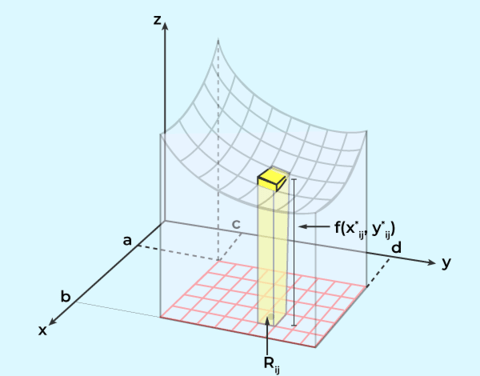
Consider that the area of the base of each small rectangle is A and its height is given by f(x', y'). The volume under region S can be calculated using:
\bold{V = \Sigma_{i=1}^n \Sigma_{j=1}^n A.f(x',y')}
We have made use of two variables m and n because the volume will be added and calculated in both directions or axes i.e. X axis and Y axis. As the value of m and n becomes very large and approaches infinity which means the area R is divided into infinite small rectangular regions, then this equation can be written as:
V=\lim_{m,n \rarr\infty}\sum_{i=1}^m\sum_{j=1}^nA.f(x',y')
We know that when the variables tend to infinity then summation can be substituted with integration which is also the definition of integration. Thus above equation becomes equal to:
V= \int\int_Rf(x,y)dA
Thus we derive the formula to find the volume under the curve using a double integral.
Double Integral vs Triple Integral
A detailed comparison between Double and Triple integral is given in the table below:
| Double Integral | Triple Integral |
|---|---|
| It is an integral of a function of two variables over a two-dimensional region in the xy-plane | It is an integral of a function of three variables over a three-dimensional region in space. |
| Region of integration for a double integral is typically a two-dimensional region bounded by curves or surfaces | Region of integration for a triple integral is typically a three-dimensional region bounded by surfaces |
| Double integrals are used to calculate quantities such as area, volume, mass, density, moments of inertia, and probabilities | Triple integrals are used to calculate quantities such as volume, mass, density, moments of inertia, and fluxes over three-dimensional regions |
| Double integrals can be evaluated by integrating first with respect to one variable (dx) and then with respect to the other variable (dy), or vice versa | Triple integrals can be evaluated by integrating first with respect to one variable (dx), then with respect to the second variable (dy), and finally with respect to the third variable (dz). |
**Related Articles
Solved Examples of Double Integral
**Example 1: Calculate \bold{\int^2_1\int^4_3 xy~dy~dx} ****.**
**Solution:
Let I = \int^2_1\int^4_3xy~dy~dx
Putting the upper and lower limits for x, we get
\Rightarrow I = \int^2_1[\frac{x^2y}{2}]^{x=4}_{x=3}dy\\\Rightarrow I = \int^2_1[\frac{4^2y}{2}-\frac{3^2y}{2}]dy
\Rightarrow I = \int^2_1[\frac{x^2y}{2}]^{x=4}_{x=3}dy = \int^2_1\frac{7y}{2}dy
Now integrating w.r.t y, we get
\Rightarrow I = \int^2_1[\frac{x^2y}{2}]^{x=4}_{x=3}dy = [\frac{7y^2}{4}]^{y=2}_{y=1}
\Rightarrow I = \int^2_1[\frac{x^2y}{2}]^{x=4}_{x=3}dy = [\frac{7(2^2)}{4}-\frac{7(1^2)}{4}]
⇒ I = 7 - 7/4 = 21/4
**Example 2: Calculate\bold{\int^2_1\int^4_3 (2x + 3y)~dy~dx} ****.**
**Solution:
I = \int^2_1\int^4_3 (2x + 3y)~dy~dx
\Rightarrow I = \int^2_1[\frac{2x^2}{2}+3xy]^{x=4}_{x=3}dy
Putting the upper and lower limits for x, we get
\Rightarrow I = \int^2_1[\frac{x^2y}{2}]^{x=4}_{x=3}dy = \int^2_1[4^2+3(4)y-(3^2+3(3)y)]dy
\Rightarrow I = \int^2_1[\frac{x^2y}{2}]^{x=4}_{x=3}dy = \int^2_1(16+12y -9-9y)dy = \int^2_1(7+3y)dy
Now integrating w.r.t y, we get
\Rightarrow I = \int^2_1[\frac{x^2y}{2}]^{x=4}_{x=3}dy = [7y+ \frac{3y^2}{2}]^{y=2}_{y=1}
\Rightarrow I = \int^2_1[\frac{x^2y}{2}]^{x=4}_{x=3}dy = 7(2)+\frac{3(2^2)}{2}-(7(1)+\frac{3(1^2)}{2})
⇒ I = 14 + 3 - 7 - 3/2 = 17/2
**Example 3: Calculate \bold{\int^1_0\int^4_2 x^2y~dy~dx} ****.**
**Solution:
I = \int^1_0\int^4_2 x^2y~dy~dx
\Rightarrow I = \int^0_1[\frac{x^3y}{3}]^{x=4}_{x=2}dy
Putting the upper and lower limits for x, we get
\Rightarrow I = \int^2_1[\frac{x^2y}{2}]^{x=4}_{x=3}dy = \int^1_0 (\frac{64y}{3}-\frac{8y}{3}) dy
\Rightarrow I = \int^2_1[\frac{x^2y}{2}]^{x=4}_{x=3}dy = \int^1_0(\frac{56y}{3})dy
\Rightarrow I = \int^2_1[\frac{x^2y}{2}]^{x=4}_{x=3}dy \frac{56}{3}\int^1_0y~dy
Now integrating w.r.t y, we get
\Rightarrow I = \int^2_1[\frac{x^2y}{2}]^{x=4}_{x=3}dy = \frac{56}{3}[\frac{y^2}{2}]^{y=1}_{y=0}
\Rightarrow I = \int^2_1[\frac{x^2y}{2}]^{x=4}_{x=3}dy = \frac{56}{3}(\frac{1}{2}-0)
⇒ I = 56/6
**Example 4: Calculate \bold{\int^2_1\int^4_3 2xy~dy~dx} ****.**
**Solution:
Using \int \int_R kf(x,y)dy~dx = k \int\int_R f(x,y)dy~dx
I = \int^2_1\int^4_3 2xy~dy~dx
\Rightarrow I = 2\int^2_1\int^4_3 xy~dy~dx
\Rightarrow I = \int^2_1[\frac{x^2y}{2}]^{x=4}_{x=3}dy = 2\int^2_1[\frac{x^2y}{2}]^{x=4}_{x=3}dy
Putting the upper and lower limits for x, we get
\Rightarrow I= 2\int^2_1[\frac{4^2y}{2}-\frac{3^2y}{2}]dy
\Rightarrow I= 2\int^2_1\frac{7y}{2}dy
Now integrating w.r.t y, we get
\Rightarrow I= 2[\frac{7y^2}{4}]^{y=2}_{y=1}
\Rightarrow I= 2[\frac{7(2^2)}{4}-\frac{7(1^2)}{4}]
⇒ I = 2(7 - 7/4) = 21/2
**Example 5: Calculate \bold{\int^5_0\int^6_0 x^3y^2~dy~dx} ****.**
**Solution:
Let I = \int^5_0\int^6_0 x^3y^2~dy~dx
\Rightarrow I= \int^5_0[\frac{x^4y^2}{4}]^{x=6}_{x=0}
Putting the upper and lower limits for x, we get
\Rightarrow I= \int^5_0[\frac{1296y^2}{4}-0]dy
\Rightarrow I= \int^5_0\frac{324y^2}{2}dy
\Rightarrow I= 162 \int^5_0 y^2dy
Now integrating w.r.t y, we get
\Rightarrow I= 162[\frac{y^3}{3}]^{y=5}_{y=0}
\Rightarrow I= 162[\frac{125}{3}-0]
⇒ I = 54(125) = 6750
Practice Problems - Double Integral
- Evaluate the double integral: \int_{0}^{1} \int_{0}^{1} (x + y) \, dx \, dy
- Find the value of the double integral: \int_{0}^{2} \int_{0}^{3} (2x + 3y) \, dx \, dy
- Compute the double integral over the region R defined by 0 \leq x \leq 1 and 0 \leq y \leq x: \int_{0}^{1} \int_{0}^{x} (x^2 - y^2) \, dy \, dx
- Evaluate the double integral: \int_{0}^{1} \int_{0}^{1-x} e^{x+y} \, dy \, dx
- Compute the double integral over the triangular region with vertices (0,0),(1,0) and (0,1): \int_{0}^{1} \int_{0}^{1-y} (x^2 + y^2) \, dx \, dy
- Evaluate the double integral: \int_{0}^{\pi/2} \int_{0}^{\sin y} \cos(x^2) \, dx \, dy
- Find the value of the double integral over the region bounded by y = x^2 and y = x + 2 : \int_{-1}^{2} \int_{x^2}^{x+2} (2xy) \, dy \, dx
- Compute the double integral: \int_{0}^{1} \int_{0}^{\sqrt{1-x^2}} x \, dy \, dx
- Evaluate the double integral: \int_{0}^{2} \int_{x/2}^{1} (3x^2 - y^2) \, dy \, dx
- Compute the double integral over the region defined by 0 \leq y \leq \sqrt{x} and 0 \leq x \leq 4 : \int_{0}^{4} \int_{0}^{\sqrt{x}} (x - y) \, dy \, dx