Line Integral (original) (raw)
Last Updated : 10 Oct, 2025
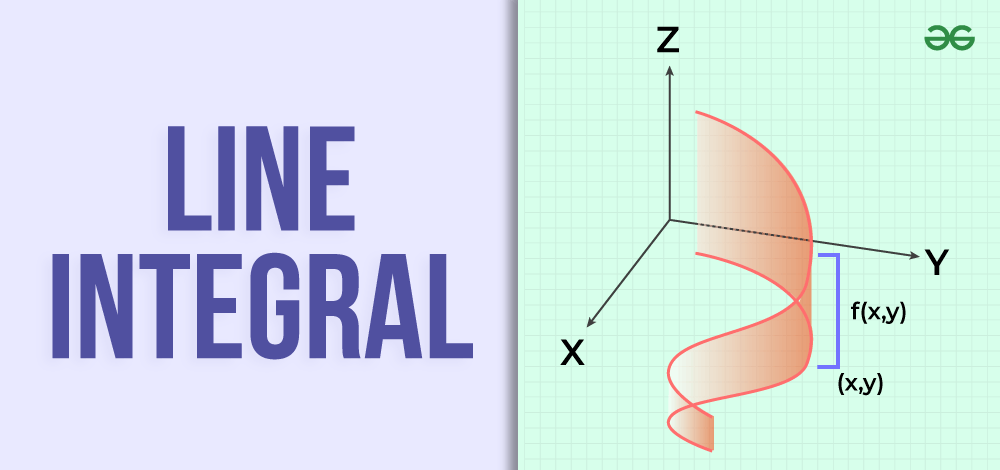
A **Line Integral is used to evaluate a function along a curve or path. It helps calculate quantities like work or flux over a specific route, often applied in engineering. Line integrals are the reverse of differentiation, also known as anti-differentiation.
- They calculate total effects (e.g., work, heat) along a path.
- Common applications include determining the work done by a force on an object along a curve.
- It is also known as a path integral, a curve integral, or a curvilinear integral.
In generic words, a line integral is the sum of the function's value at the points in the interval on the curve along which the function is integrated.
Formula of Line Integral
Line Integral is calculated for both types of functions/fields, i.e. scalar fields and vector fields. The formula for two cases is written separately as follows:
For scalar Fields
Let **f defines a scaler field, then the line integral along a smooth curve **C is defined as follows:
\oint f(\mathbf{r})\, ds = \int_{a}^{b} f[\mathbf{r}(t)] \, \lvert \mathbf{r}'(t) \rvert \, dt
Where,
- f is the Scalar Field.
- r(t) is the Parametrical Representation of Curve along which Integral is to be Evaluated.
- |r'(t)| represents the Magnitude of Derivative of the Parametric Representation.
The LHS of above equation represents the line integral of the function **f along curve **C. **a and **b represent the lower limit and upper limit of integration respectively. **r is an arbitrary parametrical representation of the curve **C.
For Vector Fields
Let **F defines a vector field and the curve along which the line integral is to be calculated is **C. Then, the expression to calculate the line integral is as follows:
\oint \mathbf{F}(\mathbf{r}) \cdot d\mathbf{s} = \int_{a}^{b} \mathbf{F}[\mathbf{r}(t)] \cdot \mathbf{r}'(t) \, dt
Here, a and b are limits of integration, r is the parametrical representation of the curve C and ' . ' represents the dot product between the vectors.
Line Integral in Differential Form
In differential form, a line integral can be expressed as a mathematical expression involving differential terms and functions. For example, a function is represented as F = <P, Q, R>, where P, Q and R are function's expressions in X, Y and Z directions respectively. Let 'dr' represents the differential displacement along the curve C along which integral is to be found, then line integral would be,
\int_C \mathbf{F} \cdot d\mathbf{r} = \int_C \langle P, Q, R \rangle \cdot \langle dx, dy, dz \rangle**∫ C
**OR
\int_C \mathbf{F} \cdot d\mathbf{r} = \int_C (P \, dx + Q \, dy + R \, dz)
r'(t) can also be written as,
\frac{d\mathbf{r}}{dt} \, dt = \left( \frac{dx}{dt} \hat{i} + \frac{dy}{dt} \hat{j} + \frac{dz}{dt} \hat{k} \right)
\mathbf{r} = dx \hat{i} + dy \hat{j} + dz \hat{k}
For any function \mathbf{F} = A \hat{i} + B \hat{j} + C \hat{k},
F.r'(t) = M.dx + N.dy + P.dz
**Related Articles
Evaluating Line Integral
Line Integral can be evaluated using the formulae defined above for a particular problem depending upon whether it is for scalar field or vector field. The basic steps involved in evaluating line integral are listed as follows:
- As a first step, we need to parameterize the curve along which integral is to be found out in specified range, if not given in that form already.
- Find the differentials for the parametric curve obtained, as dx, dy and dz.
- Select the appropriate formula based upon scalar or vector fields.
- Substitute the parametric function and it's derivative into the formula.
- Evaluate the dot product for vector fields or simply multiply for scalar ones.
- Integrate the obtained expression within specified limits to get the value of line integral.
Fundamental Theorem for Line Integrals
According to Fundamental Theorem for Line Integrals
**∫ a b F'(x) . dx = F(b) - F(a)
Applications of Line Integral
As already mentioned, a Line Integral is used to find a function's integral along a line or a curve. Here, some practical applications of line integrals are listed as follows:
- It may be used in finding work done by gravitational force to move a particle along a specific path defined by a curve.
- It can be used in finding work done by a force on a moving object.
- It is used in determining rate of reaction as per Law of Mass Action.
- It is also used to calculate the value of magnetic field around a conductor as per Ampere's Law.
- It is also used to find the voltage generated in a loop due to electromagnetic induction as per Faraday's Law.
There are many more applications of Line Integrals which one may find in various engineering fields. Below are some solved examples which are involve calculation of line integral. You may refer them to understand the concept of line integral in a better way.
Line Integrals of Vector Valued Functions
Let, r be a vect function defined in t such that,
r(t) = x(t)i + y(t)j a ≤ t ≤ b
It r(t) is differentiable on a smooth curve C then,
**∫ C f(x, y) . dr = ∫ a b f{x(t), y(t)}.√{(x'(t) 2 + y'(t) 2 } dt
if, r(t) = x(t)i + y(t)j + x(t)k a ≤ t ≤ b
**∫ C f(x, y) . dr = ∫ a b f{x(t), y(t), z(t)}.√{(x'(t) 2 + y'(t) 2 + z'(t) 2 } dt
**Also Check
Solved Examples on Line Integral
**Example 1: Evaluate the line integral ∫c(x+y) ds along the curve x2 + y2 = 9, from (0, 3) to (3, 0).
**Solution:
Given the integral:
∫C(x+y) ds
along the curve x2 + y2 = 9 from (0, 3) to (3,0):
- Parameterize the circle:
x = 3cos t, y = 3 sin t
with t going from π/2 (at (0, 3)) to 0 (at (3,0)).
- Compute ds:
\frac{dx}{dt} = -3 \sin t, \quad \frac{dy}{dt} = 3 \cos t
ds = \sqrt{(-3 \sin t)^2 + (3 \cos t)^2} \, dt = 3 \, dt
- Substitute in the integral:
0∫π/2 (3cos t + 3sin t)⋅3 dt = 9 0∫π/2 (cos t + sin t) dt
- Reverse limits:
= −9 π/2∫0 (cos t + sin t)
- Evaluate the integral:
π/2∫0 cos t dt = 1, π/2∫0 sin t dt = 1
⇒−9(1 + 1) = −18
**Example 2: A force field is represented as following function, F(x, y) = (y, 0), find the value of work done by the force on a particle moving in the direction described as x = sin(t) and y = cos(t), when t varies from 0 to 1.
**Solution:
Calculate the work done by the force field f(x, y) = (y, 0) on the particle moving along (x = sin(t)), (y = cos(t)) from (t = 0) to (t = 1).
Step 1: Parametrize the force field along the path: F(t) = (cos(t), 0)
Step 2: Calculate the derivatives of the path: \frac{dx}{dt} = \cos(t), \quad \frac{dy}{dt} = -\sin(t)
Step 3: The work done is the line integral:
W = \int_0^1 \mathbf{F}(t) \cdot \frac{d\mathbf{r}}{dt} dt = \int_0^1 \cos(t) \cdot \cos(t) + 0 \cdot (-\sin(t)) dt = \int_0^1 \cos^2(t) dt
Step 4: Use the identity:
\cos^2(t) = \frac{1 + \cos(2t)}{2}
Step 5: The integral becomes:
W = \int_0^1 \frac{1 + \cos(2t)}{2} dt = \frac{1}{2} \int_0^1 (1 + \cos(2t)) dt = \frac{1}{2} \left[ t + \frac{\sin(2t)}{2} \right]_0^1 = \frac{1}{2} \left(1 + \frac{\sin(2)}{2}\right)
Numerical value:
W \approx 0.5 + \frac{0.909297}{4} = 0.7273
**Example 3: For a vector field represented as F = <z, y, x>, evaluate the line integral ∫C F.dr along the curve C parameterized as < t2, t, t3 > for 0 < t < 1.
**Solution:
Given:
- Vector field F=⟨z, y, x⟩
- Curve C parameterized by r(t) = ⟨t2, t, t3⟩, for 0 ≤ t ≤ 1
**Step 1: Express F along the curve r(t)
We have F=⟨z,y,x⟩
Along the curve:
- x = t2
- y = t
- z = t3
So: F(r(t))=⟨t3, t, t2⟩
**Step 2: Find r′(t)
r(t) = ⟨t2, t, t3⟩
\mathbf{r}'(t) = \left\langle \frac{d}{dt}(t^2), \frac{d}{dt}(t), \frac{d}{dt}(t^3) \right\rangle = \langle 2t, 1, 3t^2\rangle
**Step 3: Write the line integral
\int_C \mathbf{F} \cdot d\mathbf{r} = \int_0^1 \mathbf{F}(\mathbf{r}(t)) \cdot \mathbf{r}'(t) \ dt
Calculate the dot product:
F(r(t)) ⋅ r′(t) = ⟨t3, t, t2⟩⋅⟨2t,1,3t2⟩ = t3⋅2t + t⋅1 + t2⋅3t2
= 2t4 + t + 3t4 = (2t4 + 3t4) + t = 5t4 + t
**Step 4: Integrate from 0 to 1
0∫1 (5t4 + t)dt = 0∫1 5t4dt + 0∫1 tdt = 5 0∫1 t4dt + 0∫1 tdt
= 5 \left[ \frac{t^5}{5} \right]_0^1 + \left[ \frac{t^2}{2} \right]_0^1 = 5 \cdot \frac{1}{5} + \frac{1}{2} = 1 + \frac{1}{2} = \frac{3}{2}a