Hyperbola Equation, Definition & Properties (original) (raw)
Last Updated : 21 Apr, 2026
A hyperbola is one of the fundamental shapes in geometry formed by intersecting a right circular cone with a plane at an angle such that both halves of the cone are intersected. It is often encountered in both mathematics and real-world applications.
- Defined as the set of all points where the difference of the distances to two fixed points (called foci) is constant.
- It is a smooth curve in a plane with two branches that mirror each other, resembling two infinite bows.
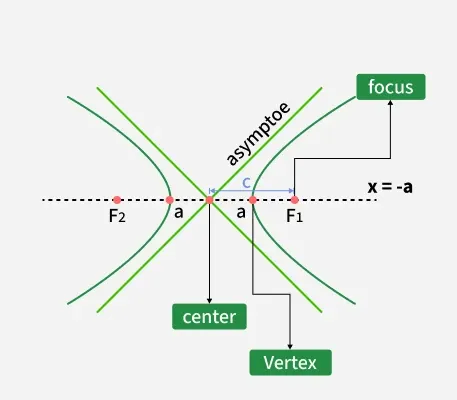
Hyperbolasare closely related to ellipses and parabolas, yet they possess distinct properties and applications. From the design of satellite dishes to the paths of celestial bodies, hyperbolas play a critical role in various scientific and engineering fields.
If P (x, y) is a point on the hyperbola and F, F' are the two foci, then the locus of the hyperbola is
PF - PF' = 2a
**Standard Equation of Hyperbola
\bold{\frac{x^{2}}{a^{2}}-\frac{y^{2}}{b^{2}}= 1} OR \bold{\frac{y^{2}}{a^{2}}-\frac{x^{2}}{b^{2}}= 1}
A hyperbola has two standard equations. These equations are based on its transverse axis and conjugate axis.
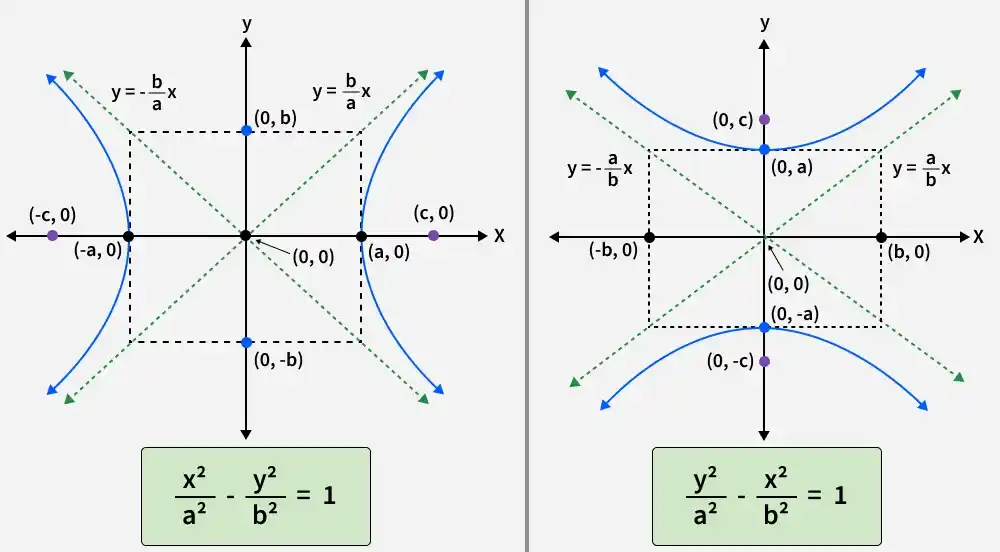
- The standard equation of the hyperbola is [(x2/a2) - (y2/b2)] = 1, where the X-axis is the transverse axis and the Y-axis is the conjugate axis.
- Furthermore, another standard equation is [(y2/a2)- (x2/b2)] = 1, where the Y-axis is the transverse axis and the X-axis is the conjugate axis.
Standard equation of the hyperbola with center (h, k) and the X-axis as the transverse axis and the Y-axis as the conjugate axis is,
\bold{\frac{(x-h)^{2}}{a^{2}}-\frac{(y-k)^{2}}{b^{2}}= 1}
- Furthermore, another standard equation of the hyperbola with center (h, k) the Y-axis as the transverse axis, and the X-axis as the conjugate axis is
\bold{\frac{(y-k)^{2}}{a^{2}}-\frac{(x-h)^{2}}{b^{2}}= 1 }
Parts of Hyperbola
A hyperbola is a conic section formed when a plane cuts a double right circular cone at an angle such that it intersects both halves (nappes) of the cone. It can be described using concepts like foci, directrix, latus rectum, and eccentricity. The following table represents the parts of the hyperbola:

| Parts | **Description |
|---|---|
| **Foci | Two foci with coordinates F(c, 0) and F'(-c, 0) |
| **Centre | The midpoint of the line joining the two foci, denoted as O |
| **Transverse Axis | Length of the transverse axis is 2a units |
| **Conjugate Axis | Length of the conjugate axis is 2b units |
| **Vertices | Intersection points with the axis, (a, 0) and (-a, 0) |
| **Transverse Axis | Line that passes through the two foci and center of the hyperbola |
| **Conjugate Axis | The line that passes through center and is perpendicular to the transverse axis |
| **Asymptotes | Equations of asymptotes are y = (b/a)x and y = -(b/a)x, lines that approach the hyperbola but never touch it |
| **Directrix | Fixed straight line perpendicular to the axis of a hyperbola |
**Eccentricity & Latus Rectum of Hyperbola
**Eccentricity
The eccentricity of a hyperbola is the ratio of the distance of a point from the focus to its perpendicular distance from the directrix. It is denoted by the letter '**e'.
- The eccentricity of a hyperbola is always greater than 1, i.e., e >1.
- We can easily find the eccentricity of the hyperbola by the formula :
e = √[1 + (b2/a2)]
where,
- a is the length of the Semi-transverse axis
- b is the length of the Semi-conjugate axis
**Latus Rectum
Latus rectum of a hyperbola is a line passing through any of the foci of a hyperbola and perpendicular to the transverse axis of the hyperbola. The endpoints of a latus rectum lie on the hyperbola, and its length is 2b2/a.
**Derivation of Equation of Hyperbola
Lets consider a point P on the hyperbola having coordinates (x, y). As the difference between the distance of point P from the two foci F and F' is 2a, i.e., PF'-PF = 2a.
Let the coordinates of the foci be F (c, o) and F '(-c, 0).

Now, by using the coordinate distance formula, we can find the distance of point P (x, y) to the foci F (c, 0) and F '(-c, 0).
√[(x + c)2 + (y - 0)2] - √[(x - c)2 + (y - 0)2] = 2a
⇒ √[(x + c)2 + y2] = 2a + √[(x - c)2 + y2]Now, by squaring both sides, we get
(x + c)2 + y2 = 4a2 + (x - c)2 + y2 + 4a√[(x - c)2 + y2]
⇒ 4cx - 4a2 = 4a√[(x - c)2 + y2]
⇒ cx - a2 = a√[(x - c)2 + y2]Now, by squaring on both sides and simplifying, we get
[(x2/a2) - (y2/(c2 - a2))] = 1
We have, c2 = a2 + b2, so by substituting this in the above equation, we get
x2/a2 - y2/b2 = 1
Hence, the standard equation of the hyperbola is derived.
Hyperbola Formula
Following formulas are widely used in finding the various parameters which include, the equation of hyperbola, the transverse and conjugate axis, eccentricity, asymptotes, vertex, foci, and semi-latus rectum.
| **Property | **Formula |
|---|---|
| Equation of Hyperbola | (x-xo)2 / a2 - (y-yo)2 / b2 = 1 |
| Transverse Axis | y = y0; Length = 2__a_ |
| Conjugate Axis | x = x0; Length = 2__b |
| Eccentricity | e = √(1 + b2/a2) |
| Asymptotes | __y_= y0 ±(_b/_a)(_x − x0) |
| Vertex | (a, y0) and (−a, y0) |
| Focus (Foci) | (a, √(a2 + b2)y0) and (−a, √(a2 + b2)y0) |
| Semi-Latus Rectum (p) | _p = _b 2/_a |
| Equation of Tangent | (xx1)/a2 - (yy1)/b2 = 1, |
| Equation of Normal | y−y1=(−y1a2)(x−x1) / (x1b2), at point (_x 1,_y 1) where, x1 ≠ 0 |
**Where,
- ( x0 , y0) is the Centre Point
- _a is the Semi-transverse Axis
- _b is the Semi-conjugate Axis
Graph of Hyperbola
A hyperbola is a curve that has two unbounded curves that are mirror images of each other. The graph shows that curve in the 2-D plane. We can observe the different parts of a hyperbola in the hyperbola graphs for standard equations given below:
Conjugate Hyperbola
Conjugate Hyperbola are 2 hyperbolas such that the transverse and conjugate axes of one hyperbola are the conjugate and transverse axis of the other hyperbola respectively.
Conjugate hyperbola of (x2 / a2) – (y2 /b2) = 1 is,
(y2 / b2) - (x2 / a2) = 1
Where,
- **a is transverse axis parameter
- **b is conjugate axis parameter
- **e is Eccentricity of hyperbola
- a2 = b2 (e2 − 1)
Properties of Hyperbola
- If the eccentricities of the hyperbola and its conjugate are e1, and e2 then, (1 / e12) + (1 / e22) = 1
- Foci of a hyperbola and its conjugate are concyclic and form the vertices of a square.
- Hyperbolas are equal if they have the same latus rectum.
Real-Life Application
- **Guitar - The narrow portion of the classical guitar, known as the waist, resembles the shape of a hyperbola, contributing both to its aesthetic appeal and the way it fits comfortably against the player's body.
- **Wavefronts - When two stones are thrown into a pool simultaneously, they create concentric ripples that move outward and intersect at point forming Hyperbolas.
- **Lenses and Monitors - Objects designed for use with our eyes make heavy use of hyperbolas. These object include microscopes, telescopes and television.
- **Satellites - Satellite systems make heavy use of hyperbolas and hyperbolic functions. When scientists launch a satellite into space, they must first use mathematical equations to predict its path.
Related Articles:
Solved Examples
**Question 1: Determine the eccentricity of the hyperbola x2/64 - y2/36 = 1.
**Solution:
Equation of hyperbola is x2/64 - y2/36 = 0
By comparing given equation with standard equation of the hyperbola x2/a2 - y2/b2 = 1, we get
a2 = 64, b2 = 36
⇒ a = 8, b = 6We have,
Eccentricity of a hyperbola (e) = √(1 + b2/a2)
⇒ e = √(1 + 62/82)
⇒ e = √(1 + 36/64)
⇒ e = √(64 + 36)/64) = √(100/64)
⇒ e = 10/8 = 1.25Hence, Eccentricity of given hyperbola is 1.25.
**Question 2: If the equation of the hyperbola is [(x-4)2/25] - [(y-3)2/9] = 1, find the lengths of the transverse axis, conjugate axis, and latus rectum.
**Solution:
Equation of hyperbola is [(x-4)2/25] - [(y-3)2/9] = 1
By comparing given equation with the standard equation of the hyperbola, (x - h)2/a2 - (y - k)2/b2 = 1
Here, x = 4 is the transverse axis and y = 3 is the conjugate axis.
a2 = 25 a = 5
b2 = 9 b = 3Length of transverse axis = 2a = 2 × (5) = 10 units
Length of conjugate axis = 2b = 2 × (3) = 6 units
Length of latus rectum = 2b2/a = 2(3)2/5 = 18/5 = 3.6 units
**Question 3: Find the vertex, asymptote, transverse axis, conjugate axis, and directrix if the hyperbola equation is [(x-6)2/72]-[(y-2)2/42] = 1.
**Solution:
Equation of hyperbola is [(x-6)2/72] - [(y-2)2/42] = 1
By comparing given equation with standard equation of hyperbola, (x - h)2/a2 - (y - k)2/b2 = 1
h = 6, k = 2, a = 7, b = 4
Vertex of a Hyperbola: (h + a, k) and (h - a, k) = (13, 2) and (-1, 2)
Transverse axis of Hyperbola is x = h x = 6
Conjugate axis of Hyperbola is y = k y = 2Equations of asymptotes of hyperbola are
y = k − (b / a)x + (b / a)h and y = k+ (b / a)x - (b / a)h
⇒ y = 2 - (4/7)x + (4/7)6 and y = 2 + (4/7)x - (4/7)6
⇒ y = 2 - 0.57x + 3.43 and y = 2 + 0.57x - 3.43
⇒ y = 5.43 - 0.57x and y = -1.43 + 0.57xEquation of the directrix of a hyperbola is x = ± a2/√(a2 + b2)
⇒ x = ± 72/√(72 + 42)
⇒ x= ± 49/√65
⇒ x = ± 6.077
**Question 4: Find the eccentricity of the hyperbola whose latus rectum is half of its conjugate axis.
**Solution:
Length of latus rectum is half of its conjugate axis
Let,
Equation of hyperbola be [(x2 / a2) – (y2 / b2)] = 1Conjugate axis = 2b
Length of Latus rectum = (2b2 / a)From given data,
(2b2 / a) = (1/2) × 2b
2b = aWe have,
Eccentricity of Hyperbola (e) = √[1 + (b2/a2)]
Now, substitute a = 2b in the formula of eccentricity
⇒ e = √[1 + (b2/(2b)2]
⇒ e = √[1 + (b2/4b2)] = √(5/4)
⇒ e = √5/2Hence, required eccentricity is √5/2.
Practice Problems
**Question 1: Find the standard form equation of the hyperbola with vertices at (-3, 2) and (1, 2), and a focal length of 5.
**Question 2: Determine the center, vertices, and foci of the hyperbola with the equation 9x2 - 4y2 = 36.
**Question 3: Given the hyperbola with the equation (x - 2)2/16 - (y + 1)2/9 = 1, find the coordinates of its center, vertices, and foci.
**Question 4: Write the equation of the hyperbola with a horizontal transverse axis, center at (0, 0), a vertex at (5, 0), and a focus at (3, 0).