First Principle of Derivatives (original) (raw)
Last Updated : 11 May, 2026
The First Principle of Differentiation involves using algebra to determine a general expression for the slope of a curve. It is also referred to as the delta method. The derivative serves as a measure of the instantaneous rate of change, denoted by f'(x), which is equal to:
f'(a) = \lim_{x \to a} \dfrac{f(x) - f(a)}{x - a}
Let's understand the Derivative by the First Principle with the help of the image attached below:
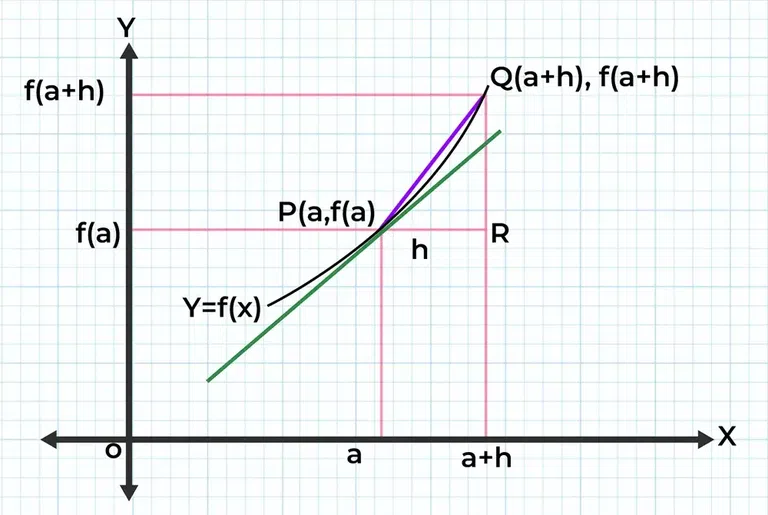
- The diagram given above represents the geometric interpretation of the derivative.
- Let's have two points P(a, f(a)) and Q(a + h, f(a + h)) which are close to each other on the graph. We know that according to the definition,
\bold{f'(a) = \lim_{h \to 0} \frac{f(a + h) -f(a)}{h}}
- From the triangle PQR, it is clear that the ratio whose limit we are taking is precisely equal to tan(QPR), which is the slope of the chord PQ. In the limiting process, as h tends to 0, the point Q tends to P, and we have,
\bold{\lim_{h \to 0} \frac{f(a + h) -f(a)}{h} = \lim_{Q \to P}\frac{QP}{QR}}
- We can see that the chord PQ tends to be tangent to the curve f(x). The limit is equal to the slope of the tangent to the curve at a particular point.
**Proof of First Principles of Derivatives
Given a function f(x), we want to find its derivative f'(x). Using the definition of the derivative, we have:
f'(x) = \lim_{h \to 0} \frac{f(x+h) - f(x)}{h}
Consider two points on the curve f(x) at x = a and x = a + h. The slope of the secant line passing through these points is given by:
\text{Slope} = \frac{f(a + h) - f(a)}{(a + h) - a} = \frac{f(a + h) - f(a)}{h}
As h approaches 0, the secant line becomes a tangent line, and its slope represents the derivative of the function at x = a .
Taking the limit of the difference quotient as h approaches 0 gives us the derivative at x = a:
f'(a) = \lim_{h \to 0} \frac{f(a + h) - f(a)}{h}
This limit represents the instantaneous rate of change of the function f(x) at x = a .
**How to Find Derivatives using the First Principle?
**Step 1: Start with the function (f(x)) for which you want to find the derivative.
**Step 2: Use the definition of the derivative: f'(x) = \lim_{h \to 0} \frac{f(x+h) - f(x)}{h}
**Step 3: Substitute f(x) into the formula.
**Step 4: Calculate f(x + h) - f(x), which represents the change in ( y )-values between two points on the function.
**Step 5: Divide the result by h, the change in x-values between the two points.
**Step 6: Take the limit as ( h ) approaches zero.
**Step 7: The resulting value is the derivative of f(x) with respect to ( x ), denoted as f'(x).
**One-Sided Derivative
One-sided derivatives are derivatives calculated from one direction only, either from the left or the right of a specific point. They are useful when a function behaves differently on one side of the point compared to the other.
- Left Hand Derivative
- Right Hand Derivative
**Example: Consider ( f(x) = x2 ) and find the one-sided derivatives at ( x = 1 ).
**Solution:
**Left-sided derivative ( f' - (1)):
f'(1-) = limh→0- \frac{f(1) - f(1 - h)}{h}
⇒ f'(1-) = limh→0- \frac{(1)^2 - (1 - h)^2}{h}
⇒ f'(1-) = limh→0- \frac{1 - (1 - 2h + h^2)}{h}
⇒ f'(1-) = limh→0- \frac{1 - 1 + 2h - h^2}{h}
⇒ f'(1-) = limh→0- \frac{2h - h^2}{h}
⇒ f'(1-) = limh→0- (2 + h) = 2**Right-sided derivative ( f' + (1)):
f'(1+) = limh→0+\frac{f(1 + h) - f(1)}{h}
⇒ f'(1+) = limh→0+\frac{(1 + h)^2 - (1)^2}{h}
⇒ f'(1+) = limh→0+\frac{(1 + 2h + h^2) - 1}{h}
⇒ f'(1+) = limh→0+\frac{2h + h^2}{h}
⇒ f'(1+) = limh→0+ (2 + h) = 2So, both the left-sided derivative ( f'(1-)) and the right-sided derivative ( f'(1+)) of ( f(x) = x2 ) at ( x = 1 ) are equal to 2.
Differentiation of Functions Using First Principles of Derivatives
To differentiate trigonometric functions using the first principles of derivatives, use the definition of the derivative: f'(x) = \lim_{h \to 0} \frac{f(x+h) - f(x)}{h}
- Derivation of sin x: = cos x
- Derivative of cos x: = -sin x
- Derivative of tan x: = sec2x
- Derivative of cot x: = −cosec2x
- Derivative of sec x: = sec x.tan x
- Derivative of cosec x: = -cosec x.cot x
**Derivative of Sinx by First Principle
Given: f(x) = sin(x)
Using the definition of the derivative:
\frac{d}{dx} sin(x) = limh → 0 \frac{\sin(x + h) - \sin(x)}{h}
Applying the angle addition formula for sine:
limh → 0 \frac{\sin(x)\cos(h) + \cos(x)\sin(h) - \sin(x)}{h}
⇒ limh → 0 \frac{\sin(x)(\cos(h) - 1) + \cos(x)\sin(h)}{h}Using the limits:
sin(x) limh → 0 \frac{\cos(h) - 1}{h} + cos(x) limh → 0 \frac{\sin(h)}{h}
As limh → 0 \frac{\sin(h)}{h} = 1 and limh → 0 \frac{\cos(h) - 1}{h} = 0 :
sin(x) · 0 + cos(x) · 1 = cos(x)
So, the derivative of sin(x) with respect to ( x ) using the first principles of derivatives is cos(x).
**Derivative of Cosx by First Principle
\frac{d}{dx}(\cos(x) = limh → 0 \frac{\cos(x + h) - \cos(x)}{h}
Using the angle addition formula for cosine:
= limh → 0 \frac{\cos(x)\cos(h) - \sin(x)\sin(h) - \cos(x)}{h}
= limh → 0 \frac{\cos(x)(\cos(h) - 1) - \sin(x)\sin(h)}{h}
= cos(x) limh → 0 \frac{\cos(h) - 1}{h} - sin(x) limh → 0 \frac{\sin(h)}{h}As limh → 0 \frac{\sin(h)}{h} = 1 and limh → 0 \frac{\cos(h) - 1}{h} = 0 \):
= cos(x) ⋅ 0 - sin(x) ⋅ 1 = -sin(x)
So, the derivative of cos(x) with respect to ( x ) using the first principles of derivatives is -sin(x).
**Solved Examples
**Example 1: Find the derivative of the function f(x) = 3x2 + 2x - 1 using the first principles of differentiation.
**Solution:
Using the definition of the derivative:
f'(x)=lim_{h\to0}\frac{f(x + h) - f(x)}{h}
Substituting f(x) = 3x2 + 2x - 1 into the formula:
f'(x)=lim_{h\to0}\frac{3(x + h)^2 + 2(x + h) - 1 - (3x^2 + 2x - 1)}{h}
⇒ f'(x)=lim_{h\to0}\frac{3(x^2 + 2xh + h^2) + 2x + 2h - 1 - 3x^2 - 2x + 1}{h}
⇒ f'(x)=lim_{h\to0}\frac{3x^2 + 6xh + 3h^2 + 2x + 2h - 1 - 3x^2 - 2x + 1}{h}
⇒ f'(x)=lim_{h\to0}\frac{6xh + 3h^2 + 2h}{h}⇒ f'(x)=lim_{h\to0}(6x+3h+2)
⇒ f'(x)=6x+2So, the derivative of f(x) = 3x2 + 2x - 1 with respect to x using the first principles of differentiation is
f'(x) = 6x + 2.
**Example 2: Calculate the derivative of the function ( g(x) = √x) using the first principles of differentiation.
**Solution:
Using the definition of the derivative:
g'(x)=lim_{h \to 0}\frac{g(x + h) - g(x)}{h}Substituting (g(x) = √x) into the formula:
g'(x)=lim_{h \to 0}\frac{\sqrt{x + h} - \sqrt{x}}{h}To simplify this expression, use the conjugate:
⇒ g'(x)=lim_{h \to 0}\frac{\sqrt{x + h} - \sqrt{x}}{h} \times \frac{\sqrt{x + h} + \sqrt{x}}{\sqrt{x + h} + \sqrt{x}}
⇒ g'(x)=lim_{h \to 0}\frac{(x + h) - x}{h(\sqrt{x + h} + \sqrt{x})}
⇒ g'(x)=lim_{h \to 0}\frac{ h}{h(\sqrt{x + h} + \sqrt{x})}
⇒ g'(x) = limh → 0 g'(x)=lim_{h \to 0}\frac{ 1}{\sqrt{x + h} + \sqrt{x}}Now, as ( h ) approaches 0:
g'(x)=\frac{1}{2\sqrt{x}}
So, the derivative of g(x) = √x with respect to x using the first principles of differentiation is
g'(x) =\frac{1}{2\sqrt{x}} .
**Example 3: Determine the derivative of the function h(x) = ex using the first principles of differentiation.
**Solution:
Using the definition of the derivative:
⇒ h'(x)=lim_{h \to 0}\frac{h(x + h) - h(x)}{h}Substituting h(x) = e^x into the formula:
⇒ h'(x) = lim_{h \to0} \frac{e^{x + h} - e^x}{h}
⇒ h'(x) = lim_{h \to0} \frac{e^x(e^h - 1)}{h}
⇒ h'(x) =e^x lim_{h \to0} \frac{e^h - 1}{h}Now, as h approaches 0:
h'(x) =e^x lim_{h \to0} \frac{e^h - 1}{h}Using the standard limit lim_{h\to0}\frac{e^h-1}{h}=1:
h'(x) = e^x \cdot 1 = e^x
So, the derivative of h(x) = ex with respect to x using the first principles of differentiation is h'(x) = ex.
**Practice Questions
**Q1. Find the derivative of the function ( f(x) = x3 + 2x2 - 3x + 1 ) using the first principles of differentiation.
**Q2. Calculate the derivative of the function ( g(x) = 1/x) using the first principles of differentiation.
**Q3. Determine the derivative of the function ( h(x) = ln(x) ) using the first principles of differentiation.
**Q4. Find the derivative of the function ( p(x) = 1/√x) using the first principles of differentiation.
**Q5. Calculate the derivative of the function ( q(x) = e2x) using the first principles of differentiation.