Height of a Parallelogram Formula and Solved Examples (original) (raw)
Last Updated : 7 Aug, 2025
Height of a Parallelogram formula is to calculate the height of a Parallelogram. The height of a Parallelogram is the perpendicular distance between the base side and the parallel side opposite to it. A Parallelogram can be defined as a quadrilateral in which opposite sides are parallel and the length of these opposite sides is also equal.

Height of a Parallelogram Formula
The opposite angles of Parallelogram are also equal. Let's know more about Height of a Parallelogram Formula with derivation in detail below.
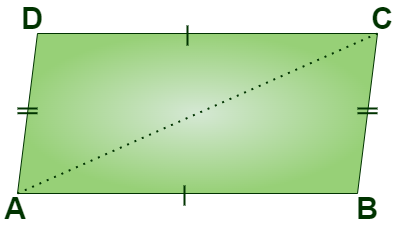
Height of a Parallelogram Formula
Height of a Parallelogram Formula
Height of a Parallelogram is calculated using the formula Area is equal to Base multiplied by Height, so if the area of a Parallelogram is known its height is calculated by dividing the Area by its Base.
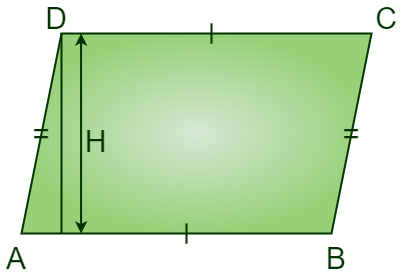
The height of a Parallelogram formula is derived from the area formula, area of a Parallelogram can be found using the base length and height of the Parallelogram.
Area = Base × Height
**Height = Area/Base
**Perimeter of a Parallelogram
Perimeter is defined as the sum of all sides using which a closed figure is been constructed. In the case of a Parallelogram, it has 4 sides out of which opposite sides are equal so the perimeter is the sum of all four sides.
Let's take the measure of opposite sides as X and Y hence
Perimeter of Parallelogram = X + Y + X + Y = 2X + 2Y = 2(X + Y)
**Perimeter = 2(X + Y)
**Related Resources
Solved Example on Height of Parallelogram
**Example 1: Find the height of a Parallelogram if its area is 625 cm 2 and the length of the base is 25 cm.
**Solution:
The height of a Parallelogram can be calculated using the height of a Parallelogram formula
Height = Area /Base
Height = 625/25
Height = 25 cm.
Hence the height of the Parallelogram is 25 cm
**Example 2: Find the area of a Parallelogram whose base is 20 cm and height is 15 cm.
**Solution:
Area of Parallelogram = Base × Height
Base and height are given as 20 cm and 15 cm respectively.
Area = 20 × 15
Area = 300 cm.
**Example 3: Perimeter of a Parallelogram is 226 cm and one side of the Parallelogram is of length 12 cm, find the measure of the other side.
**Solution:
Perimeter of Parallelogram = 2(X + Y)
Where X is length of one side and Y is length of other side, so let X = 12 cm
226 = 2(X + Y)
2(X + Y) = 226
2(12 + Y) = 226
24 + 2Y =226
2Y = 226 - 24
2Y = 202
Y = 202/2
Y = 101 cm.
**Example 4: Find the height of a Parallelogram if its area is 800 cm 2 and the length of the base is 40 cm.
**Solution
The height of a Parallelogram can be calculated using the height of a Parallelogram formula
Height = Area /Base
Height = 800/40
Height = 20 cm.
Hence the height of the Parallelogram is 20 cm
**Example 5: Perimeter of a Parallelogram is 400 cm and one side of the Parallelogram is of length 80 cm, find the measure of another side.
**Solution:
Perimeter of Parallelogram = 2(X + Y)
Where X is length of one side and Y is length of other side, so let X = 80 cm
400 = 2(X + Y)
2(X + Y) = 400
2(80 + Y) = 400
160 + 2Y =400
2Y = 400 - 160
2Y = 240
Y = 120 cm.
Height of Parallelogram Formula
What is the formula for height of Parallelogram?
The formula for height of Parallelogram is area(a)/base(b).
**What is the base and height of a Parallelogram?
"Base" refers to the length of a side and "Height" is the length of a perpendicular between two parallel lines.
**What is Height of a Parallelogram?
Height of a Parallelogram is referred to as the perpendicular distance between two parallel lines of a Parallelogram.
**What is area of a Parallelogram?
Area of Parallelogram is referred as the space inside the boundary of a Parallelogram.