Parallel Lines (original) (raw)
Last Updated : 6 Mar, 2026
Parallel lines are two or more lines in the same plane that never intersect and remain at a constant distance from each other. They run side by side indefinitely without meeting. Since parallel lines never intersect, no matter how far they are extended, the symbol ∥ is used to represent them.
For example, if line A is parallel to line B and X is parallel to line Y, it is written as A ∥ B, X || Y.
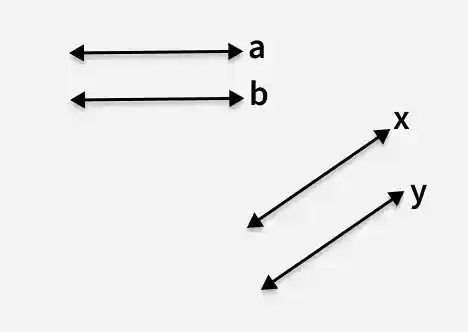
Properties
- Two or more lines can be considered parallel if, even on extending the lines, there is no chance that the lines will meet or cut each other (intersect each other).
- Parallel lines have the special property of maintaining the same slope.
- The distance between parallel lines always remains the same. Note: Here, the lines that are considered to be parallel need not be equal in their length, but a mandatory condition for lines to be considered parallel is that the distance between the lines remains the same, even on the extension of the lines.
- Parallel lines are denoted by the pipe symbol (||). For example, if two lines, A and B, are parallel to each other. They can be represented to be parallel to each other by AB.
Parallel Lines and Transversals
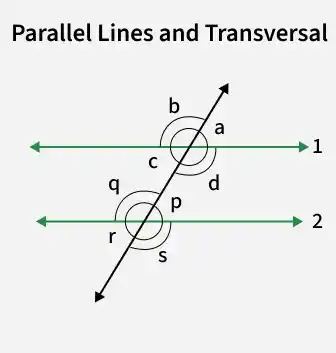
When a line intersects two parallel lines or lines that are not parallel, it is called a transversal. Due to the transversal line, many relations among the pair of angles are created. They can be supplementary or congruent angles. Suppose the given diagram is creating angles a, b, c, d, and p, q, r, s due to the transversal. These eight separate angles formed by the parallel lines and transversal reflect some properties.
1. For a line with equation y = mx + b, we define:
- m: Slope of the given line
- b: Intercept of the line on the Y-axis.
2. If two points (a, b) and (c, d) on the line are given, then we can find the slope of the line using the formula:
Slope = (b – d) / (a – c)
The equation of the line can be determined by considering a point (x, y) on the line. Since we can also find the slope in terms of x and y, we can write
Slope = (y – d) / (x – c)
Equating this with the actual value of the slope, we can derive the equation for the given line as,
(y – d) / (x – c) = (b – d) / (a – c)
3. For a given line ax + by + c = 0, we can write the slope as:
Slope = – a / b
Angles in Parallel Lines
Angles are created due to transversal and parallel lines 1 and 2.
- **Alternate Interior Angles****:** Alternate interior angles are created by the transversal on parallel lines, and they are equal in nature. For example, here, ∠c = ∠p and ∠d = ∠q. The best way to identify the alternate interior angles is by creating a 'Z' in mind. The angles formed by the Z are the alternate interior angles and are equal to each other.
- **Alternate Exterior Angles****:** Alternate exterior angles are also equal in nature. In the diagram above, the alternate exterior angles are ∠a = ∠r and ∠b = ∠s.
- **Consecutive Interior Angles****:** Consecutive interior angles are also known as co-interior angles. They are the angles formed by the transversal on the inside of parallel lines, and they are supplementary to each other. In the above diagram, ∠d + ∠p = 180° and ∠c + ∠q = 180°.
- **Vertically Opposite Angles****:** Vertically opposite angles are formed when two lines intersect each other. The opposite angles are called vertically opposite angles and are parallel to each other. In the above diagram, ∠a = ∠c, ∠b = ∠d, ∠p = ∠r, and ∠q = ∠s.
- **Corresponding Angles****:** Corresponding angles in parallel lines are equal to each other. In the above diagram, ∠a = ∠p, ∠d = ∠s, ∠b = ∠q, and ∠c = ∠r.
**Methods to Identify Parallel Lines: When two or more parallel lines are cut by a transversal, then the angle made by the transversal with the parallel lines shows some distinct properties:
- Parallel lines, when cut by a transversal, have equal alternate interior angles.
- Parallel lines, when cut by a transversal, have equal alternate exterior angles.
- Parallel lines, when cut by a transversal, have equal corresponding angles.
- Parallel lines, when cut by a transversal, have consecutive interior angles on the same side as supplementary.
Violation of any of the above properties will lead to the lines not being considered parallel lines.
Parallel Lines Axioms and Theorems
Below are the axioms and theorems of parallel lines:
**Corresponding Angle Axiom: Corresponding angles are equal to each other. In the corresponding angles axiom, it is said that if the reverse of the property is true, that is, if the reason for the property is true, the assertion must be true as well.
The corresponding angles axiom states that if the corresponding angles are equal, it means that the lines on which the transversal is drawn are parallel to each other.
**Theorem 1: If a transversal is drawn on two parallel lines, the vertically opposite angles will be equal. From the figure given below:
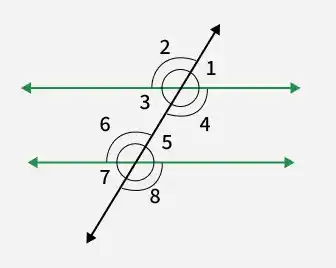
**To Prove: ∠3 = ∠5, ∠4 = ∠6
**Proof: ∠1 = ∠3 and ∠5 = ∠7 (Vertically opposite angles)
∠1 = ∠5 (Corresponding angles)
Therefore, ∠3 = ∠5.
Similarly, ∠4 = ∠6.
The converse of the theorem is also true; that is, if the vertically opposite angles are equal to each other, the lines are parallel in nature.
**Theorem 2: If two lines are parallel to each other and are intersected by a transversal, the interior angles' pairs are supplementary to each other.
**To prove: ∠4 + ∠5 = 180° and ∠3 + ∠6 = 180°.
**Proof: ∠4 = ∠6 (Alternate interior angles)
∠6 + ∠5 = 180° (Linear Pair)
Therefore, ∠4 + ∠5 = 180°
Similarly, ∠3 + ∠6 = 180°.
The converse of the theorem is also true; that is, if the interior angles are supplementary to each other, the lines are parallel in nature.
Parallel Lines are Consistent or Inconsistent
In a system of linear equations, if two lines are parallel, they have the same slope but different y-intercepts.
y=mx+c_1\\ y=mx+c_2
When solving such a system:
- If the lines coincide (same slope and same intercept), the system has infinitely many solutions (consistent and dependent).
- If the lines are distinct and parallel (same slope, different intercepts), the system has no solution (inconsistent).
Related Articles
Solved Examples
**Example 1: In the given figure, angle CMQ is given as 45. Find the rest of the angles.
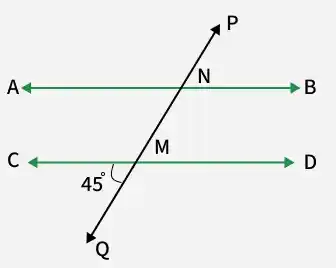
∠CMQ = 45°.
From vertically opposite angles,
∠PMD = 45°.
From linear pair:
∠PMD + ∠PMC = 180°.
⇒ ∠PMC = 135°.
From linear pair:
∠CMQ + ∠DMQ = 180°
⇒ ∠DMQ = 135°.
From Linear pair:
∠DMQ + ∠DMP = 180°.
⇒ ∠DMP = 135°.
From linear pair:
∠CMP + ∠CMQ = 180°.
⇒ ∠CMP = 135°
Thus, ∠ANP = ∠CMP = 135°. (Corresponding angles)
Thus, ∠BNP = ∠DMQ = 135°. (Corresponding angles)
**Example 2: Check if the following lines are parallel.
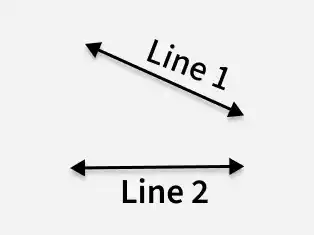
Since the distance between the two lines is continuously decreasing, the lines can't be called parallel lines.
**Example 3: Check if the following lines are parallel.
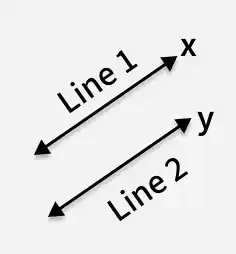
Since on extending, the two lines don't meet each other and the distance between the two lines remains the same. So, yes the lines can be called Parallel Lines.
**Example 4: Find the values of x and y in the given figure where AB is parallel to CD.
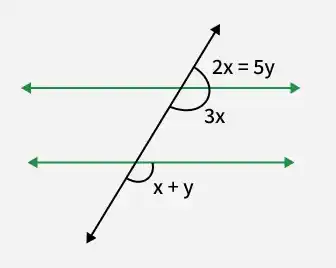
In the above figure:
2x + 5y + 3x = 180 (Linear pair)
⇒ 5x + 5y = 180
⇒ x + y = 36
⇒ x + y = 3x (Corresponding angles)\
⇒ 36 = 3x
⇒ x = 12
Now, x + y = 36
⇒ 12 + y = 36
⇒ y = 24
Parallel Lines Practice Problems
**Problem 1: Given the lines l1, l2, and l3 with slopes 5, 5, and -2-2, respectively, determine which lines are parallel to each other.
**Problem 2: Line _m is parallel to line _n, and they are cut by a transversal _t. If the measure of one of the alternate interior angles formed is 6565°, find the measure of the corresponding angle on the opposite side of the transversal.
**Problem 3: Lines _a and _b are parallel, and a transversal cuts through them, creating an angle of 12120°. What are the measures of the consecutive interior angles on the same side as the given angle?
**Problem 4: Given the equation of a line _y = 2x² + 3, find the equation of a line parallel to it that passes through the point (−2, 1).