How to Calculate Angle in Degrees? (original) (raw)
Last Updated : 23 Jul, 2025
Angle is measured in degrees (°) or radians. In geometry, an angle is formed by two rays (or line segments) that share a common endpoint, called the **vertex. Angles are crucial in understanding various geometric and trigonometric concepts. Every polygon has a specific number of angles based on its sides, and calculating these angles is essential in many areas of mathematics.
Key Measurements:
- A **full circle = 360°
- A **straight line = 180°
- A **semicircle = 180°
- A **Quarter circle = 90°
Angles can be calculated using different methods, depending on the situation and the information available.
Here are some of the most common methods:
Using the Protractor
A protractor is a type of ruler or scale that is used to measure angles physically. A protractor has two scales (0°–180° and 180°–0°).
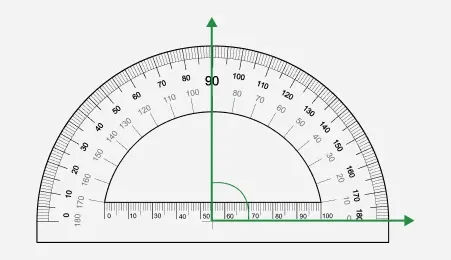
A Protractor measuring 90°
How to use it:
- Place the **center point of the protractor on the **angle's vertex (the corner where the two lines meet).
- Line up one side of the angle with the **0° line on the protractor.
- Look at where the other side of the angle points — the number it touches is the **measure of the angle in degrees.
**➣ Check: How to use a Protractor
Central Angle of a Circle
A circle is a round shape figure whose boundary is equidistant from its center point. The distance between the center point and the boundary is known as the radius of the circle. The angle formed by the two radii of the circle is known as the central angle. The value of the central angle of a circle lies between 0 and 360 degrees.
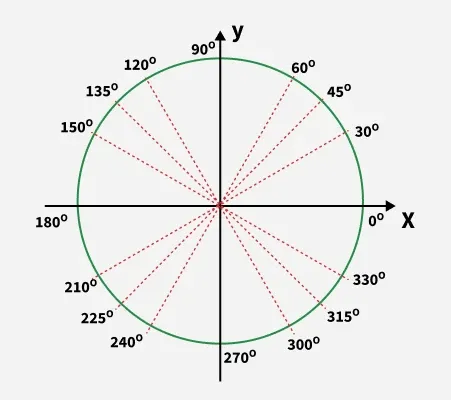
different angle values of the circle from center
The formula to calculate the center angle of a circle is given by:
Length of arc = 2πr × (θ/360)
Θ = 360L/2πrWhere:
- r is the radius of the circle
- Θ is the angle in degrees.
- L = Arc length
**Example: Find the central angle of a circle of radius 2 cm with an arc length of 4 cm.
**Solution:
The formula to calculate the center angle of a circle is given by: Θ = 360L / 2πr
Given:
- r = 2 cm
- L = 4 cm
Θ = 360 L /2 πr
Θ = 114.6°Thus the central angle of the circle is 114.6°.
**➣ Read in Detail: Central angle of a circle with Questions and Answers
Using the Pythagoras Theorem
If two sides of a right angle are known, we can easily calculate the third side of a right angle triangle.
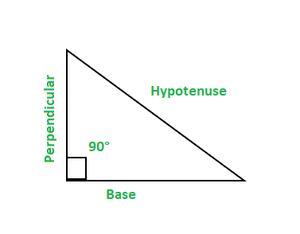
A right-angle triangle has three sides:
- **Base: It is an adjacent side to the angle of 90°.
- **Perpendicular: It is also an adjacent side to the angle of 90°.
- **Hypotenuse: It is a side opposite to the angle of 90°.
In a right-angled triangle, Pythagoras' Theorem is given by:
****(Hypotenuse)** 2 = (Base) 2 + (perpendicular) 2
**➣ Check the trick to learn trigonometric ratios quickly - [SOHCAHTOA]
Once we have these values, we can use inverse functions to find the angle.
**Example: In a right-angled triangle with base = 3, perpendicular = 4, hypotenuse = 5.
**Solution:
To find the angle at the base:
_θ = tan−1(perpendicular/base)
=tan−1(4/3) ≈ 53.13∘.
**➣ Check: Pythagorean Theorem
Sum of Angles Formula
The Sum of angles refers to the total sum of internal angles of a polygon formed between the two sides. If there are six sides of a polygon, there are around six angles. It helps to find an angle if other angles and the sum of angles of a polygon are known.
The formula to find the total sum of angles of a polygon is given by:
**Total sum of angles = 180 (n – 2)
Where,
n is the number of sides of a polygon
**➣ Read More: Sum of Angles
**Example:
- If n = 4:
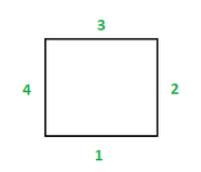
Total sum of angles = 180 (4 – 2)
= 180 (2)
= 360 °If n = 5,
Total sum of angles = 180 (5 – 2)
= 180 (3)
= 540 °To find each angle divide it by n = 4
540/4 = 135°
so, we get 135° each .
- If n = 6
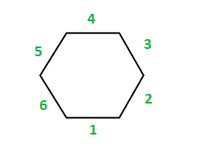
Total sum of angles = 180 (6 – 2)
= 180 (4)
= 720°So, each angle = 720/6 = 120°
Solved Question on Angle in Degrees
**Question 1: Find the central angle of a circle of radius 10cm with an arc length of 18cm.
**Solution:
The formula to calculate the center angle of a circle is given by: Θ = 360L/2πr
Where,
- r = 10cm
- L = 18cm
Θ = Angle in degrees
Θ = 360 × 18 /2 × π × 10
Θ = 103.13°Thus the central angle of the circle is 103.13°.
**Question 2: Find the angle of a parallelogram if the other three angles are 80°, 95°, and 105°.
**Solution:
There are four sides in a parallelogram with the total sum of angles 360°.
Formula to find the sum of angles = 180 (n – 2)Where, n is the number of sides of a polygon
Here, n = 4,The total sum of angles = 180 (4 – 2)
= 180 (2)
= 360 °Total sum = Angle 1 + Angle 2 + Angle 3 + Angle 4
360 = 80+ 95+ 105+ Angle 4
360 = 280 + Angle 4
Angle 4 = 360 – 280
Angle 4 = 80°
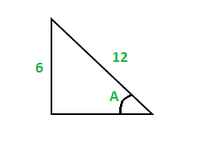
**Question 3: Find angle A in the given figure.
**Solution:
Given: Hypotenuse = 12, Perpendicular = 6
The trigonometry function to calculate the angle is given by:
sinA = 6/12
A = 30°
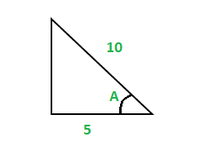
**Question 4: Find angle A in the given figure.
**Solution:
Given: Hypotenuse = 10, Base= 5
The trigonometry function to calculate the angle is given by:
CosA = 5/10
A = 60°
**Question 5: Find the angle of a pentagon if the other four angles are 115°, 100°, 105°, and 100°.
**Solution:
There are five sides in a pentagon with the total sum of angles 540°.
Formula to find the sum of angles = 180 (n – 2)
Where, n is the number of sides of a polygon
Here, n = 5,Total sum of angles = 180 (5 – 2)
= 180 (3)
= 540°Total sum = Angle 1 + Angle 2 + Angle 3 + Angle 4 + Angle 5
540 = 115° + 100° + 105°+100° + Angle 5
540 = 420 + Angle 5
Angle 5 = 540 - 420
Angle 5 = 120°
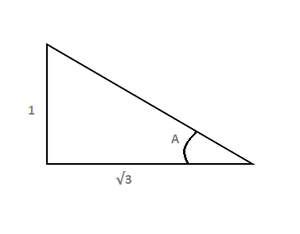
**Question 6: Find angle A in the given figure.
**Solution:
Given: Base = √3, Perpendicular= 1
The trigonometry function to calculate the angle is given by:
tanθ = \frac{perpendicular}{base}
tanθ = 1/√3A = 30°
**Question 7: Find the angle of a parallelogram if the other three angles are 100°, 70°, and 80°.
**Solution:
There are four sides in a parallelogram with the total sum of angles 360°.
Formula to find the sum of angles = 180 (n – 2)
Where, n is the number of sides of a polygonHere, n = 4,
Total sum of angles = 180 (4 – 2)
= 180 (2)
= 360°Total sum = Angle 1 + Angle 2 + Angle 3 + Angle 4
360 = 100 + 70 + 80 + Angle 4
360 = 250 + Angle 4
Angle 4 = 360 – 250
Angle 4 = 110°Thus, the other angle is 110°.
**Question 8: Find the angle of a hexagon if the other five angles are 120°, 115°, 110°, 125°, and 105°.
**Solution:
There are six sides in a hexagon with the total sum of angles 720°.
Formula to find the sum of angles = 180 (6 – 2)Where,
n is the number of sides of a polygonHere, n = 6,
Total sum of angles = 180 (6 – 2)
= 180 (4)
= 720°Total sum = Angle 1 + Angle 2 + Angle 3 + Angle 4 + Angle 5 + Angle 6
720 = 120 + 115 + 110 + 125 + 105 + Angle 6
720 = 575 + Angle 6
Angle 6 = 720 - 575
Angle 6 = 145°Thus, the sixth angle of hexagon is 145°.