Introduction to Logarithm (original) (raw)
Last Updated : 21 Apr, 2026
Logarithmis a mathematical function that represents the exponent to which a fixed number, known as the base, must be raised to produce a given number. In other words, it is the inverse operation of exponentiation.
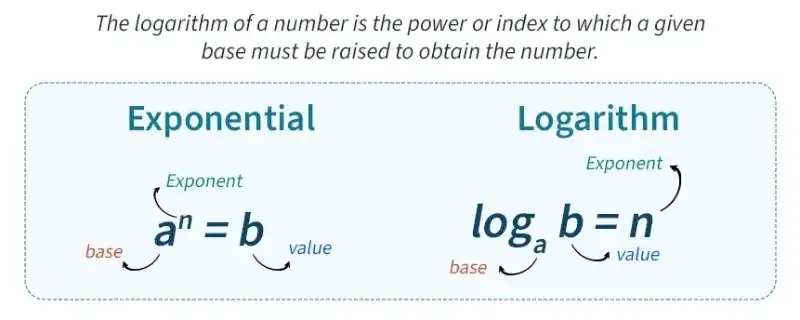
Mathematical Expression for Log
If an = b then log or logarithm is defined as the log of b at base a is equal to n. It should be noted that in both cases base is 'a' but in the log, the base is with the result and not the power.
**a n = b ⇒ log a b = n
- **a is Base
- **b is Argument
- **a and **b Positive Real Numbers
- **n is Real Number
Conversion from Exponential to Log Form
If a number is expressed in the exponential form for example, an = b where a is the base, n is the exponent and b is the result of the exponent then to convert it into the logarithmic form the base 'a' remains base in logarithm, the result 'b' becomes an argument and the exponent 'n' becomes the result here.
**a n = b ⇒ log a b = n
Conversion from Log to Exponential Form
If the expression is in logarithmic form then we can convert it into exponential form by making the argument as a result and the result of logarithm becomes the exponent while the base remains the same. It can be better understood from the expression mentioned below:
**log a b = n ⇒ a n = b
Types of Logarithm
Depending upon the base, there are two types of logarithm, which are,
Common Logarithm
The logarithm with base 10 is known as Common Logarithm. It is written as log10X. The common logarithm is generally written as log only instead of log10.
Let's see some examples.
- log10 = log1010 = 1
- log1 = log101 = 0
- log1000 = log101000 = 3
Natural Logarithm
The logarithm with base e, where e is a mathematical constant is called Natural Logarithm. It is written as logeX. The natural logarithm is also written in the abbreviated form as ln i.e. logeX = ln X.
Let's see some example:
- loge2 = X ⇒ eX = 2
- loge5 = y ⇒ ey = 5
**Learn More: Difference Between Log and Ln
Rules of Logarithm
The common properties or rules of Log are discussed in****:** Logarithm Rules. Apart from the standard properties, there are some other properties of Log. Using these properties we can directly put their values in any equation. These properties are mentioned below:
- Log 1 = 0 This property of log states that the value of Log 1 is always zero, no matter what the base is. This is because any number raised to power zero is 1. Hence, Log 1 = 0.
- Logaa This Property of log states that if the base and augment of a logarithm are the same then the logarithm of that number is 1. This is because any number raised to power 1 results in the number itself. Hence, ln e = logee = 1.
- The value of log of zero is not defined as there is no such number when raised to any power that results in zero. Hence, log 0 = Not defined.
Log and Antilog Table
A log and antilog table is a numerical table that is used to help perform multiplication, division, exponentiation, and root extraction, using logarithms.
Log Table
Log table is used to find the value of the log without the use of a calculator. The log table provides the logarithmic value of a number at a particular base.
A log table has mainly three columns. The first column contains two-digit numbers from 10 to 99, the second column contains differences for digits 0 to 9 and hence called the difference column and the third column contains mean difference from 1 to 9 and hence called mean difference column.
The log table for base e is called the natural logarithm table and that for base 2 is called the binary log table.
The logarithmic value of a number contains two parts named characteristics and mantissa both separated by a decimal. Characteristic is the integral part written on the left side of the table and can be positive or negative while the mantissa is the fraction or decimal that is always positive.
Anti Log Table
Antilog is the process of finding the inverse of the log of the number. This is used when the number is already given in log value and we need to find out the number for which log value is given. If log a = b then a = antilog (b).
Antilog table is helpful in finding the Antilog value without using the calculator. The antilog table also consists of 3 columns among which the first column contains numbers from .00 to .99, the second block which is the difference column contains digits from 0 to 9, and the third block which is the mean difference column contains digits from 1 to 9.
Logarithmic Function
A logarithmic function is the inverse of an exponential function and is defined for positive real numbers with a positive base (not equal to 1). The logarithmic function to the base _b is represented as f(x) = logb(x), where x>0 and __b_>0. In this function, X is the argument of the logarithm, and b is the base.
Graph of Logarithmic Function
A logarithmic function is the inverse of an exponential function and is defined for positive real numbers with a positive base (not equal to 1). The logarithmic function to the base _b is represented as f(x) = logb(x), where x>0 and __b_>0. In this function, X is the argument of the logarithm, and b is the base.
We know that the domain of Logarithmic Function is (0, ∞) and its range is a set of all real numbers. If we plot the graph using the set of domain and range we find that the graph of the logarithmic function is just the inverse of the graph obtained for the exponential function.
.png)
Logarithmic Graph
This indicates the inverse relationship between exponential and logarithmic functions. Also, the logarithmic graph is symmetric around the line y = x. We know that the value of log 1 is zero at any base value. Hence it has an intercept (1,0) on the x-axis and no intercept on the y-axis as log 0 is not defined.
Solved Examples on Logarithms
**Example 1: Find loga16 + 1/2 loga225 - 2loga2
**Solution:
loga16 + 1/2 ✕ 2loga15 - loga22
⇒ loga16 + loga15 - loga4
⇒ loga(16 ✕ 15) - loga4⇒ loga(16 ✕ 15/4) = loga60
**Example 2: Solve logb3 - logb48
**Solution:
log23 - log248
⇒ log2(3/48)
⇒ log2(1/16)
⇒ 1/ 16 = 2-4
⇒ log2(2 - 4)
⇒ log2 (2- 4) = - 4
**Example 3: Find x in logbx + logb(x - 3) = logb10
**Solution:
Given logbx + logb(x - 3) = logb10
⇒ logb(x)(x - 3) = logb10
⇒ (x)(x - 3) = 10
⇒ x2 - 3x - 10 = 0
⇒ x2 - 5x + 2x - 10 = 0
⇒ x(x - 5) + 2(x - 5)
⇒ (x - 5)(x + 2) = 0
⇒ x = 5, -2