Last Minute Notes – Discrete Mathematics (original) (raw)
Last Updated : 26 Aug, 2025
**GATE CSE is a national-level engineering entrance exam in India conducted by top Indian institutions like IISc Bangalore and various IITs. Preparing for the GATE (Graduate Aptitude Test in Engineering) requires strategic planning, especially as the exam day approaches.
Discrete mathematics typically constituting 10% of the total marks. Some of the important topics of Discrete Mathematics are :
- Propositional and First Order Logic
- Sets, Relations and Functions
- Group Theory
- Graph Theory
- Combinatorics
Propositional Logic
Propositional Logic deals with propositions (simple declarative statements) that can be true or false.
**Operators in Propositional logic: Words or symbols that modify or join statements to form more complex statements.
| Operator | Term | Precedence |
|---|---|---|
| ¬ | Negation ( NOT ) | 1 |
| ∧ | Conjunction ( AND ) | 2 |
| ∨ | Disjunction ( OR ) | 3 |
| **→ | Implication | 4 |
| ↔ | Double Implication | 5 |
**Propositional Statements and their Meanings
| Statement | Meaning |
|---|---|
| if p, then q | p implies q |
| if p, q | p only if q |
| p is sufficient for q | a sufficient condition for q is p |
| q if p | q whenever p |
| q when p | q is necessary for p |
| a necessary condition for p is q | q follows from p |
| q unless ¬ p | q provided that p |
**Truth tables for propositional Statements.
| p | q | ¬p | p ∧ q | p ∨ q | p **→ q | p ↔ q |
|---|---|---|---|---|---|---|
| T | T | F | T | T | T | T |
| T | F | F | F | T | F | F |
| F | T | T | F | T | T | F |
| F | F | T | F | F | T | T |
- **Implication ( →): The statement “if p then q” is called an implication and it is denoted by p → q. ( q occurs when ever p occurs but vice versa is not true).
- **Biconditional (↔): The statement “p if and only if( iff ) q” is called a biconditional and it is denoted by p ↔ q. ( q occurs when ever p occurs and vice versa is also true).
Laws in Propositional Logic
**De Morgan’s Law
- **¬( p ∧ q ) ≡ ( ¬p ∨¬q ) The negation of a conjunction is equivalent to the disjunction of the negations.
- **¬( p ∨ q ) ≡ ( ¬p ∧¬q ) The negation of a disjunction is equivalent to the conjunction of the negations.
**Some other laws :
- **Commutative Laws
- **p ∨ q ≡ q ∨ p
- **p ∧ q ≡ q ∧ p
- **Associative Laws
- **p ∨ (q ∨ r) ≡ (p ∨ q) ∨ r
- **p ∧ (q ∧ r) ≡ (p ∧ q) ∧ r
- **Distributive Laws
- **p ∨ (q ∧ r) ≡ (p ∨ q) ∧ (p ∨ r)
- **p ∧ (q ∨ r) ≡ (p ∧ q) ∨ (p ∧ r)
- **Identity and Domination Laws
- **p ∨ F ≡ P
- **p ∨ T ≡ T
- **p ∧ T ≡ P
- **p ∧ F ≡ F
- **Inverse Laws
- **p ∨ ¬p ≡ T
- **p ∧ ¬p ≡ F
Conditional Statements in Propositional Logic
1. Implication : If p (the antecedent) is true, then q (the consequent) must also be true. If p is false, the statement is true regardless of q's value.
**Representation : p **→ q
**Example: If it rains (p), then the ground will be wet (q)
**2. Converse : It represents the reverse of a conditional statement. If q is true, then p must be true.
**Representation : For a statement **p → q its converse is represented as **q → p
**Example: If the ground is wet (q), then it must have rained (p).
**3. Contrapositive : Negates and reverses the original conditional statement. If q is false, then p is false.
**Representation : For a statement **p → q its contrapositive is represented as (¬q → ¬p)
**Example: If the ground is not wet (¬q), then it did not rain (¬p).
- Inverse : Negates both the antecedent and the consequent of the original conditional statement. If p is false, then q is false.
**Representation : For a statement **p → q its inverse is represented as (**¬p → ¬q)
**Example: If the ground is not wet (¬q), then it did not rain (¬p).
**5. Biconditional: In a biconditional p is true if and only if q is true. Both p and q must either be true or false together.
**Representation : For a statement **p → q its biconditional is represented as (**p ↔ q)
**Example: It rains if and only if the ground is wet.
**Types of propositions based on Truth values
**1. Tautology– A **tautology is a logical proposition or formula that is always **true, regardless of the truth values of its components.
**Example: p ∨¬p
**2. Contradiction– A **contradiction is a logical proposition or formula that is always **false, regardless of the truth values of its components.
**Example: p ∧¬p
**3. Contingency – A **contingency is a logical proposition or formula that is **neither always true nor always false; its truth value depends on the truth values of its components.
**Example: p ∧q
**Rules of Inference
A **rule of inference is a logical rule that specifies valid ways to derive conclusions from premises in a formal argument.
Predicate Logic
**Predicates are expressions in logic that represent properties, conditions, or relationships involving one or more variables.
**Example : P(x) ∧ Q(x)
**Quantifiers in predicate : Quantifiers like ∀(for all) and ∃(there exists) are used with predicates to create logical statements:
- ∀x P(x): "For all x, P(x) is true."
- ∃x P(x): "There exists an x for which that P(x) is true."
**Important equivalences involving quantifiers
- **∀x (P(x) ∧ Q(x)) ≡ ∀x P(x) ∧ ∀x Q(x)
- **Ǝx (P(x) ∨ Q(x)) ≡ Ǝx P(x) ∨ Ǝx Q(x)
**Predicate logic follows all the rules of **propositional logic, but it extends those rules to include variables, quantifiers, and predicates.
Combinatorics
**Combinatoricsis the branch of mathematics that studies the counting, arrangement, and combination of objects within a set under specific rules.
**Permutation: A permutation of a set of distinct objects is an ordered arrangement of these objects.

**Combination: A combination of a set of distinct objects is just a count of the number of ways a specific number of elements can be selected from a set of a certain size. The order of elements does not matter in a combination. and it is given by

**Binomial Coefficients: The combination of r items form a set of n elements is denoted by nCr. This number is also called a binomial coefficient since it occurs as a coefficient in the expansion of powers of binomial expressions.
Let x and y be variables and n be a non-negative integer. Then

**The binomial expansion using Combinatorial symbols

**Number of elements in the Union of Finite sets
For a number of finite sets, A1, A2, . . . , An, the number of elements in the union A1 U A2 U ... U An is given by :
****| A** 1 **U A 2 **U ... U A n | = ∑ i | A i ****| - ∑** i<j | A i **⋂ A j | + ∑ i<j<k | A i **⋂ A j ⋂ A k | - .... + (-1) n+1 | A 1 **⋂ A 2 ⋂ A 3 ⋂ .... ⋂A n |
**Important Binomial Expansion Formulas
Some of the important Binomial Expansion formulas are:
- ****(1 + x)** n = **n C 0 x 0 1 n + **n C 1 x 1 1 n-1 **+ **n C 2 x 2 1 n-2 **+ **n C 3 x 3 1 n-3 + ..... + + **n C n x n 1 0
- ****(1 + ax)** n = **n C 0 a 0 x 0 1 n + **n C 1 a 1 1x 1 1 n-1 **+ **n C 2 a 2 2x 2 1 n-2 **+ **n C 3 a 3 x 3 1 n-3 + ..... + + **n C n a n x n 1 0
- ****(1 + x** m ) n = **n C 0 x 0 1 n + **n C 1 x m 1 n-1 **+ **n C 2 x 2m 1 n-2 **+ **n C 3 x 3m 1 n-3 + ..... + + **n C n x nm 1 0
- ****(1 - x** n+1 ****)/(1 + x) = 1 + x+ x** 2 + x 3 + ..... + x n
- **1/(1 - x) = 1 + x+ x 2 + x 3 + ..... = \sum ^\infty _{i=0} x^i
- **1/(1 - ax) = 1 + ax+ a 2 x 2 + a 3 x 3 + ..... = \sum ^\infty _{i=0} a^ix^i
- **1/(1 + x) n = \sum ^\infty _{i=0} \ ^{-n}C_i\ x^i = \sum ^\infty _{i=0} \ ^{n + 1 - i}C_i\ (-x)^i
- **1/(1 + x) n = \sum ^\infty _{i=0} \ ^{-n}C_i\ (-x)^i = \sum ^\infty _{i=0} \ ^{n + 1 - i}C_i\ (x)^i
Set Theory
**Set is an unordered collection of objects, known as elements or members of the set. Example { 1,3,5,4,7, 9,2 }
An element ‘a’ belong to a set A can be written as ‘a ∈ A’, ‘a ∉ A’ denotes that a is not an element of the set A.
- **Equal sets : Two sets are said to be equal if both have same elements. For example A = {1, 3, 9, 7} and B = {3, 1, 7, 9} are equal sets.
**NOTE: Order of elements of a set doesn’t matter. - Subset: A set A is said to be subset of another set B if and only if every element of set A is also a part of other set B. Denoted by ‘⊆‘. ‘A ⊆ B ‘ denotes A is a subset of B.
If the number of elements in the set B is less then the number of element in the set A then it is called a proper subset and if the number of element in set B is equal to the number of element in set A then it is called an improper subset.
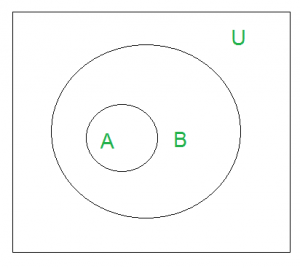
- **Size of a Set: Size of the set S is known as Cardinality ,and it is denoted as |S|.
**Note: Cardinality of a null set is 0. - **Power Sets: The power set is the set all possible subset of the set S. Denoted by P(S). **Example: For a set S = {0, 1, 2} the power set P(S) = {{∅}, {0}, {1}, {2}, {0, 1}, {0, 2}, {1, 2}, {0, 1, 2}}.
**Note: Empty set and set itself is also the member of this set of subsets. - **Cardinality of power set : The Cardinality of power set of a set S is 2n, where n is the number of elements in a set S.
- **Cartesian Products: Cartesian product of A and B is denoted by A × B, is the set of all ordered pairs (a, b), where a belong to A and b belong to B.
**A × B = {(a, b) | a ∈ A ∧ b ∈ B}. - **Cardinality of Cartesian Product : The cardinality of A × B is N*M, where N is the Cardinality of A and M is the cardinality of B.
**Note: A × B is not the same as B × A.
**Set Operations
- **Union : Union of the sets A and B, denoted by A ∪ B, is the set of distinct element belongs to set A or set B, or both.
A U B = n(A) + n(B) - n(A **⋂ B) - **Intersection: The intersection of the sets A and B, denoted by A ∩ B, is the set of elements belongs to both A and B i.e. set of the common element in A and B
- **Set Difference: Difference between sets is denoted by ‘A – B’, is the set containing elements of set A but not in B. i.e all elements of A except the element of B.
A - B = n(A) - n(A **⋂ B) - **Complement: The complement of a set A, denoted by Ac ,It is the set of all the elements in the universal set except A. Complement of the set A is U – A.
**Laws Related to Set Operations
- **Idempotent Law
- A U A = A
- A **⋂ A = A
- **Domination Law
- A **∪ U = U
- A **⋂ ϕ = ϕ
- **Identity Law
- A **⋂ U = A
- A **U ϕ = A
- **Associative Law
- **A ∪ (B ∪ C) = (A ∪ B) ∪ C
- **A ⋂ (B ⋂ C) = (A ⋂ B) ⋂ C
- **Distributive Law
- **A ∪ (B ⋂ C) = (**A ∪ B) ⋂ ( A ∪ C)
- **A ⋂ (B ∪ C) = (**A ⋂ B) ∪ ( A ⋂ C)
- **De Morgan's Law
- \overline{A \cup B} = \overline{A} \cap \overline{B}
- \overline{A \cap B} = \overline{A} \cup \overline{B}
**Multiset : A **multiset is a collection of elements where duplicates are allowed, and the number of times an element appears (its "multiplicity") matters. Unlike a regular set, a multiset can have repeated elements. **Example : {a, a, b, c, c, c} is a multiset where multiplicity of c is 3.
**Note : Size of multiset is equal to the sum of all the multiplicities.
**Relations
A **relation R from a set A to a set B is a subset of the Cartesian product A×B. That is: R ⊆ A×B . Each element of R is an ordered pair (a, b), where a ∈ A and b ∈ B, and a is related to b under R.
Number of possible relations on a set A = 2^{n^2} where n is the number of element of set A.
For a relation (x, y) ∈ R
**Domain of R = all possible values of x
**Range of R = all possible values of y
**Inverse of Relation
For a relation R the inverse of the relation is given by R-1 . R-1 = { (y, x) (x, y) ∈ R }
**Types of relations
- **Reflexive : aRa, ∀ a ∈ A
- **Symmetric : ∀a, b ∈ A ( aRb ⇒ bRa)
- Antisymmetric : ∀a, ∀b ( aRb **∧ bRa ⇒ a = b )
- Asymmetric: ∀a, ∀b ( aRb ∈ R ⇒ bRa ∉ R )
- Transitive : ∀a, ∀b, ∀c ( aRb **∧ bRc ⇒ aRc)
**Closure
The **closure of a relation refers to the smallest relation that contains the original relation and satisfies a specific property (such as reflexivity, symmetry, or transitivity).
- **Reflexive Closure : The reflexive closure of a relation R on a set A is the smallest relation that contains R and is reflexive. It ensures every element is related to itself.
**Example : Given R={(1,2),(2,3)} on A={1,2,3}, then the reflexive closure R' = {(1,1),(2,2),(3,3),(1,2),(2,3)}. - **Symmetric closure : The symmetric closure of a relation R is the smallest relation that contains R and is symmetric. It ensures if (a,b)∈R , then (b,a)∈R.
**Example : Given R={(1,2),(2,3)} on A={1,2,3}, then the symmetric closure R' = {(1,2),(2,1),(2,3),(3,2)}. - **Transitive Closure: The transitive closure of a relation R is the smallest relation that contains R and is transitive. It ensures if (a,b)∈R and (b,c)∈R, then (a,c)∈R.
**Example : Given R={(1,2),(2,3)} on A={1,2,3}, then the transitive closure R' = {(1,2),(2,3),(1,3)}.
**Equivalence relation
An Equivalence relation is a relation which is reflexive ****,** symmetric, and transitive.
**Example: The relation "is equal to" (=) is an equivalence relation on the set of real numbers (R).
**Equivalence Class : For an equivalence relation R on a set A. For any element a ∈ A, the **equivalence class of a, denoted as [a], is defined as: [a]={x∈A∣(a,x)∈R}
This means [a] contains all elements of A that are related to a under the relation R.
For any two equivalence class either **[a] U [b] = ϕ or [a] = [b]
**Partial Order Relation: A **partial order relation is a binary relation defined on a set that is reflexive antisymmetric and transitive.
**POSET: A POSET (partially ordered set) is a set of itemsthat follows a partial order relations it is represented as [A: R] where A is the set in which the partial order relation R is defined. **Example : ( R, ≤ ) , relation defined by less than equal to on the real numbers.
Hasse Diagram : A **Hasse diagram is a graphical representation of a poset (partially ordered set) that shows the ordering of elements in a simplified way.**
**Minimal and Maximal Elements: In a poset (P,≤), **minimal and **maximal elements are defined as follows:
- **Minimal Element:
- An element a ∈ P is minimal if there is no x ∈ P such that x<a (strictly smaller).
- a has no smaller element in the poset.
- **Maximal Element:
- An element a∈P is maximal if there is no x∈P such that a<x (strictly larger).
- a has no larger element in the poset.
**Note: There can be multiple minimal or maximal elements in a poset.
**Least Upper Bound (LUB) : The **least upper bound of a subset S of a poset P is the smallest element in P that is **greater than or equal to every element in S. It is also known as supremum and is denoted as sup(S). If u is an upper bound: For all x ∈ S, x ≤ u.
**Greatest Lower Bound (GLB) : The **greatest lower bound of a subset S of a poset P is the largest element in P that is **less than or equal to every element in S. It is also known as Infimum and Denoted as inf(S). If g is a lower bound: For all x ∈ S, g ≤ x.
Lattice
A**latticeis a special type of partially ordered set (**poset) in which **every pair of elements has both **Least Upper Bound (LUB) and Greatest Lower Bound (GLB).
**Types of lattice :
- **Bounded Lattice: A lattice with a **least element (denoted 0) and a **greatest element (denoted 1).
- **Complete Lattice: A lattice in which every subset (not just pairs) has both a join and a meet.
- **Distributive Lattice : A lattice where the operations ∨ and ∧ distribute over each other.
**Groups
A **group is a set G with a binary operation + that satisfies:
- **Closure: For all a, b ∈ G a + b ∈ G.
- **Associativity: (a + b) + c = a + (b + c) for all a, b, c ∈ G.
- **Identity Element: There exists an element e ∈ G such that a + e = e + a = a for all a ∈ G.
- **Inverse Element: For every a ∈ G, there exists b ∈ G such that a + b = b + a = e.
**Semigroup: A **semigroup is a set S with a binary operation + that satisfies the conditions for closure and Associativity .
**Monoid : A **Monoid is a set S with a binary operation + that satisfies the conditions for closure and Associativity and has an identity element.
**Subgroup : A **subgroup is a subset H of a group G that itself forms a group under the same binary operation. Intersection of two subgroup is also a subgroup but the union of two subgroups does not necessarily a sub group
**Cyclic Group : A **cyclic group is a group G that can be generated by a single element g, Every element of G can be written as gn for some integer n.
All sub group of a cyclic group are cyclic.
**Read more : **Group Theory
Graph Theory
- No. of edges in a complete graph = n(n-1)/2
- Bipartite Graph : There is no edges between any two vertices of same partition . In complete bipartite graph no. of edges =m*n
- Sum of degree of all vertices is equal to twice the number of edges.
- Maximum no. of connected components in graph with n vertices = n
- Minimum number of connected components is 0 (null graph) and 1 (not null graph)
- Minimum no. of edges to have connected graph with n vertices = n-1
- To guarantee that a graph with n vertices is connected, minimum no. of edges required = {(n-1)*(n-2)/2 } + 1
- A graph is euler graph if it there exists atmost 2 vertices of odd – degree
- Tree
- Has exactly one path btw any two vertices
- not contain cycle
- connected
- no. of edges = n -1
- For complete graph the no . of spanning tree possible = nn-2
- For simple connected planar graph
- A graph is planar if and only if it does not contain a subdivision of K5 and K3, 3 as a subgraph.
- Let G be a connected planar graph, and let n, m and f denote, respectively, the numbers of vertices, edges, and faces in a plane drawing of G. Then n – m + f = 2.
- Let G be a connected planar simple graph with n vertices and m edges, and no triangles. Then m ≤ 2n – 4.
- Let G be a connected planar simple graph with n vertices, where n ≥ 3 and m edges. Then m ≤ 3n – 6.
- Every bipartite graph is 2 colourable and vice versa
- The no. of perfect matchings for a complete graph (2n)/(2nn!)
- The no. of complete matchings for Kn.n= n!