Latus Rectum (original) (raw)
Last Updated : 23 Jul, 2025
**Latus rectum is a crucial concept in the study of conic sections, such as parabolas, ellipses, and hyperbolas. The name latus rectum comes from the Latin words “latus” means (side) and “rectum” means (straight). It refers to the line segment perpendicular to the major axis of the conic section that passes through the focus of the conic section and has endpoints on the curve.
Understanding the latus rectum is essential for analyzing the geometric properties and dimensions of these curves. Latus Rectum plays a significant role in defining the geometric effects of conic sections like ellipses, parabolas, and hyperbolas.
This article provides a detailed explanation of the latus rectum, highlighting its relationship to the focal points and axes of conic sections
Table of Content
- What is Latus Rectum?
- Terms Related to Latus Rectum
- Properties of Latus Rectum
- Latus Rectum of Parabola
- Latus Rectum of Hyperbola
- Latus Rectum of a Ellipse
What is Latus Rectum?
Latus rectum of a conic section is a l**ine segment that passes through a focus of the conic section and is perpendicular to the major axis. Its endpoints lie on the curve of the conic section. The length of the latus rectum is a measure of how "wide" the conic section is at the focus. It plays a significant role in characterizing the geometric properties of conic sections like ellipses, parabolas, and hyperbolas.
These are various terms required to define the Latus Rectum are:
Directrix
Directrix of a conic section is a l**ine such that the ratio of the distance of any point on the conic from the focus to its perpendicular distance from the directrix is constant. This ratio is known as the eccentricity 𝑒.
Transverse Axis
Transverse axis is a term used specifically in the context of hyperbolas. The **transverse axis of a hyperbola is the line segment that joins the two vertices of the hyperbola and passes via the center. It is the axis along which the hyperbola opens, and it fibs along the line that intersects the foci of the hyperbola.
Conjugate Axis
Conjugate axis is a term associated with hyperbolas, completing the concept of the transverse axis. It plays a significant role in defining the structure and properties of hyperbolas. The **conjugate axis of a hyperbola is the line segment that is perpendicular to the transverse axis and passes through the center of the hyperbola. It does not intersect the hyperbola itself but helps in describing its asymptotic behavior and the form of the associated rectangle used in drawing the hyperbola.
Latus Rectum of Parabola
The **latus rectum is the line segment that passes through the focus, perpendicular to the axis of symmetry of the parabola. The length of the latus rectum for a standard equation of a parabola y2 = 4ax is equal to LL' = 4a. The endpoints of the latus rectum of a Parabola are (a, 2a), (a, -2a).
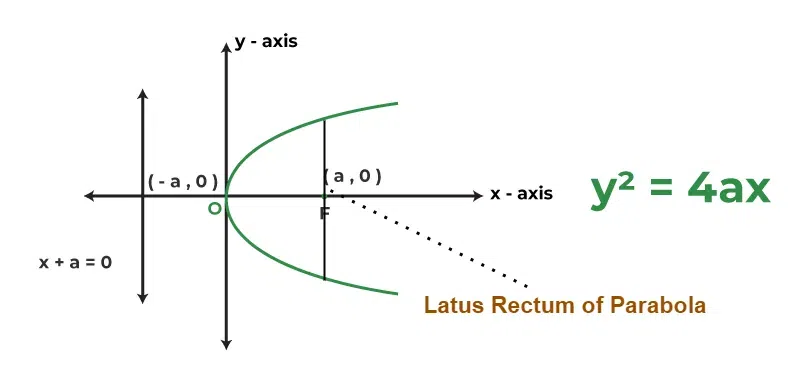
Latus Rectum of Parabola
Length = 4a
a= parabola’s focal length.
Properties of Latus Rectum a Parabola
- **Symmetry: Latus rectum is symmetric with respect to the axis of the parabola.
- **Focus: It passes through the focus of the parabola.
- **Length: Length of the latus rectum is always four times the distance from the vertex to the focus.
Latus Rectum of Hyperbola
The latus rectum of a hyperbola is the line segment that passes through one of the foci and is perpendicular to the transverse axis and whose ending point lies on the hyperbola. The length of the latus rectum is given by 2b^2/a, similar to the ellipse, where a and b are the lengths of the semi-transverse and semi-conjugate axes, respectively.

Latus Rectum of Hyperbola
Length = 2b^2/a
a= length of semi transverse axis
b= length of semi conjugate axis
Properties of Latus Rectum of a Hyperbola
- **Focus: Latus rectum passes through each focus of the hyperbola.
- **Length: Length of each latus rectum is proportional to the square of the semi-minor axis divided by the semi-major axis, similar to an ellipse.
- **Endpoints: Endpoints can be found by substituting the x-coordinate of the focus into the hyperbola's equation to find the corresponding y-coordinates.
Latus Rectum of a Ellipse
Latus rectum of an ellipse is a **line segment that is perpendicular to the major axis and passes through either focus, and whose endpoints lie on the ellipse. The length of the latus rectum is given by 2b^2/a, where a is the length of the semi-major axis and b is the length of the semi-minor axis. It is an important geometric feature used in various calculations and properties of ellipses.
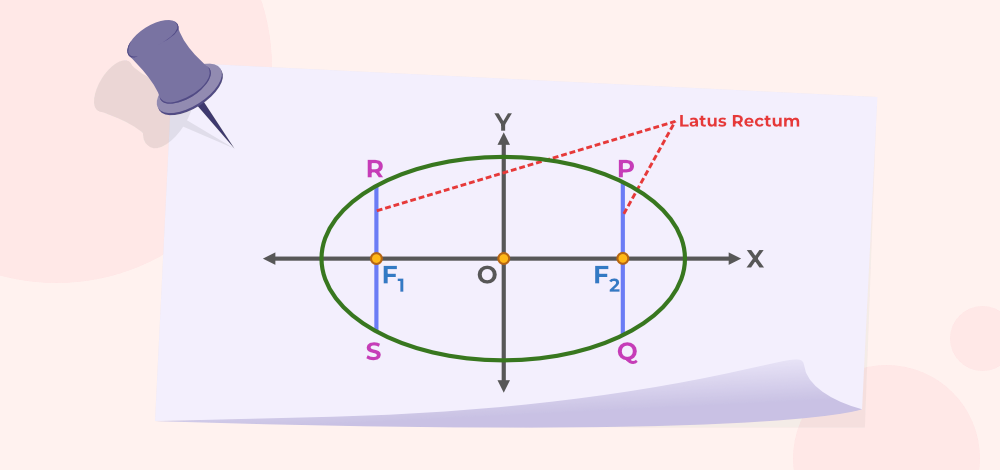
Length = 2b^2/a
a= length of semi-major Axis
b= Length of semi minor axis
Properties of Latus Rectum of an Ellipse
- **Focus: Latus rectum passes through each focus of the ellipse.
- **Length: Length of each latus rectum is proportional to the square of the semi-minor axis divided by the semi-major axis.
- **Endpoints: Endpoints can be found by substituting the x-coordinate of the focus into the ellipse's equation to find the corresponding y-coordinates.
**1: What will be the length of the latus rectum of the following parabola x 2 **= - 4y.
From the equation given above, we can conclude that the parabola is symmetric about the Y-axis and it is open in a downward position.
x2 = - 4y
x2 = - 4ay
4a = 4
Thus, the length of the latus rectum of a given parabola is 4 units.
**2: Find the equation of the parabola having its focus ( 0, -3) and the directrix of the parabola is on the line y = 3.
As the focus of the parabola is on the y- axis and is also below the directrix, the parabola will be opened downward, and the value of a = -3
Hence, equation of a parabola is given as x² = 12x
Length of the latus rectum of a parabola is |4 (-3)| = 12
**3: Find the latus rectum of parabola y 2 **= 20x.
Given equation of a parabola is y2 = 20x
Comparing this with the standard equation of a parabola y2=4ax we have
4a = 20
a = 5
For equation of a parabola y2= 4ax the equation of latus rectum is x = -a, which is
x = -5
x + 5 = 0
Therefore the equation of latus rectum of parabola is x + 5 = 0
Practice Questions on Latus Rectum
**Q1. Calculate the length of the latus rectum of the following parabola x 2 - 2x + 8y + 17 = 0
**Q2. Find the equation of directrix of a parabola x 2 = - 16y
**Q3. Find the length of latus rectum of the ellipse x 2 /49 + y 2 /25 = 1
Conclusion
In the conclusion, the latus rectum is a term that refers to the conic area of the spine. It is necessary to first learn what conic sections are in order to understand what a latus rectum is. latus rectum provides valuable insights into the dimensions and shape of these curves. Conic sections are two-dimensional curves that are formed when a cone meets a plane in a circular way.