Linear Equations Formula (original) (raw)
Last Updated : 19 Feb, 2026
A linear equation is known as an algebraic equation that represents a straight line. It is composed of variables and constants. Linear equations consist of the first-order, which involves the highest power of any of the involved variables, i.e.
- It is also considered a polynomial of a degree
- The equation that contains only one variable is known as a homogeneous equation.
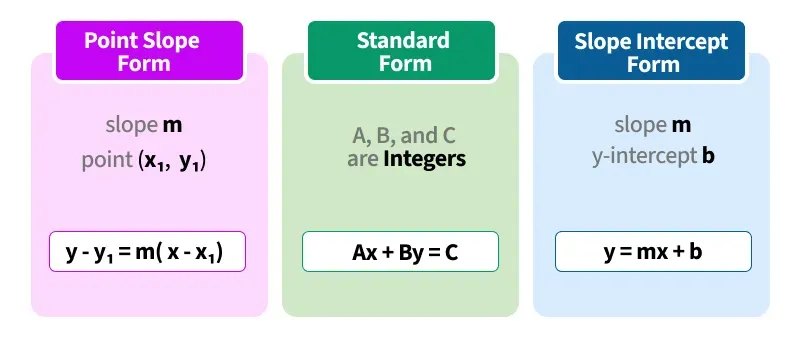
The formula used to represent linear equations is called the linear equation formula. There are various ways to represent the linear equations, such as,
Standard Form
The most generalized form of a linear equation in two variables is:
Ax + By = C where A, B, and C are constants, and x and y are variables.
This form is particularly useful for quickly determining the intercepts and is common in algebraic problems.
**Example: Convert the equation y = 2/3x - 4 into standard form.
**Solution:
We start with the given equation: y = 2/3x − 4
Multiply everything by 3 to eliminate the fraction: 3y = 2x − 12Rearrange to get it in Ax + By = C form: 2x − 3y = 12
**Read More: Standard Form
Slope-Intercept Form
This is another highly popular form for representing linear equations, especially when graphing:
y = mx + by where m is the slope of the line, and b is the y-intercept.
This form directly shows how y changes with x and where the line crosses the y-axis.
**Example: Find the equation of a line with slope m = −5m and y-intercept b = 7.
**Solution:
Since we are given the slope and y-intercept, we directly substitute into the equation:
y = −5x + 7
**Read More: Slope-Intercept Form
Point-Slope Form
Useful for when you know a point on the line (x1, y1) and the slope
m: y − y1 = m(x − x1)
This form is handy for writing the equation of a line when you are given a point on the line and the slope.
**Example: Find the equation of the line passing through (3, -2) with a slope of 4.
**Solution:
Using the point-slope formula: y − (−2) = 4(x − 3)
Simplify: y + 2 = 4x − 12
Subtract 2 from both sides:
y = 4x − 14 (which is also in slope-intercept form)
**Read More: Point-Slope Form
Intercept Form
If the line intercepts the axes at (a, 0) and (0, b), then the equation can be expressed as:
\frac{x}{a} + \frac{y}{b} = 1
This is useful when you know where the line crosses the x-axis and y-axis.
**Example: Find the equation of the line that intercepts the x-axis at (6,0) and the y-axis at (0, 4).
**Solution:
Using the formula: \frac{x}{a} + \frac{y}{b} = 1
Substituting a = 6 and b = 4:
\frac{x}{6} + \frac{y}{4} = 1
**Related Articles
**Solved Examples of Linear Equations Formula
**Question 1: Solve for y, 6y – 3 = 0
**Solution:
Solving for the value of y,
Adding 3 to both sides of the equation,
⇒ 6y - 3 + 3 = 3
⇒ 6y = 3Dividing both sides of the equation by 6
⇒ y = 3/6Simplifying the equation,
⇒ y = 1/2
**Question 2: Solve the equation in x, 4/5x -5 = 15
**Solution:
4/5x - 5 = 15
Taking constants to RHS,
4/5x = 15 + 5
4/5x = 20
x = 100/4
x = 25
**Question 3: There are two numbers, one equal to 7/6 and the other equal to 1/3 times some number x. The sum of these two numbers is 1. Find x.
**Solution:
The sum of both the numbers is 1 so the equation will be, 7/6 + 1/3x = 1
Taking all the constants to the R.H.S of the equation.
1/3x = 1 - 7/6
1/3x = -1/6Multiplying both the side of the equation by 3
3 (1/3x) = 3 × (-1/6)
x = -1/3
**Question 4: Solve the equation in x, 3x + 5y = 33, where y = 3
**Solution:
We have been provided with an equation 3x + 5y = 33
We have to find the value of x as the value of y is provided in the question y= 3
So, putting the value of y in the equation
3x + 5(3) = 33
3x + 15 = 33By taking all the constants to the R.H.S of the equation.
3x = 33 - 15
3x = 18
x= 18/3
x = 6So here the value of x is 6
**Question 5: There are two numbers, one equal to 2/4 some number y, and the other equal to 1/3 times some number x. The sum of these two numbers is 3. Find y. And the value of x is x = 2
**Solution:
The sum of both the numbers is 3 so the equation will be, 2/4y + 1/3x= 3
Pitting the value of x the equation will be
2/4y + 1/3(2)= 3
2/4y + 2/3= 3Taking all the constants to the R.H.S of the equation.
2/4y = 3-2/3
2/4y = 4/3
y= 4*4/3*2
y = 16/6
y = 8/3So, the value of y will be 8/3
Linear Equations Formula - Practice Problems
**Question 1: Solve for x: 5x + 7 = 12.
**Question 2: Solve for y: 9y − 4 = 23.
**Question 3: Solve for z: 3z + 11 = 2z + 7.
**Question 4: Solve for x: 7x − 5 = 2x + 20.
**Question 5: Solve for y: 12y + 4 = 8y − 16.
**Question 6: Solve for y: \frac{5}{2}z - 3 = 7 .
**Question 7: Solve for x: 4x + \frac{3}{5} = \frac{2}{3} .
**Question 8: Solve for y: \frac{3}{4}y + 7 = 2.
**Question 9: Solve for x: \frac{2}{3}x - 5 = \frac{1}{4}.
**Question 10: Solve for z: \frac{6}{7}z + 3 = 10.
**Answer:-
- 1
- 3
- -4
- 5
- -5
- 4
- 1/60
- -20/3
- 63/8
- -49/6