Standard Form of a Line (original) (raw)
Last Updated : 30 Jan, 2026
There are several ways to represent the equation of a straight line. One of the most commonly used forms is the standard form, where all variables appear on one side of the equation and the constant on the other.
The standard form of an equation is
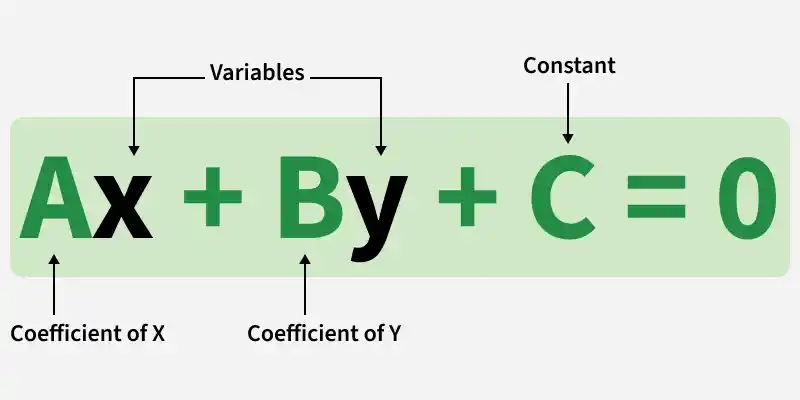
Standard form of a straight line
Here, A, B, and C are the real constant and the values of A and B are not zero.
Graph
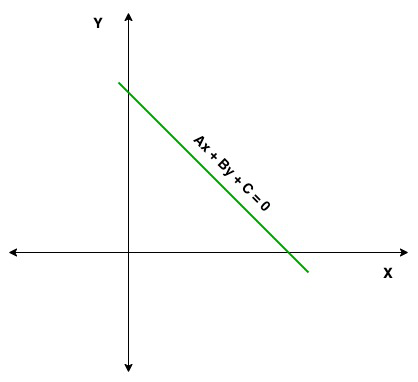
The graph of any equation in standard form is always a straight line on the coordinate plane.
**Special Cases
- If the value of A = 0 then the equation of the line is y = -C/B. The line is horizontal, which means parallel to the x-axis.
- If the value of B = 0, then the equation of the line is x = -C/A. The line is vertical, means parallel to the y-axis.
**For example,
- 2x + 4y + 3 = 0
- 4x - 6y = -34
Both the above equations are in the standard form
- 3x = -3y - 2
- 3y = 2(x + 1)
Both the above equations are not in the standard form
**Converting Standard Form to Other Forms
The standard form of the equation can of represented in three different forms:
**Slope-Intercept Form
As we know the equation of slope-intercept form is y = mx + c. Now we see how to represent the general equation i.e., Ax + By + C = 0 in the Slope-intercept form.
So, if the value of B ≠ 0, then the general equation i.e., Ax + By + C = 0 can be written as:
y = -\frac{A}{B}x-\frac{C}{B}...(1)
Now, compare the equation(1) with the slope-intercept form,i.e. y = mx + c, we get
m = -A/B, and c = -C/B
Hence, the slope of the Ax + By + C = 0 is -A/B, and the y-intercept is -C/B.
**Examples: Find the slope and the y-intercept of the given equation, 2x + 5y + 1 = 0.
**Solution:
Given: equation of line = 2x + 5y + 1 = 0
Find: slope and y-intercept
So the given equation can be written as
y = (-1 - 2x)/5
y = -2x/5 - 1/5...(1)
As we know that the slope-intercept form is
y = mx + c...(2)
On comparing eq(1) and (2) we get
m = -2/5 and c = -1/5
Hence, the slope is -2/5 and y-intercept is -1/5
**Intercept Form
As we know the intercept form of the equation is\frac{x}{a}+\frac{y}{b}=1. Now we see how to represent the general equation i.e., Ax + By + C = 0 in the intercept form.
So, if the value of C ≠ 0, then the general equation i.e., Ax + By + C = 0 can be represented as:
\frac{x}{-\frac{C}{A}}+\frac{y}{-\frac{C}{B}} = 1 ...(1)
Now, compare the equation(1) with the intercept form, i.e.\frac{x}{a}+\frac{y}{b}=1 , we get
a = -C/A and b = -C/B
So, the x-intercept is -C/A and the y-intercept is -C/B. And if the value of C = 0, then the general equation is Ax + By = 0, which means the line passes through the origin so, it has zero intercepts.
**Examples: Find the x and y-intercept of the given equation, 4x + 8y + 2 = 0.
**Solution:
Given: 4x + 8y + 2 = 0.
Find: x and y-intercept
So the given equation can be written as
\frac{x}{\frac{-2}{4}}+\frac{y}{\frac{-2}{8}}=1 ...(1)
As we know that the Intercept Form is
\frac{x}{a}+\frac{y}{b}=1 ...(2)
On comparing eq(1) and (2) we get
a = -2/4 = -1/2
b = -2/8 = -1/4
So the x-intercept is -1/2 and y-intercept is -1/4
**Normal Form
As we know the intercept form of the equation is xcosω + ysinω = p. Now we see how to represent the general equation i.e., Ax + By + C = 0 in the normal form.
So let us consider the normal form is Ax + By + C = 0.
Divide the whole equation by: \sqrt{A^2 + B^2}.
\frac{A}{\sqrt{A^2 + B^2}} x + \frac{B}{\sqrt{A^2 + B^2}} y + \frac{C}{\sqrt{A^2 + B^2}} = 0
Rearranging: \frac{A}{\sqrt{A^2 + B^2}} x + \frac{B}{\sqrt{A^2 + B^2}} y = - \frac{C}{\sqrt{A^2 + B^2}}
Comparing with normal form x cos ω + y sin ω = p, we get:
\cos \omega = \frac{A}{\sqrt{A^2 + B^2}}, \qquad\sin \omega = \frac{B}{\sqrt{A^2 + B^2}}
p = - \frac{C}{\sqrt{A^2 + B^2}}
As we know that
sin2ω + cos2ω = 1
So, the normal form of the general equation is xcosω + ysinω = p.
**Example: Convert the given equation in the normal form 2x - 2y - 6 = 0.
**Solution:
Given: 2x - 2y - 6 = 0
Divide the given equation
√(2)2 + (-2)2 = √4 + 4 = √8 = 2√2
So, 2x/2√2 - 2y/2√2 = 6/2√2
x/√2 - y/√2 = 3/√2...(1)
As we know that the Intercept Form is
xcosω + ysinω = p...(2)
On comparing eq(1) and (2) we get
cosω = 1/√2
sinω = -1/√2
So, xcos45° + ysin225° = 3/√2
**Converting Slope-Intercept Form to Standard Form
We have an equation y = 3/5x + 2/9. Now we convert the given equation into the standard form. Here, the given equation is written in slope-intercept form, i.e., y = mx + c, and we have to convert the given equation into a standard form which is Ax + By + C = 0.
So, the given equation is multiplied by 45 on both sides, because 45 is divisible by 5 and 9
45y = 45(3x/5) + 45(2/9)
45y = 9(3x) + 5(2)
45y = 21x + 10
or 21x - 45y + 10 = 0So, the standard form of the equation y = 3/5x + 2/9 is 21x - 45y + 10 = 0.
Related Articles
Solved Questions
**Question 1: Find the slope and the y-intercept of the given equation, 3x + 6y - 9 = 0.
**Solution:
Given: equation of line = 3x + 6y - 9 = 0
Find: slope and y-intercept
3x +6y-9 = 0
6y = -3x + 9
y = -1/2(x) + 3/2
Comparing this with the slope-intercept form, we find:
Slope ? = -1/2
Y-intercept ? = 3/2
So, the slope of the given equation is -1/2 and y - intercept is 3/2
**Question 2: Find the x and y-intercept of the given equation, 12x - 4y - 2 = 0.
**Solution:
Given: 12x - 4y - 2 = 0
Find: x and y-intercept
So the given equation can be written as
\frac{x}{\frac{2}{12}}+\frac{y}{\frac{2}{-4}}=1 ...(1)
As we know that the Intercept Form is
\frac{x}{a}+\frac{y}{b}=1 ...(2)
On comparing eq(1) and (2) we get
a = 2/12 = 1/6
b = -2/4 = -1/2
So the x-intercept is 1/6 and y-intercept is -1/2
**Question 3: Find the value of p and ω, equation is x + y + 3 = 0.
**Solution:
Given: x + y + 3 = 0
Divide the given equation
√(1)2 + (1)2 = √2
So, x/√2 + y/√2 = -3/√2...(1)
As we know that the Intercept Form is
xcosω + ysinω = p...(2)
On comparing eq(1) and (2) we get
cosω = 1/√2
sinω = 1/√2
xcos45° + ysin45° = -3/√2
Hence, p = -3/√2 and ω = 45°
Practice Problems on Standard Form of a Straight Line
**Question 1: The equation of a line is given by, 2x – 6y + 3 = 0. Find the slope and both the intercepts.
**Question 2: Given that the coordinate (3, 4) lies on the line y = 3x + c calculate the y-intercept of the straight line.
**Question 3: The coordinate A = (0, 2) lies on a straight line. The gradient of the line is 5. Using this information, state the equation of the straight line.
**Question 4: Find the equation of the straight line passing through the points with coordinates (3, 4) and (6, -5).
**Question 5: Draw the graph of the linear equation 3x + 4y = 6. At which points does the graph cut the x-axis and y-axis?