Introduction to Proofs (original) (raw)
Last Updated : 2 Jun, 2026
Mathematical proof is a logical argument used to show that a mathematical statement is true. To verify a statement, we use statements, logical operators, and quantifiers.
- A statement is either true or false, but not both.
- Logical operators include AND, OR, NOT, IF–THEN, and IF AND ONLY IF.
- Quantifiers include “for all” and “there exists.”
- These are used to check the correctness of mathematical statements.
A proof is a clear, step-by-step explanation that shows why a statement (theorem, lemma, or corollary) is true using axioms, definitions, and previously proven results. Proofs help convert conjectures into established mathematical truths.
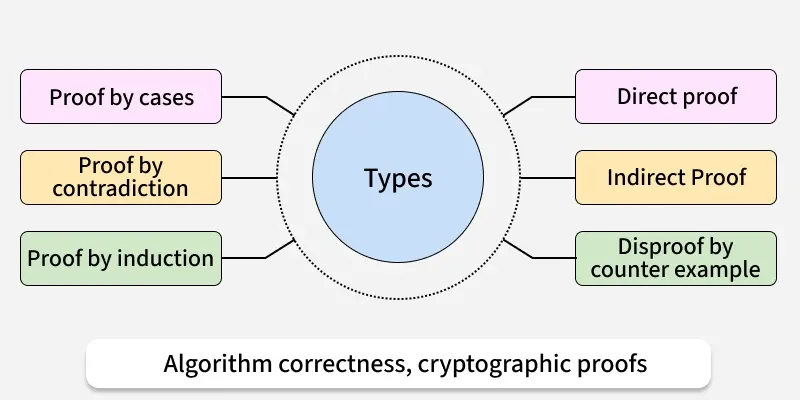
**Types of Mathematical Proofs
Mathematicians use several styles of proof, depending on the nature of the statement being proven and the tools available. The most common types are:
**Proof by Cases
In this method, we evaluate every case of the statement to conclude its truthiness.
**Example: For every integer x, the integer x(x + 1) is even
**Proof: If x is even, hence, x = 2k for some number k. now the statement becomes: 2k(2k + 1)
which is divisible by 2, hence it is even.
If x is odd, hence x = 2k + 1 for some number k, now the statement becomes: (2k+1)(2k+1+1) = (2k + 1) 2(k + 1)
which is again divisible by 2 and hence in both cases we proved that x(x+1) is even.
- Used in algorithm analysis when different inputs cause the algorithm to behave differently, and you need to prove correctness for each scenario.
**Proof by Contradiction
We assume the negation of the given statement and then proceed to conclude the proof.
**Example: Prove that sqrt(2) is irrational.
Suppose sqrt(2) is rational.
sqrt(2) = a/b, for some integers a and b with b != 0.
Let us choose integers a and b with sqrt(2) = a/b, such that b is positive and as small as possible. (Well-Ordering Principle)a2 = 2b2
Since a2 is even, it follows that a is even.
a = 2k for some integer k, so a2 = 4k2
b2 = 2k2. Since b2 is even, it follows that b is even.
Since a and b are both even, a/2 and b/2 are integers with b/2 > 0, and sqrt(2) = (a/2)/(b/2), because (a/2)/(b/2) = a/b.
But it contradicts our assumption b is as small as possible. Therefore sqrt(2) cannot be rational.
- Common in theoretical computer science to prove impossibility results or limits.
**Proof by Induction
The Principle of Mathematical Induction (PMI). Let P(n) be a statement about the positive integer n. If the following are true:
1. P(1),
2. (for all n there exists Z+) P(n) implies P(n + 1),
Then (for all n there exists Z+) P(n).
**Example: For every positive integer n prove that , 1 + 2 +···+ n = n(n + 1)/ 2
**Proof:
Base case: If n = 1,
1 + ··· + n = 1
n(n + 1)/2 = 1**Inductive step:
Suppose that for a given n there exists Z+,1 + 2 +···+ n = n(n + 1)/ 2 ---- (i) (inductive hypothesis)
Our goal is to show that:
1 + 2 +···+ n + (n + 1) = [n + 1]([n + 1] + 1)/ 2
i.e. 1 + 2 +···+ n + (n + 1) = (n + 1)(n + 2) /2Add n + 1 both sides to equation (i), we get,
1 + 2 +···+ n + (n + 1)
= n(n + 1)/ 2 + (n + 1)
= n(n + 1) /2 + 2(n + 1) /2
= (n + 2)(n + 1) /2Hence Proved
- Essential for proving the correctness of recursive algorithms, loop invariants, and formulas used in algorithms.
**Direct Proof
When we want to prove a conditional statement p implies q, we assume that p is true, and follow implications to get to show that q is then true.
It is Mostly an application of hypothetical syllogism, [(p → r) ∧ (r → q)] → (p → q)]
We just have to find the propositions that lead us to q.
**Theorem: If m is even and n is odd, then their sum is odd
**Proof:
Since m is even, there is an integer j such that m = 2j.
Since n is odd, there is an integer k such that n = 2k+1. Then,
m+n = (2j)+(2k+1) = 2(j+k)+1Since j+k is an integer, we see that m+n is odd.
- Used in program verification to show that a function meets its specification directly from the code logic.
**Indirect Proof
This method is also called as proof by contraposition.
In this method to prove a conditional statement p → q, we assume that ∼q is true and then follow the implication by applying knowledge and facts that we know to show that ∼p is true.
Since, we know that ∼q → ∼p is equivalent to p->q, by proving ∼q → ∼p, we'll indirectly be showing that p → q. Hence, the name "indirect proof".
**Example: Prove that if n is an integer and 3n + 2 is even, then n is even.
**Proof: Assume n is odd,
Hence n = 2k + 1, for some integer k
Now, 3n + 2 = 3(2k + 1) + 2
3n + 2 = 3(2k) + 3(1) + 2
3n + 2 = 2(3k) + 3 + 2
3n + 2 = 2(3k) + 5, where 3k is some integer
So, 3n + 2 is an odd integer.From above, n is odd implies 3n + 2 is odd. Hence Proved.
**Disproof by Counter Example
In this proof technique, a given statement is disproved by providing a counterexample.
**Example: Prove or disprove the conjecture, "For every positive integer n, n! <= n2.
**Proof: 4 is a positive integer, but 4! is not less than or equal to 42. Therefore, given conjecture is false.
- Used in **testing and debugging to invalidate incorrect algorithms or claims.
Solved Examples
**Statement: Prove that if n is an odd integer, then n2 is odd.
**Proof:
Let n be an odd integer, By definition, n can be written as n = 2k+1 for some integer k.
Now, square both sides: n2 = (2k +1)2
Expand the square : n2 = 4k2 + 4k + 1
Factor out the 2 from the first two terms: n2 = 2(2k2 +2k) + 1
Since 2k2 + 2k is an integer , we can write n2 = 2m +1 , where m =2k2 + 2kTherefore , n2 is odd
**Statement: Prove that there is no smallest positive rational number.
**Proof:
Assume , for the sake of contradiction, that there is a smallest positive rational number, say r.
Since r is rational , we can write r = p/q where p and q are positive and integers with no common factors.
Consider the number r/2 = p/2q
Since p/2q is positive and smaller than r, this contradicts our assumption that r is the smallest positive rational number.
Hence, there is no smallest positive rational number.
**Statement: Prove that if n is not divisible by 3, then n2 is not divisible by 3
**Proof:
The contrapositive of the statement is "if n2 is divisible by 3, then n is divisible by 3.
Assume that n2 is divisible by 3. This means that n2 = 3k for some integers k.
if n2 is divisible by 3, then n must be divisible by 3 (because if a square of number is divisible by a prime number, the number itself must be divisible by that prime number).
Therefore, if n2 is divisible by 3, n must be divisible by 3.
Since the contrapositive is true, the original statement is true.
Practice Problems
**Problem 1: Prove that the product of any two odd integers is odd.
**Problem 2: Prove that there is no integer n such that n2 = 2n +1
**Problem 3: Prove that if n2 is even, then n is even.
**Problem 4: Prove that there are infinitely many prime numbers
**Problem 5: Prove that there is no rational number that is equal to √3
**Problem 6: Prove that there is no integer solution to the equation x2 + y2 = 3
**Problem 7: Prove that if a triangle is not equilateral, then it does not have all equal angles.
**Problem 8: Prove that 3n +2 is divisible by 4 for all natural numbers n.
**Problem 9: Prove that the square of any even integer is divisible by 4.
**Problem 10: Prove that for any integer n, if n is divisible by 6, then n is divisible by both 2 and 3.