nth Term of AP (original) (raw)
Last Updated : 17 Apr, 2026
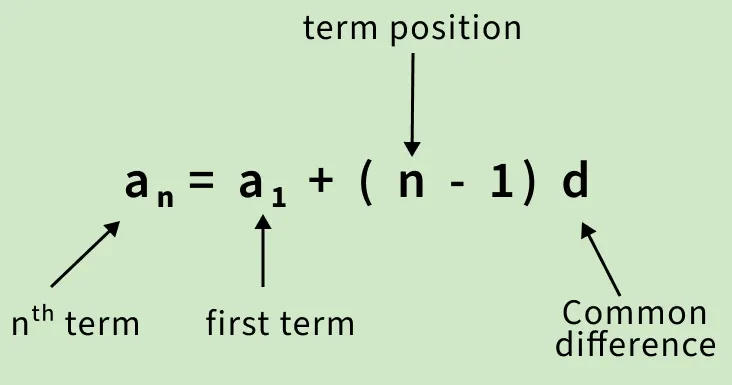
The nth term of an Arithmetic Progression (AP) is the term at position n in the sequence. It can be found directly using a formula without listing all terms.
If the first term is a and the common difference is d, then:
Nth term of an A.P. from the End
To find the nth term from the end of the A.P., consider an A.P. where:
- The first term is a,
- The common difference is d,
- The A.P. has m terms.
The n-th term from the end is equivalent to the (m − n + 1)th term from the beginning. Using the formula for the k-th term of an A.P. (ak = a + (k − 1)d, the n-th term from the end can be written as:
am-n+1 = a + (m – n)d
Related Articles:
**Solved Questions
**Question 1: Check whether progression 11, 10, 9, 8, 5.... is an A.P. or not.
**Solution:
The given progression is 11, 10, 9, 8, 5....
Now, we have to check that d is constant for all term or not.. if it's vary then it is not an A.P.
d = a2 - a1 = 10- 11 = -1 and d = a5 - a4 = 5 - 8 = -3Common difference is not same for all .so, it's not an A.P.
**Question 2: Show that the sequence 7, 2, -3,.......... is an A.P. Find the general term.
**Solution:
Let sequence 7, 2, -3 ........
if it's an A.P. then d is constant for alld = a3 - a2 = -3 -2 = -5
d = a2 - a1 = 2-7 = -5Hence, it is an A.P
General term of an A.P. is an
an = a + (n - 1)d
an = 7 + (n - 1) (-5)
an = 7 + -5n + 5an = 12- 5n
**Question 3: For the A.P. n-1, n- 2, n - 3, ........, find am.
**Solution:
A.P: n-1, n-2, n-3, ..........
Here, a = n-1 , d = (n-2) - (n-1) = -1
am = a + (m - 1)d
am = n-1 +(m - 1)(-1)
am = n-1 - m + 1am = n - m
**Question 4: Is 50 a term of sequence 3, 7, 11, .........
**Solution:
Let us assume 50 is nth term of this sequence or an A.P.
an = 50Given, a = 3 , d = 4
an = a + (n - 1) d
50 = 3 + (n-1)4
50 = 3 + 4n - 4
51 = 4n
12.7 = nSince n must be a natural number (whole number), 12.7 is not valid.
Hence, 50 is not a term of this sequence.
**Question 5: Which term in the A.P. 5, 2, -1, .........is - 22?
**Solution:
A.P.: 5, 2, -1 ,...........
Given, a = 5 , d = -3
Now, we have to check - 22 is it's term or not .
an = a + (n - 1)d
an = 5 + (n - 1)(-3)
-22 = 8 -3n
30 = 3n
n = 10The 10th term of the A.P. 5, 2, −1,…5, 2, -1, is −22.
**Question 6: Which term of the A.P. 11, 17, 23, ........is 551.
**Solution:
Here, a = 11 , d = 17 - 11 = 6
an = 551
an = a + (n - 1)d = 551
11 + (n - 1)6 = 551
11 + 6n - 6 = 551
6n = 546
_n = 91
**Question 7: Determine the number of terms in the progression 3, 7, 11, ......., 407. Also, find its 10th term from the end.
**Solution:
A.P.: 3 , 7 , 11 , ........., 407
Given, a = 3 , d= 4 and an = 407
an = a+ (n - 1)d
407 = 3 + (n - 1)4
407 = 3 + 4n - 4
408 = 4n
102 = nNow, it's 10th term form the end is a102-10 + 1 = a93
10th term from the end = 3 + 92(3) = 3 + 276 = 371