Pascal's Triangle Formula (original) (raw)
Last Updated : 23 Jul, 2025
Pascal's Triangle is a triangular array of numbers where each number is the sum of the two numbers directly above it. The triangle starts with a "1" at the top, and each subsequent row contains the coefficients of the binomial expansion.
Here is an example of Pascal's Triangle:
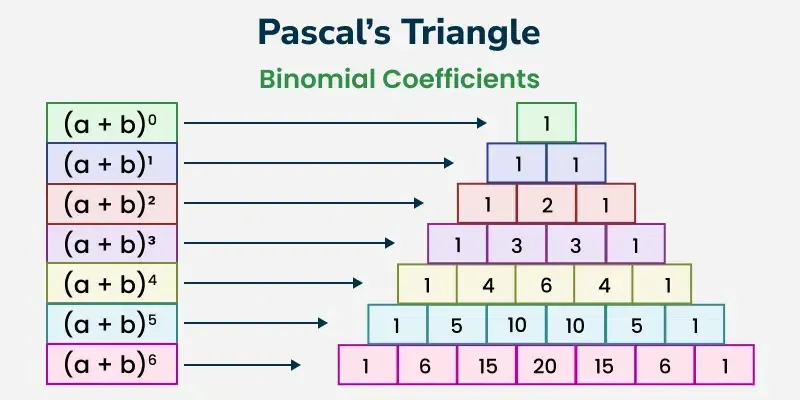
The formula to calculate any element in Pascal's Triangle is based on binomial coefficients, denoted as:
\dbinom{n}{k} = \dfrac{n!}{k!(n - k)!}
Pascal's triangle is a beautiful concept of probability developed by the famous mathematician Blaise Pascal, which is used to find coefficients in the expansion of any binomial expression. It is a method to know the binomial coefficients of terms of binomial expression (x + y)n, where n can be any positive integer and x, and y are real numbers.
This triangle is used in different types of probability conditions. Here each row represents the coefficient of expansion of (x + y)n.
(x + y)0 = 1
(x + y)1 = 1x + 1y
(x + y)2 = 1x2 + 2xy + 1y2
(x + y)3 = 1x3 + 3x2y + 3xy2 + 1y3
(x + y)4 = 1x4 + 4x3y + 6x2y2 + 4xy3+1y4
(x + y)5 = 1x5 + 5x4y + 10x3y2 + 10x2y3 + 5xy4 + 1y5
Here the power of y in any expansion of (x + y)n represents the column of Pascal's Triangle.
- n represents the row of Pascal's triangle.
- Row and column are 0 indexed in Pascal's Triangle.
**Pascal's Triangle Construction
It's quite simple to make a Pascal's Triangle.
- Start by creating the top row (the 0th row) with just the number 1.
- In the following rows, each new number in Pascal's Triangle is the sum of the two numbers directly above it.
- For example, to find the number in row 4, column 2:
- Add the numbers from row 3, column 1, and row 3, column 2.
- So, the number in row 4, column 2 is 1 + 2 = 3.
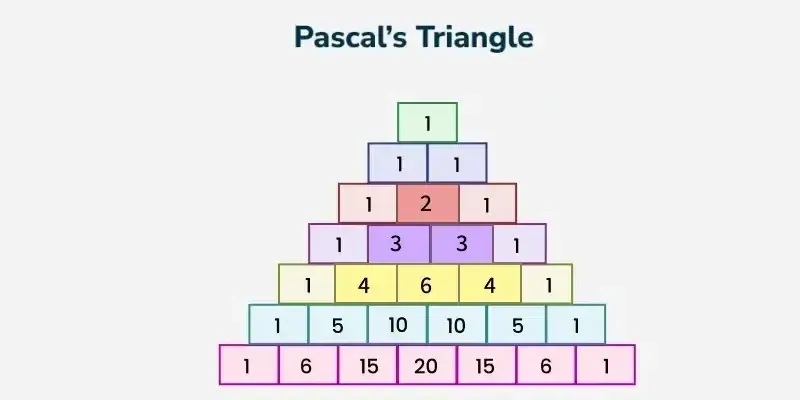
Pascal's Triangle Construction
**Properties of Pascal's Triangle
- Each number in Pascal's Triangle is the sum of two numbers above it.
- Numbers in a row are symmetric.
- Each number represents a binomial coefficient.
- Numbers on the left and right sides of the triangle are always 1.
- nth row contains (n+1) numbers in it.
Read more: Important Facts about Pascal's Triangle
**Pascal's Triangle Other Formulas
The Pascal's Triangle formula to find the element in the n-th row and k-th column of the triangle is:
\binom{p}{q} = \binom{p-1}{q-1} + \binom{p-1}{q}
Here, 0 ≤ q ≤ p, p is a non-negative number
Alternatively, the formula to find the number in the nnn-th row and r-th column is given by:
\binom{p}{q} = \frac{p!}{q!(p-q)!}
And another recursive expression is:
\binom{p}{q} = \binom{p}{q-1} + \binom{p-1}{q-1}
**Pascal's Triangle Binomial Expansion
As we already know tascal's triangle defines the binomial coefficients of terms of binomial expression (x + y)n, So the expansion of (x + y)n is:
(x + y)n = a0xn + a1xn-1 + ......an-1xyn-1 + anyn
Practice Questions on Pascal's Triangle
**Question 1: Find the coefficient of the term x 2y **in the expansion of (x + y) 3 .
**Solution:
**Method 1:
We look at the row 3rd row of Pascal's Triangle because n is 3 and 1st column of the Pascal's Triangle because power of y is 1 in the term x2y. So the coefficient is 3.
**Method 2:
We simply apply nCr where n = 3, r = 1.
So coefficient of x2yin the expansion of (x + y)3 is 3C1 = 3
**Question 2: Find the coefficient of the term x 2 y 2 **in the expansion of (4x + 3y) 4 .
**Solution:
**Method 1:
We look at the row 4th row of Pascal's Triangle because n is 4 and 2nd column of the Pascal's Triangle because power of y is 2 in the term x2y2. So number in Pascal's Triangle is 6.
But we see that coefficient of x is 4 and y is 3 now since power of x is 2 and y is 2 in the term x2y2 so pascal Triangle number will be multiplied by 42 and 32 to find the coefficient.
Coefficient = 6 x 42 x 32 = 864
**Method 2:
We simply apply nCr where n = 4, r = 2.
So Pascal Triangle number of term x2y2 in the expansion of (4x +3y)4 is 4C2 = 6.
But we see that coefficient of x is 4 and y is 3 now since power of x is 2 and y is 2 in the term x2y2 so pascal Triangle number will be multiplied by 42 and 32 to find the coefficient.Coefficient = 6 x 42 x 32 = 864
**Question 3: Write the 6th row of the Pascal's Triangle
**Solution:
6th row can be written as : 6C0 6C1 6C2 6C3 6C4 6C5 6C6
**1, 6, 15, 20, 15, 6, 1
**Question 4: Find the coefficient of the term x 4 **in the expansion of (2x + y) 4 .
**Solution:
**Method 1:
We look at the row 4th row of Pascal's Triangle because n is 4 and 0th column of the Pascal's Triangle because power of y is 0 in the term x4. So number in Pascal's Triangle is 1.
But we see that coefficient of x is 2 and y is 0 now since power of x is 4 and y is 0 in the term x4 so Pascal Triangle's number will be multiplied by 24 and 10 to find the coefficient.
Coefficient = 1 x 24 x 10= 16
**Method 2:
We simply apply nCr where n = 4, r = 0.
So Pascal Triangle number of term x4 in the expansion of (2x + y)4 is 4C0 = 1.
But we see that coefficient of x is 2 and y is 0 now since power of x is 4 and y is 0 in the term x4 so Pascal Triangle's number will be multiplied by 24 and 10 to find the coefficient.Coefficient = 1
**Question 5: Find the coefficient of the term xy 2 **in the expansion of (2x + y) 3 .
**Solution:
**Method 1:
We look at the row 3rd row of Pascal's Triangle because n is 3 and 2nd column of the Pascal's Triangle because power of y is 2 in the term xy2. So number in Pascal's Triangle is 3.
But we see that coefficient of x is 2 and y is 1 now since power of x is 2 and y is 1 in the term xy2 so Pascal Triangle's number will be multiplied by 21 and 12 to find the coefficient.
Coefficient = 3 x 21 x 12 = 6
**Method 2:
We simply apply nCr where n = 3, r = 2.
So Pascal Triangle number of term xy2 in the expansion of (2x + y)3 is 3C2 = 3.
But we see that coefficient of x is 2 and y is 1 now since power of x is 2 and y is 1 in the term xy^2 so Pascal Triangle's number will be multiplied by 21 and 12 to find the coefficient.
Coefficient = 3 x 21 x 12 = 6