Pascal's Triangle (original) (raw)
Last Updated : 18 Oct, 2025
Pascal's Triangle is a triangular arrangement of numbers where each number is the sum of the two numbers directly above it in the previous row. It is named after the French mathematician Blaise Pascal, although it was studied by mathematicians in various cultures long before him.
Various patterns can be observed in Pascal's Triangle, some of which are:
**Structure of Pascal's Triangle
- The triangle starts with a **1 at the top.
- Each row begins and ends with **1.
- Any other number in the triangle is the sum of the two numbers immediately above it in the previous row.
Pascal’s Triangle Patterns
As observed above, various patterns in Pascal’s triangles are:
- Diagonals in Pascal’s Triangle
- Binomial Coefficients
- Horizontal Sum
- Prime Numbers in a Triangle
- Fibonacci Pattern, etc.
**Diagonals in Pascal’s Triangle
Each rightward diagonal of Pascal’s Triangle, when considered as a sequence represents the different numbers such as the first rightward diagonal represents a sequence of number 1, the second rightward diagonal represents triangular numbers, the third rightward diagonal represents the tetrahedral numbers, the fourth rightward diagonal represents the Penelope numbers and so on.
**Pascal’s Triangle Binomial Expansion
We can easily find the coefficient of the binomial expansion using Pascal's Triangle. The elements in the (n + 1)th row of the Pascal triangle represent the coefficient of the expanded expression of the polynomial (x + y)n.
We know that the expansion of (x + y)n is,
(x + y)n = a0xn + a1xn-1y + a2xn-2y2 + … + an-1xyn-1 + anynHere, a0, a1, a2, a3, ...., an are the term in the (n+1)th row of Pascal's Triangle
**Horizontal Sum of Rows
On close observing Pascal’s Triangle we can conclude that the sum of any row in Pascal’s triangle is equal to a power of 2. The formula for the same is, For any (n + 1)th row in Pascal’s Triangle the sum of all the elements is, 2n
Applying this Formula in the first 4 rows of Pascal’s triangle we get,
1 = 1 = 20
1 + 1 = 2 = 21
1 + 2 + 1 = 4 = 22
1 + 3 + 3 + 1 = 8 = 23
Exponents of 11
Each row of Pascal's Triangle corresponds to a power of 11:
Row n (starting from n = 0) represents 11n.
**Examples:
- **Row 0: 1 → 110 = 1
- **Row 1: 1, 1 → 111 = 11
- **Row 2: 1, 2, 1 → 112 = 121
- **Row 3: 1, 3, 3, 1 → 113 = 1331
**Note: For higher powers of 11, the digits in the triangle rows exceed single digits, causing a carry-over effect. In such cases, the numbers in Pascal's Triangle no longer directly represent 11n. Instead, the pattern can still be reconstructed by summing the digits appropriately.
**Prime Numbers in Pascal’s Triangle
Another very interesting pattern in the Pascals triangle is that if a row starts with a prime number (neglecting 1 at the start of each row), then all the elements in that row are divisible by that prime number. This pattern does not hold true for the composite numbers.
For example, the eighth row in the Pascal triangle is,
**1 7 21 35 35 21 7 1
Here, all the elements are divisible by 7.
Fibonacci Sequence in Pascal’s Triangle
We can easily obtain the Fibonacci sequence by simply adding the numbers in the diagonals of Pascal's triangle. This pattern is shown in the image added below,
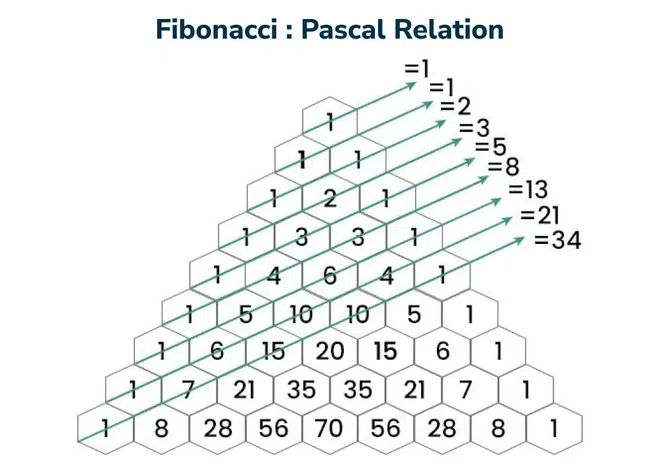
Fibonacci & Pascal's triangle relation
Pascal’s Triangle Formula
**Pascal Triangle Formula is the formula that is used to find the number to be filled in the mth column and the nth row. As we know the terms in Pascal's triangle are the summation of the terms in the above row. So we require the elements in the (n-1)th row, and (m-1)th and nth columns to get the required number in the mth column and the nth row.
The elements of the nth row of Pascal's triangle are given, nC0, nC1, nC2, ..., nCn.
The formula for finding any number in Pascal's triangle is:
**n C m = **n-1 C m-1 + **n-1 C m
Where,
- **n C m represents the (m + 1)th element in the nth row., and
- **n is a non-negative integer [0 ≤ m ≤ n]
How to Use Pascal’s Triangle?
We use the Pascal triangle to find the various cases of the possible outcomes in probability conditions. This can be understood by the following example, tossing a coin one time we get two outcomes i.e. H and T this is represented by the element in the first row of Pascal's Triangle.
Similarly tossing a coin two times we get three outcomes i.e. {H, H}, {H, T}, {T, H}, and {T, T} this condition is represented by the element in the second row of Pascal's Triangle.
Thus, we can easily tell the possible number of outcomes in tossing a coin experiment by simply observing the respective elements in the Pascal Triangle.
The table below tells us about the cases if a coin is tossed one time, two times, three times, and four times, and its accordance with Pascal's Triangle
| Number of TossesORA row of Pascals Triangle | Possible Outcomes | Elements in Pascal Triangle |
|---|---|---|
| 1 | {H},{T} | 1 1 |
| 2 | {HH},{HT}, {TH},{TT} | 1 2 1 |
| 3 | {HHH},{HHT}, {HTH}, {THH},{HTT}, {THT}, {TTH},{TTT} | 1 3 3 1 |
| 4 | {HHHH},{HHHT}, {HHTH}, {HTHH}, {THHH}, {HHTT}, {HTHT}, {HTTH}, {THHT}, {THTH}, {TTHH}, {HTTT}, {THTT}, {TTHT}, {TTTH},{TTTT} | 1 4 6 4 1 |
Pascal’s Triangle Properties
Various Properties of Pascal's Triangle are,
- Every number in the Pascal triangle is the sum of the number above it.
- The starting and the end numbers in Pascal's triangle are always 1.
- The first diagonal in Pascal's Triangle represents the natural number or counting numbers.
- The sum of elements in each row of Pascal's triangle is given using a power of 2.
- Elements in each row are the digits of the power of 11.
- The Pascal triangle is a symmetric triangle.
- The elements in any row of Pascal's triangle can be used to represent the coefficients of Binomial Expansion.
- Along the diagonal of Pascal's Triangle, we observe the Fibonacci numbers.
**Related Articles
Solved Examples of Pascal’s Triangle
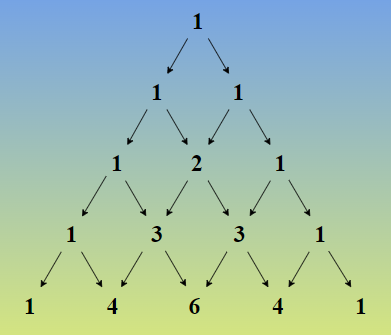
**Example 1: Find the fifth row of Pascal’s triangle.
**Solution:
The Pascal triangle with 5 row is shown in the image below,
**Example 2: Expand using Pascal Triangle (a + b)2.
**Solution:
First write the generic expressions without the coefficients.
(a + b)2 = c0a2b0 + c1a1b1 + c2a0b2
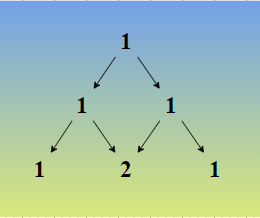
Now let’s build a Pascal’s triangle for 3 rows to find out the coefficients.
The values of the last row give us the value of coefficients, c0 = 1, c1 = 2, c2 =1
(a + b)2 = a2b0 + 2a1b1 + a0b2
Thus verified.
**Example 3: Expand using Pascal Triangle (a + b)6.
**Solution:
First write the generic expressions without the coefficients.
(a + b)6 = c0a6b0 + c1a5b1 + c2a4b2 + c3a3b3 + c4a2b4 + c5a1b5 + c6a0b6
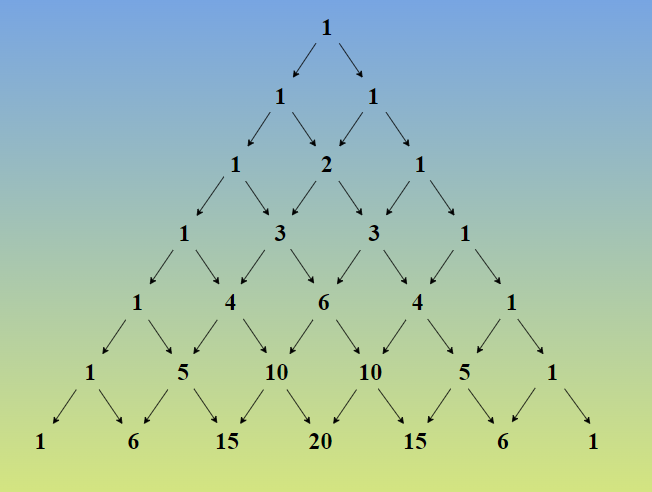
Now let’s build a Pascal’s triangle for 7 rows to find out the coefficients.
The values of the last row give us the value of coefficients.
c0 = 1, c1 = 6, c2 = 15, c3 = 20, c4 =15, c5 = 6 and c6 = 1.
(a + b)6 = 1a6b0 + 6a5b1 + 15a4b2 + 20a3b3 + 15a2b4 + 6a1b5 + 1a0b6
**Example 4: Find the second element in the third row of Pascal’s triangle.
**Solution:
To find the 2nd element in the 3rd row of Pascal’s triangle.
We know that the nth row of Pascal’s triangle is nC0, nC1, nC2, nC3…
The Pascal Triangle Formula is, nCk = n-1Ck-1 + n-1Ck,where nCk represent (k+1)th element in nth row.
Thus, 2nd element in the 3rd row is,
3C1 = 2C0 + 2C1
= 1 + 2
= 3Thus, the second element in the third row of Pascal’s triangle is 3.
Practice Questions on Pascal's Triangle
**Question 1: What is the sum of the elements in the fifth row of Pascal's triangle?
**Question 2: Find the value of the 3rd element in the 7th row of Pascal's triangle without constructing the entire row.
**Question 3: How can you use Pascal’s triangle to calculate the binomial coefficient \binom{6}{4}?
**Question 4: If the sum of the elements in the n-th row of Pascal's triangle is 2n, find the sum of the elements in the 8th row.
**Question 5: Determine the coefficient of a2b3when expanding (a + b)5 using Pascal's Triangle.
**Question 6: What is the difference between the 6th element in the 6th row and the 4th element in the 5th row of Pascal’s triangle?
**Question 7: Using Pascal’s Triangle, expand the expression (x−y)4 and identify the coefficient of x2y2.
**Question 8: Find the sum of the diagonals in the first five rows of Pascal's Triangle.