Polar and Exponential Forms of Complex Numbers (original) (raw)
Last Updated : 23 Jul, 2025
Before going to discuss the different forms of complex numbers and the conversion between them we have to know about complex numbers. Complex numbers are a part of mathematics represented as a combination of a real part and an imaginary part. A complex number contains the real part as well as the imaginary part where the real part is the constant number and the imaginary part contains the variable "i" with a constant coefficient. Let a+ib be a complex number then a is called a real part and b called an imaginary coefficient.
There are three forms of complex numbers. They are,
- General form
- Polar form
- Exponential form
General Form of Complex Number
The general form of the complex number is represented as z = a + ib where a is called as real part and b is called the imaginary part of the complex number. It can also be represented in the diagrammatic form below:
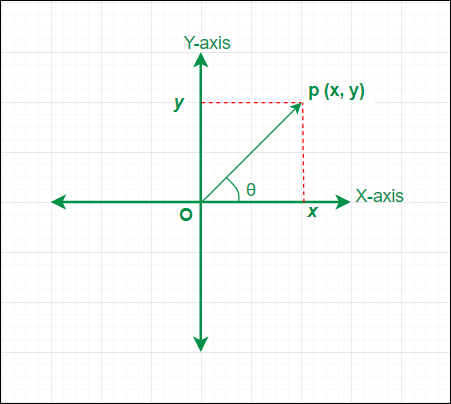
Polar Form of Complex Numbers
The Polar form of the complex number is represented as z = r(cos∅ + i sin∅) where rcos∅ is called as real part and rsin∅ is called the imaginary part of the complex number.
In the above diagram a = rcos∅ and b = rsin∅. In general form, a + ib where a = real part and b = imaginary part, but in polar form there is an angle is included in the cartesian where a=rcos∅ and b=rsin∅ . Here r is the square root of the sum of squares of both a and b and also **∅ can also have a formula which is **tan -1 (imaginary part/real part). Therefore r can be represented as a **Square root (a 2 **+ b 2 ). Therefore ∅ can be represented as tan -1 (b/a) where b is the imaginary part and a is a real part.
Exponential Form of Complex Numbers
Exponential form of the complex number is represented as z = r exp(i∅) where exp(i∅) is also represented as cos∅ + i sin∅. From this, I can say that the Exponential form, polar form, and general form are related closely.
Z = r(cos∅ + i sin∅)
Z = r ei ∅
Z = r angle(∅) [This is a phasor representation of exponential form]
**Different Complex number representation
- In general form Z = a + ib
- In polar form Z = r(cos∅ + i sin∅)
- In Exponential form Z = r ei ∅
Conversion of Complex Numbers
Complex numbers can be converted to convenient polar form or exponential form or general form. How this was converted is shown below.
**Converting General Form to Polar Form
- Before converting the general form to the Polar form check whether the general form is in the form of a+ib and values of a, and b is known already in the general form.
- The polar form looks like Z = r(cos∅ + i sin∅).
- To convert into the above polar form structure we need to know how a, and b values in general form relate to r, ∅.
- Formulas of r,∅ are r = √(a2 + b2), ∅ = tan-1(b/a).
- Above formulas in terms of a, and b are derived to convert from general form to polar form so that we can substitute r, ∅ in polar form Z = r(cos∅ + i sin∅).
**Converting General Form to Exponential Form
- Before convert general form to an exponential form check whether the general form is in the form of **Z = a + ib and values of a, and b are known already in a general form.
- The exponential form looks like **Z = r e i ∅ .
- To convert into the above exponential form structure we need to know how a, and b values in general form relate to r, ∅.
- Formulas of r, ∅ are r = √(a 2 + b 2 ), ∅ = tan -1 (b/a).
- Above formulas in terms of a and b is derived to convert from general form to polar form so that we can substitute r, ∅ in polar form **Z = r e i ∅ .
**Converting Polar Form to General Form
- Before converting polar form to general form check whether the polar form is in the form of **Z = r(cos∅ + i sin∅) and values of r, ∅ which is known already in polar form.
- The general form looks like Z = a + ib.
- To convert into the above general form structure we need to know how r,∅ values in general form relate to a, b.
- Formulas of a,b are **a = rcos∅, b = rsin∅ where r,∅ is known already in polar form.
- Above formulas in terms of r,∅ is derived to convert from polar form to general form so that we can substitute a, b in general form Z = a + ib.
**Converting Polar Form to Exponential Form
- Before converting polar form to exponential form check whether the polar form is in the form of **Z = r(cos∅ + i sin∅) and values of r, ∅ which is known already in polar form.
- Exponential form looks like **Z = re i∅ .
- To convert into the above exponential form structure we need to know r,∅ values only because exponential form is also want r,∅ values.
- Substitute r,∅ value to **Z = re i∅to convert from polar form to exponential form.
**Converting Exponential Form to General Form
- Before converting exponential form to general form check whether the exponential form is in the form of **Z = re i∅ and values of r,∅ is known already in exponential form.
- General form looks like **Z = a + ib.
- To convert into the above general form structure we need to know how r,∅ values in general form relate to a,b.
- Formulas for a,b derived from Z = re i∅ = r(cos∅ + isin∅) where **a = rcos∅, b = rsin∅. Since **e i∅ **= cos∅ + isin∅ we know it already in trigonometry.
- Above formulas in terms of r,∅ is derived to convert from exponential to general form so that we can substitute a, b in general form Z = a + ib.
**Converting Exponential Form to Polar Form
- Before converting exponential form to polar form check whether the exponential form is in the form of **Z = re i∅ and values of r, ∅ is known already in exponential form.
- The polar form looks like **Z = r(cos∅ + isin∅).
- To convert into the above polar form structure we need to know r,∅ values only because the polar form is also want r,∅ values.
- Substitute r, ∅ value to **Z = r(cos∅ + isin∅) to convert from exponential form to polar form.
Sample Questions
**Question 1: Convert 2 + i 9 into polar form.
**Solution:
Let Z = 2 + i 9
Z is in the form of a + ib
Where a = 2 and b = 9
Polar form of complex number Z = r (cos∅ + i sin∅)
Compare a + ib with polar form r cos∅ + i rsin∅
Here r = √(a2 + b2)
r = √(22 + 92)
r = √(4+81)
r = square root(85)
r = 9.2
And ∅ has formula which is tan(b/a)
∅ = tan-1(b/a) = tan-1(9/2)
∅ = 77°
From this r,∅ we can represent general form 2 + i9 into p**olar form **Z = 9.2(cos 77° + i sin 77°)
**Question 2: Convert the polar form (r, ∅) = (-1,0) into general form.
**Solution:
Given that polar form coordinates (r, ∅) = (-1, 0)
General form or rectangular form of complex number Z = a + ib
Where a = rcos∅, b = r sin∅
From the given polar form in question a = -1 × cos(0) and b = -1 × sin(0)
a = -1, b = 0 [cos(0) = 1 and sin(0) = 0]
**General form Z = a + ib = -1 + i 0.
**Question 3: Convert the exponential form 2e i80 into general form as well as polar form.
**Solution:
Given that exponential form 2ei90
2 ei80 is in the form of r ei∅
r ei∅ is represented in polar form as r(cos∅ + isin∅)
Where r=2 and ∅=80 by comparing
Substitute r,∅ in polar form r(cos∅+isin∅) we get polar form as 2(cos80+i sin80)
In the above polar form a=2 cos80 and b=2 sin80 by comparing general form and polar form
a = 2 cos80 = 0 .17 and b = 2 sin80 = 0.98
**General form a + ib = 0.17 + i 0.98.
**Question 4: Convert the polar form (r, ∅) = (1, 90) into general form.
**Solution:
Given that polar form coordinates (r, ∅) = (1, 89)
General form or rectangular form of complex number Z = a + ib
Where a = rcos∅, b = r sin∅
From the given polar form in question a = 1× cos(89) and b = 1 × sin(89)
a = 0.017, b = 0.99 [cos(89) = 0.017 and sin(89) = 0.99]
**General form Z = a + ib = 0.017 + i 0.99
**Question 5: Convert the polar form (r, ∅) = (4, 45°) into the Exponential form.
**Solution:
Given that polar form coordinates (r,∅)=(4,45)
To convert into Exponential form we have the formula r ei∅
Where r = 4 and ∅ = 45
Therefore Exponential form **r e i∅ **= 4e i45
**Question 6: Convert Z = 7 + i9 into Exponential form.
**Solution:
To convert into exponential form we have the formula rei∅
Compare Z = 7 + i9 with Z = a + ib then a = 7 and b = 9
Where r = √(a2 + b2)
r = √(7 × 7+ 9 × 9)
r = √(130)
r = 11.4
Where ∅ = tan-1(b/a) = tan-1(9/7)
∅ = 52.12°
Therefore Exponential form rei∅ = 11.4 ei52.12
Practice Problem on Polar and Exponential Forms of Complex Numbers
**Problem 1: Convert the complex number z=3+4i to its polar form.
**Problem 2: Convert z = -5-12i to its polar form.
**Problem 3: Find the magnitude and argument of z = -7+24i.
**Problem 4: Express z = -6 in polar form.
Problem 5: If z_1 = 2(\cos 30^\circ + i \sin 30^\circ) and z_2 = 3(\cos 45^\circ + i \sin 45^\circ), find** z_1 \cdot z_2** in polar form.
Problem 6: Divide z_1 = 5(\cos 60^\circ + i \sin 60^\circ) by z_2 = 2(\cos 45^\circ + i \sin 45^\circ). Express the result in polar form.
**Problem 7: Convert the complex number z=1+i to its exponential form.
**Problem 8: Express z= -3-4i in exponential form.
Problem 9: For z = e^{i\pi/4}, find the modulus and argument.
**Problem 10 :Express z = 2 - 2\sqrt{3}i in exponential form.
Summary
In summary, the polar and exponential forms of complex numbers offer alternative ways to represent and manipulate complex numbers, leveraging their magnitude and angle to simplify calculations and provide geometric interpretations.