Polynomial Identities (original) (raw)
Last Updated : 23 Jul, 2025
Polynomial identities are mathematical expressions or equations that are true for all values of the variables involved. These identities are particularly useful in simplifying expressions and solving equations involving polynomials.
These are the equations involving polynomials that hold true for all values of the variables involved. These identities are very useful in simplifying expressions and solving equations more efficiently.
It is an equation that hold for all values of the variables within them. These identities are often used to simplify expressions and solve polynomial equations more easily.

**It is an equation that holds for all possible values of the variables involved. It establishes a relation between two or more polynomial expressions, regardless of the specific numerical values of the variables. One common example is the polynomial identity (_a+_b)2=_a_2+ 2__ab +__b_2, which remains true for any values of _a and _b.
Let's know more about various identities of polynomials, types of polynomial identities, and their proof along with some solved examples for clear understanding.
**Polynomial Identities
A Polynomial Equation is a type of algebraic equation that involves multiple variables, each raised to positive integral powers. Various terms may exist within such equations with different powers of the same variable.
A Polynomial Identity, on the other hand, is an equality involving polynomial expressions that remains valid for any values assigned to its variables. Polynomial identities are particularly useful for the expansion or factorization of polynomial equations.
Polynomial identities play a significant role in algebraic manipulations, offering a versatile toolset for simplifying expressions, finding common factors, and expanding polynomial equations.
Polynomial Identity Definition
Polynomial identity is a mathematical statement asserting the equality of two polynomial expressions, holding true for all variable values.
Polynomial Identity serves as a foundational tool for simplifying and manipulating polynomial expressions in algebra, facilitating mathematical analysis and problem-solving.
Examples of Polynomial Identity
Some Examples of Polynomial Identity are:
- **Square of a Binomial: (a + b)2 = a2 + 2ab + b2
- **Difference of Squares: (a - b)(a + b) = a2 - b2
- **Cubing a Binomial: (a + b)3 = a3 + 3a2b + 3ab2 + b3
- **Sum of Cubes: a3 + b3 = (a + b)(a2 - ab + b2
- **Factorization of Quadratic Expression: a2 - b2 = (a + b)(a - b)
- **Fourth Power Formula: (a + b)4 = a4 + 4a3b + 6a2b2 + 4ab3 + b4
- **Factorization of Quartic Expression: a4 - b4 = (a2 + b2)(a2 - b2) = (a2 + b2)(a + b)(a - b)
- **Binomial Theorem: (a + b)^n = \sum_{k=0}^{n} \binom{n}{k} a^{n-k} b^k
**Types of Polynomial Identity
The types of polynomials are based on the degree or the highest power of the identities. Polynomial Identities are classified as follow:
- **2 nd Degree Polynomial Identities
- **3 rd Degree Polynomial Identities
- **n Degree Polynomial Identities
**2 nd Degree Polynomial Identities
Second-degree polynomial identities consists of the polynomials of degree 2 i.e. they involve the identities where maximum power of a variable in a term is 2.
Following is the list of all 2nd Degree Polynomial Identities:
- (a+b)2=a2+b2+2ab
- (a−b)2=a2+b2−2ab
- (a+b+c)2=a2+b2+c2+2ab+2bc+2ca
- (a−b−c)2=a2−b2−c2−2ab+2bc−2ca
- (x+a)(x+b)=x2+(a+b)x+ab
**3 rd Degree Polynomial Identities
Third-degree polynomial identities consists of the polynomials of degree 3 i.e. they involve the identities where maximum power of a variable in a term is 3.
Following is the list of all 3rd Degree Polynomial Identities:
- (a+b)3=a3+b3+3ab(a+b)
- (a−b)3=a3−b3−3ab(a−b)
- a3+b3+c3–3abc=(a+b+c)(a2+b2+c2–ab–bc–ca)
**n-Degree Polynomial Identities
n degree polynomial identities consists of the polynomials of degree 'n' i.e. they involve the identities where maximum power of a variable in a term is 'n'. Here 'n' is any natural number.
Following is the formula used for all n Degree Polynomial Identities:
**a n -b n **= (a-b)[(a n−1 )+(a n−2 )b+…+(b n−2 )a+(b n−1 )]
**where n is a natural number
- If **n is even (n = 2k)
- If **n is odd (n = 2k+1)
**Also Check
**Polynomial Formulas
Following are some more polynomial formulas used in mathematics:
- a2−b2=(a+b)(a−b)
- a3−b3=(a−b)(a2+ab+b2)
- a3+b3=(a+b)(a2−ab+b2)
- a4−b4=(a2−b2)(a2+b2)
- a4−b4=(a+b)(a−b)[(a+b)2−2ab]
- 2(a2+b2)=(a+b)2+(a−b)2
- (a+b)2−(a−b)2=4ab
**Proving Polynomial Identities
This segment will provide a proof of the most commonly used four polynomial identities which are:
- (a+b)2 = a2+b2+2ab
- (a-b)2 = a2+b2-2ab
- (a+b)(a-b)2 = a2-b2
- (x + a)(x + b) = x2 + x(a + b) + ab
**Identity 1: (a+b)2 = a2+b2+2ab
The expression (a+b)2 can be expanded using the distributive property:
(a+b)2 = (a+b) · (a+b)
= a · (a+b) + b · (a+b)
= a · a + a · b + b · a + b · b
= a2 + ab + ba + b2
Since multiplication is commutative i.e., (ab = ba), we can simplify this expression to:
a2 + 2ab + b2
∴ Proof demonstrates that (a+b)2 is equal to ( a2 + 2ab + b2).
**Visual Proof,
Proof of ****(a+b)** 2 **= a 2 + 2ab + b 2 identity, let’s take a square of side a+b and divide it like the following diagram.
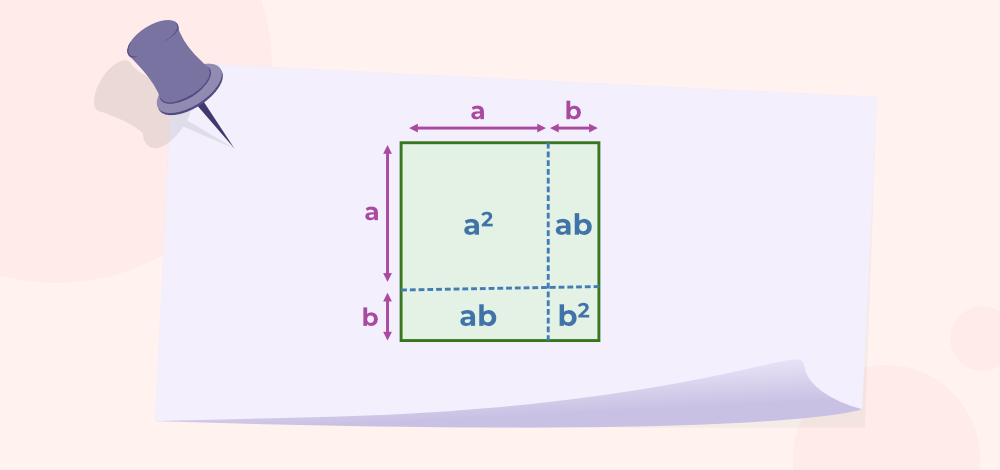
To prove the identity, we have to calculate the area of the square with side (a+b) which is (a+b)2.
**Identity 2: (a-b)2 = a2+b2-2ab
To prove the polynomial identity (a - b)2 = a2 + b2 - 2ab, we can use the distributive property and perform the necessary algebraic steps:
Starting with the left-hand side:
(a - b)2 = (a - b) · (a - b)
Using the distributive property:
(a - b)2 = a · (a - b) - b · (a - b)
Further simplifying:
(a - b)2 = a2 - ab - ab + b2
Combining like terms:
(a - b)2 = a2 - 2ab + b2
Now, the result matches the right-hand side of the given identity:
(a - b)2 = a2 + b2 - 2ab
∴ Polynomial identity (a - b)2 = a2 + b2 - 2ab is proved.
**Visual Proof
Proof of (a-b)2 = a2-2ab+b2 identity, let’s again consider a square but this time with side “a”.

Now, take a small segment “b” from its side and divide the square as follows:
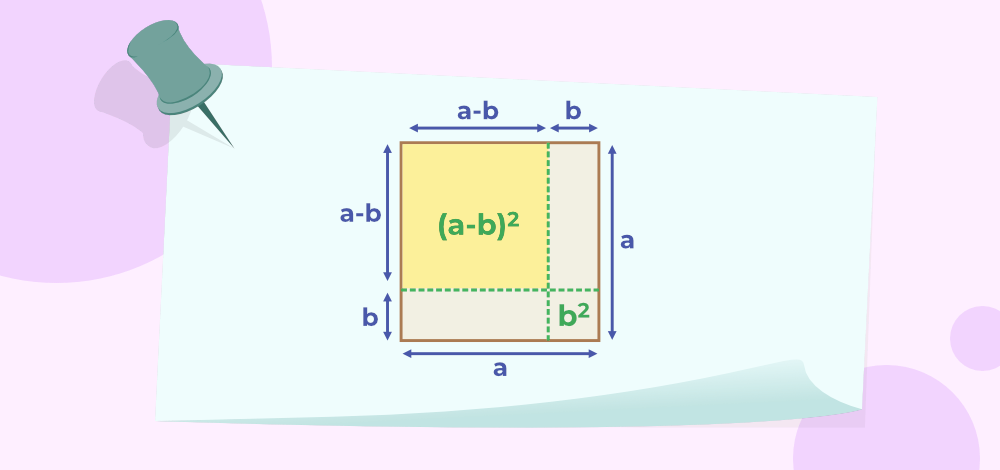
To prove the identity, we have to calculate the area of the square with side (a-b) which is (a-b)2.
**Identity 3: (a+b)(a-b)2 = a2-b2
Use the distributive property (FOIL method) to multiply the two binomials:
(_a + _b)(a −__b)=_a (_a_−__b) + _b (_a_−__b)
Now, multiply each term separately:
_a (a −__b) = _a_2−__ab
_b (a −__b) = __ab_−__b_2
Combine the two results:
(_a+b)(__a_-_b)=_a_2−__ab+__ab_−__b_2
Solving like terms:
(_a+b)(__a_-_b)=__a_2−__b_2
Hence,the polynomial identity (_a+b)(__a_-_b)=__a_2−__b_2 is proved.
Identity 4: (x + a)(x + b) = x2 + x(a + b) + ab
Certainly, let's prove the polynomial identity (x + a)(x + b) = x2 + x(a + b) + ab
Start with the left side of the identity: (x + a)(x + b)
Use the distributive property (FOIL method) to multiply the two binomials:
(x + a)(x + b) = x(x + b) + a(x + b)
Now, multiply each term separately:
x(x + b) = x2 + xb
a(x + b) = ax + ab
Combine the two results:
(x + a)(x + b) = x2 + xb + ax + a
Combine like terms:
(x + a)(x + b) = x2 + x(a + b) + ab
Hence proved the polynomial identity (x + a)(x + b) = x2 + x(a + b) + ab
List of Polynomial Identities
The list of some common polynomial identities which are widely used are given below:
| (a + b)2 | a2 + 2ab + b2 |
|---|---|
| (a − b)2 | a2 − 2ab + b2 |
| (a + b)(a − b) | a2 − b2 |
| (x + a)(x + b) | x2 + x(a + b) + ab |
| (a + b + c)2 | a2 + b2 + c2 + 2ab + 2bc + 2ca |
| (a + b)3 | a3 + 3a2b + 3ab2 + b3 |
| (a − b)3 | a3 − 3a2b+ 3ab2 − b3 |
| (a)3 − (b)3 | (a − b)(a2 + ab + b2) |
| (a)3 + (b)3 | (a + b)(a2 − ab + b2) |
Applications of Polynomial Identities
Applications of Polynomial identities have a wide scope in various field, but it is most commonly used in Algebraic Equation. It is used in solving Algebraic equations are mentioned below:
Use in Solving Algebraic Equations
Following are the uses of Polynomial Identities in Solving Algebraic Equations:
- **Factoring Equations: Polynomial identities help factorize algebraic expressions, making it easier to solve equations.
- **Root Finding: Identifying roots or solutions of equations by manipulating expressions using polynomial identities.
- **Solving Quadratic Equations: Quadratic identities, derived from polynomial identities, aid in solving quadratic equations efficiently.
- **Simplification of Expressions: Applying polynomial identities simplifies complex expressions, facilitating equation simplification.
- **Expression Substitution: Substituting variables with expressions derived from polynomial identities to simplify equations.
- **System of Equations: Polynomial identities contribute to solving systems of equations by expressing relationships between variables.
- **Functional Analysis: Understanding the behavior of functions and their solutions becomes easier through the application of polynomial identities.
Some Other Applications of Polynomial Identities are:
- **Mathematical Modeling: Represent and analyze real-world phenomena for predictions and conclusions.
- **Computer Science: Used in algorithm design, error correction codes, and cryptography.
- **Physics and Engineering: Applied for modeling physical systems, solving equations, and analyzing structures.
- **Statistical Analysis: Provide tools for expressing relationships and analyzing data patterns.
- **Optimization Problems: Used in solving problems to find maximum or minimum values.
- **Number Theory: Contribute to the study of integers and their properties in mathematics.
**Read More
Solved Examples on Polynomial Identities
**Example 1: Calculate the product of (x - 2) 2
**Solution:
Expanding this expression involves multiplying each term in the bracket by itself:
(x - 2)2 = (x - 2)(x - 2)
Using the distributive property:
= x(x) - x(2) - 2(x) + 2(2)
Simplifying further:
= x2 - 2x - 2x + 4
Combining like terms:
= x2 - 4x + 4
So, (x - 2)2 expands to (x2 - 4x + 4).
**Example 2: Evaluate (4a + 7b) 2
**Solution:
Given (4a + 7b)2
Using the formula (a + b)2 = (a2 + 2ab + b2), we can apply it to our expression:
(4a + 7b)2 = (4a)2 + 2(4a)(7b) + (7b)2
Simplifying further:
16a2 + 56ab + 49b2
So, (4a + 7b)2 simplifies to (16a2 + 56ab + 49b2)
**Example 3: Simplify (2m + 3n) 2 - (m - 2n) 2
**Solution:
We know (a+b)2 = a2+b2+2ab
Apply the above identity in (2m + 3n)2 and (m - 2n)2
(2m + 3n)2 = 4m2 + 12mn + 9n2
similarly,
(m - 2n)2 = m2 - 4mn + 4n2
Now, subtracting the second expression from the first:
(4m2 + 12mn + 9n2) - (m2 - 4mn + 4n2)
Combine like terms:
4m2 - m2+ 12mn + 4mn + 9n2 - 4n2
Solving the above equation we get:
3m2 + 16mn + 5n2
Hence, (2m + 3n)2 - (m - 2n)2 simplifies to (3m2 + 16mn + 5n2)
**Polynomial Identity Practice Questions
**Q1. Expand and simplify: (x + 3)2
**Q2. Find the product: (a - b)2
**Q3. Determine the value of: (2x + 5)2
**Q4. Simplify: (m + n)2- (m - n)2
**Q5. Expand and simplify: (3p - 4q)2