Properties of Vectors (original) (raw)
Last Updated : 12 Jun, 2026
Vectors are quantities that have both magnitude and direction. Vector properties are the mathematical rules that govern operations such as vector addition, scalar multiplication, dot products, and cross products.
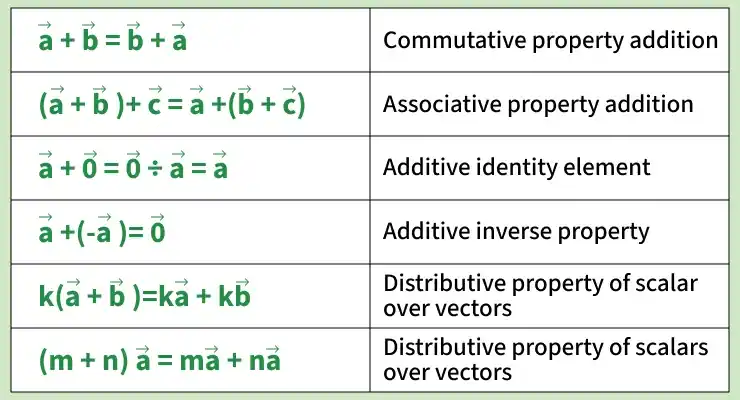
**1. Commutative Property of Vector Addition: The order in which two vectors are added does not affect the result.
Formula:\mathbf{A}+\mathbf{B}=\mathbf{B}+\mathbf{A}
**Example: Let, \mathbf{A}=(2,3), \mathbf{B}=(4,1)
Then, \mathbf{A}+\mathbf{B}=(2+4,3+1)=(6,4) and \mathbf{B}+\mathbf{A}=(4+2,1+3)=(6,4)
Hence, \mathbf{A}+\mathbf{B}=\mathbf{B}+\mathbf{A}
**2. Associative Property of Vector Addition: When adding three vectors, the grouping of vectors does not change the result.
Formula: \mathbf{A}+(\mathbf{B}+\mathbf{C})=(\mathbf{A}+\mathbf{B})+\mathbf{C}
**Example: Let ,\mathbf{A}=(1,2),\mathbf{B}=(3,1), \mathbf{C}=(2,4)
Then, (\mathbf{A}+\mathbf{B})+\mathbf{C} = (4,3)+(2,4) = (6,7) and
\mathbf{A}+(\mathbf{B}+\mathbf{C}) = (1,2)+(5,5) = (6,7)Thus, both sides are equal.
**3. Additive Identity Property: Adding the zero vector to any vector leaves it unchanged.
Formula:\mathbf{A}+\mathbf{0}=\mathbf{A} , where \mathbf{0}=(0,0,0)
**Example: (5,-2)+(0,0) = (5,-2)
Therefore, the zero vector acts as the additive identity.
**4. Additive Inverse Property: Every vector has an opposite vector known as its additive inverse.
Formula:\mathbf{A}+(-\mathbf{A})=\mathbf{0}
**Example: \mathbf{A}=(3,-4)
Its inverse is -\mathbf{A}=(-3,4)
Therefore, (3,-4)+(-3,4)=(0,0)
**5. Distributive Property of Scalar Multiplication over Vector Addition: A scalar can be distributed across the sum of vectors.
Formula:k\mathbf{A}+k\mathbf{B}
**Example: Let, k=2\mathbf{A}=(1,2),\mathbf{B}=(3,4)
Then, 2(4,6) = (8,12)
and (2,4)+(6,8) = (8,12)
Hence, the property is verified.
**6. Associative Property of Scalar Multiplication: When multiple scalars multiply a vector, the grouping does not matter.
Formula: (km)\mathbf{A}
**Example: Let k=2, m=3, \mathbf{A}=(1,2)
Then, 2(3,6) = (6,12) and 6(1,2) = (6,12)
**7. Zero Property of Scalar Multiplication: Multiplying a vector by zero produces the zero vector.
Formula:\mathbf{0}
**Example: (0,0)
Solved Examples
**Example 1: Verify the commutative property for vectors (2,1)) and ((3,4)
Commutative property states: a+b = b+a ,
(2,1)+(3,4) = (5,5) and (3,4)+(2,1) = (5,5)
Therefore, the property holds.
**Example 2: Find 3[(1,2)+(2,3)].
Adding terms inside big bracket then multiplying: 3[3,5]=(9,15)
**Example 3: Find the additive inverse of (4,-7).
The additive inverse will be(-4,7)
**Example 4 : Find dot product of (1,2).(3,4).
The dot product of two vectors is obtained by multiplying the corresponding components and then adding the products.
1(3)+2(4) = 11
Practice Problems
- Verify the commutative property for vectors (4,2) and (1,5).
- Verify the associative property for vectors (1,1), (2,3), and (4,2).
- Find the additive inverse of (6,-3).
- Compute 4[(1,2) + (3,1)].
- Verify (2+3)(1,2) = 2(1,2) + 3(1,2).