Ratio and Proportion (original) (raw)
Last Updated : 11 May, 2026
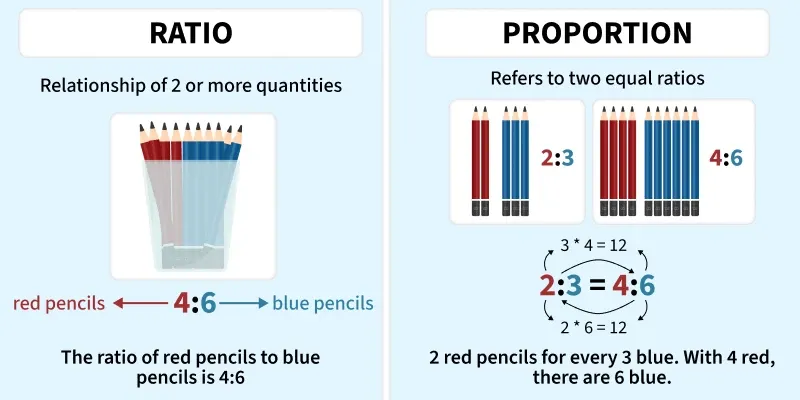
Ratios and proportions are used for comparison. A ratio is a comparison of two quantities, while a proportion is a comparison of two ratios.
Ratio
A Ratio is a comparison of two quantities of the same unit. The ratio of two quantities is given by using the colon symbol (:).
The ratio of two quantities a and b is given as :
a : b
where ,
- a is called Antecedent.
- b is called Consequent.
The ratio a:b means ak/bk where k is the common factor k is multiplied to give equivalent fractions whose simplest form will be a/b. We can read a:b as 'a ratio b' or 'a to b'.
Ratio Properties
Some Key properties of the Ratio are:
- If a ratio is multiplied by the same term both in the antecedent and consequent, then there is no change in the actual ratio.
**Example, A : B = nA : nB - If the antecedent and consequent of a ratio are divided by the same number, then there is no change in the actual ratio.
**Example, A : B = A/n : B/n - If two ratios are equal, then their reciprocals are also equal.
**Example: If A : B = C : D then B : A = D : C - If two ratios are equal then their cross-multiplications are also equal.
**Example: A : B = C : D then A × D = B × C - The ratios for a pair of comparisons can be the same but the actual value may be different.
**Example 50:60 = 5:6 and 100:120 = 5:6 hence ratio 5:6 is the same but the actual value is different.
Proportion
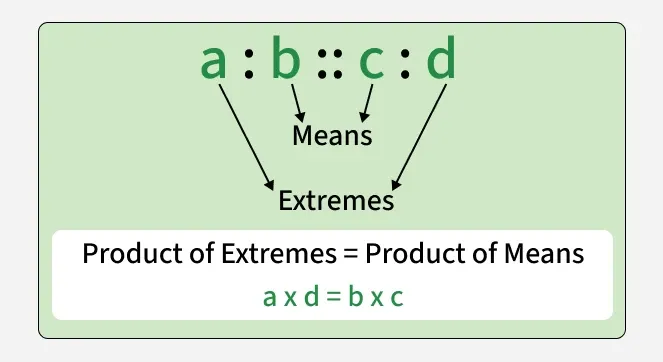
Proportion refers to the comparison of ratios. If two ratios are equal then they are said to be proportionate to each other. Two proportional ratios are represented by a double colon(::). If two ratios a:b and c:d are equal then they are represented as
a : b :: c : d
where
- a and d are called extreme terms.
- b and c are called mean terms.
Proportion Properties
Key properties of Proportions are:
- For two ratios in proportion i.e. A/B = C/D, A/C = B/D holds true.
- For two ratios in proportion i.e. A/B = C/D, B/A = D/C holds true.
- For two ratios in proportion i.e. A : B :: C : D, the product of mean terms is equal to the product of extreme terms i.e. AD = BC
- For two ratios in proportion i.e. A/B = C/D, (A + B)/B = (C + D)/D is true.
- For two ratios in proportion i.e. A/B = C/D, (A - B)/B = (C - D)/D is true.
Types of Proportions
There are three types of Proportions:
**Direct Proportion:
When two quantities increase and decrease in the same ratio then the two quantities are said to be in Direct Proportion. It means if one quantity increases/decreases then the other will also increase/decrease. It is represented as a ∝ b.
**Example, if the speed of vehicle increases then the distance travelled will also increase. ( provided time is same in both scenarios )
**Inverse Proportion:
When two quantities are inversely related to each other i.e. increase in one leads to a decrease in the other or a decrease in the other leads to an increase in the first quantity then the two quantities are said to be Inversely Proportional to each other.
**Example, if the speed of vehicle increases then the time taken to travel the same distance travelled will decrease.
**Continued Proportion:
If the ratio a:b = b:c = c:d, then we see that the consequent of the first ratio is equal to the antecedent of the second ratio, and so on then the a:b:c:d is said to be in continued proportion.
If the consequent and antecedent are not the same for two ratios then they can be converted into continued proportion by multiplying.
**For Example, a:b and c:d can be converted into continued proportion by multiplying the first ratio by c and the second by b, giving ac : bc : bd. In a continued proportion a:b:c:d, c is the third proportion and d is the fourth proportion.
Ratio and Proportion Formulas
**Compound Ratios: IfTwo ratios are multiplied together then the new ratio formed is called the compound ratio.
**Example a:b and c:d are two ratios then ac:bd is a compound ratio.
**Proportion Formulas:
**1. Addendo:
If a : b = c : d, then (a + c) : (b + d) = a : b = c : d.
**Example: If 2 : 3 = 4 : 6, then (2 + 4) : (3 + 6) = 6 : 9 = 2 : 3.**2.Subtrahendo
If a : b = c : d, then (a − c) : (b − d) = a : b = c : d.
**Example: If 6 : 8 = 3 : 4, then (6 − 3) : (8 − 4) = 3 : 4.**3.Dividendo
If a : b = c : d, then (a − b) : b = (c − d) : d.
**Example: If 8 : 4 = 6 : 3, then (8 − 4) : 4 = (6 − 3) : 3 = 1 : 1.**4.Componendo
If a : b = c : d, then (a + b) : b = (c + d) : d.
**Example: If 6 : 3 = 4 : 2, then (6 + 3) : 3 = (4 + 2) : 2 = 3 : 1.**5.Alternendo
If a : b = c : d, then a : c = b : d.
**Example: If 2 : 3 = 4 : 6, then 2 : 4 = 3 : 6 = 1 : 2.**6.Invertendo
If a : b = c : d, then b : a = d : c.
**Example: If 2 : 3 = 4 : 6, then 3 : 2 = 6 : 4 = 3 : 2.**7.Componendo and Dividendo
If a : b = c : d, then (a + b) : (a − b) = (c + d) : (c − d).
**Example: If 8 : 4 = 6 : 3, then (8 + 4) : (8 − 4) = (6 + 3) : (6 − 3) = 3 : 1.**8. Direct Proportion
If a is proportional to b, then a = kb, where k is a constant.
**Example: If a = 2b and b = 5, then a = 10.**9. Inverse Proportion
If a is inversely proportional to b, then a = k / b, where k is a constant.
**Example: If a = 20 / b and b = 4, then a = 5.**10. Equivalent Ratio Property
Multiplying or dividing both terms of a ratio by the same number gives an equivalent ratio.
**Example: 3 : 5 = 6 : 10 (multiply both terms by 2).
**Mean Proportion: Consider two ratios a:b = b:c then as per the rule of proportion product of the mean term is equal to the product of extremes, this means b2 = ac, hence b = √ac is called mean proportion.
Ratio vs Proportion
The comparison between Ratio and Proportion is tabulated below:
| Ratio | Proportion |
|---|---|
| Ratio is used to compare two quantities of the same unit | Proportion is used to compare two ratios |
| Ratio is represented using (:), a/b = a:b | Proportion is represented using (::), a:b = c:d ⇒ a:b::c:d |
| Ratio is an expression | Proportion is an equation that equates two ratios |
Ratio and Proportion Tricks
Let us learn here about some rules and tricks to solve question-related ratios and proportions:
If \frac{u}{v} = \frac{x}{y} , then
- uy = vx
- \frac{u}{x} = \frac{v}{y}
- \frac{v}{u} = \frac{y}{x}
- \frac{u + v}{v} = \frac{x + y}{y}
- \frac{u - v}{v} = \frac{x - y}{y}
If \frac{a}{b + c} = \frac{b}{a + c} = \frac{c}{a + b} and a + b + c ≠ 0 then a = b = c