Fractions in Maths (original) (raw)
Fractions are numerical expressions used to represent parts of a whole or ratios between quantities.
**Example: If an apple is divided into 4 equal parts, and one part is taken out, thus the fraction representing the taken out part is 1/4 as one part is taken out of 4 equal parts.
If 3 parts are taken then the fraction representing the taken out part will be 3/4.
Parts of a Fraction
If we divide anything into some equal parts, then a fraction consists of two main parts and a fraction line:
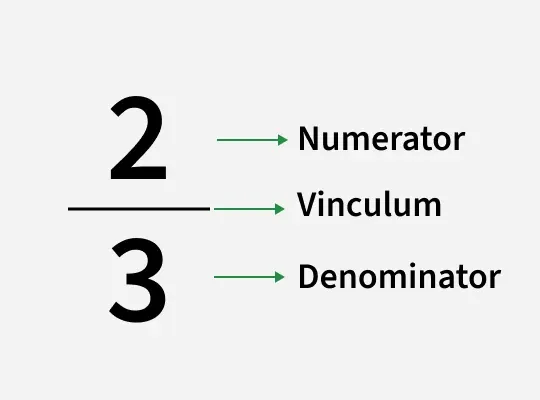
- **Numerator****:** The number at the top of the fraction represents the number of parts being considered.
- **Vinculum: The line that separates the numerator and denominator is also called the fraction line.
- **Denominator****:** The number at the bottom of the fraction, representing the total number of equal parts into which the whole is divided.
**Types of Fractions
They are categorized based on their numerator and denominator, and they are:
**1) **Proper Fraction: Fractions in which the numerator value is less than the denominator value.
**2) **Improper Fractions: Fractions in which the numerator value is greater than the denominator value.
**3) **Mixed Fractions: A fraction that consists of a whole number with a proper fraction.
Fraction Properties
Fractions follow important mathematical properties similar to whole numbers and integers. These properties help us perform operations like addition and multiplication correctly.
**1. Commutative Property (Addition and Multiplication)
The order of fractions does not change the result.
- Addition: \frac{a}{b} + \frac{c}{d} = \frac{c}{d} + \frac{a}{b}
- Multiplication: \frac{a}{b} \times \frac{c}{d} = \frac{c}{d} \times \frac{a}{b}
**2. Associative Property (Addition and Multiplication)
The grouping of fractions does not change the result.
- Addition: (\frac{a}{b} + \frac{c}{d}) + \frac{e}{f} = \frac{a}{b} + (\frac{c}{d} + \frac{e}{f})
- Multiplication: (\frac{a}{b} \times \frac{c}{d}) \times \frac{e}{f} = \frac{a}{b} \times (\frac{c}{d} \times \frac{e}{f})
**3. Identity Property
The identity element is a number that keeps the fraction unchanged.
- **Additive identity: \frac{a}{b} + 0 = \frac{a}{b}
- **Multiplicative identity: \frac{a}{b} \times 1 = \frac{a}{b}
**4. Multiplicative Inverse
The reciprocal of a fraction, when multiplied by the original fraction, gives 1. \frac{a}{b} \times \frac{b}{a} = 1
**5. Distributive Property
Multiplying a fraction by a sum is the same as multiplying each fraction separately and then adding the results. \frac{a}{b} \times \left(\frac{c}{d} + \frac{e}{f}\right) = \frac{a}{b} \times \frac{c}{d} + \frac{a}{b} \times \frac{e}{f}
Fractions Operations
Topics Related to Fractions
- Comparing Fractions
- Decimal Fractions
- Convert Fractions to Decimals
- Real Life Application of Fractions
- Interesting Facts About Fractions
Practice
- Fractions Practice Questions (Easy)
- Fractions Practice Questions (Medium)
- Fractions Practice Questions (Hard)
- Adding Fractions with Unlike Denominators Worksheet
- Add and Subtract Fractions Quiz
- Fractions Aptitude Quiz
Fraction Worksheets
Practice the fractions with these useful worksheets on fractions.