Representation of Rational Numbers on a Number Line (original) (raw)
Last Updated : 7 Feb, 2026
A rational number is any number that can be written in the form p/q, where p and q are integers and q ≠ 0. Rational numbers include positive numbers, negative numbers, and zero. To understand these numbers better, we often represent them on a number line. The number line helps us see their exact position, compare them, and understand which numbers are bigger or smaller.
**Proper Fractions
A proper fraction is a fraction in which the numerator is smaller than the denominator. This means the value of the fraction is less than 1.
**For Example: 2/5, 3/8, 7/10
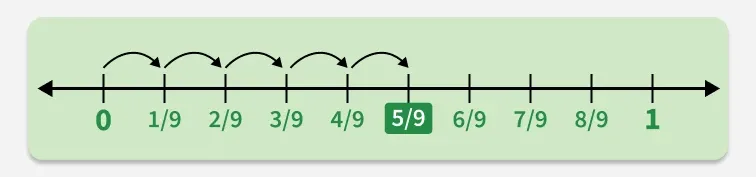
**Example 1: Representation of 5/9 on the number line.
**Solution:
- First, we mark 0 (the origin) and 1 on the number line because proper rational numbers always lie between 0 and 1.
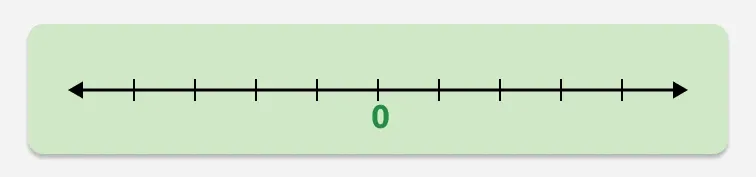
- Next, we divide the space between 0 and 1 into equal parts, and the number of parts should be the same as the denominator of the fraction.
- Then, we count and mark the part that corresponds to the numerator of the fraction.
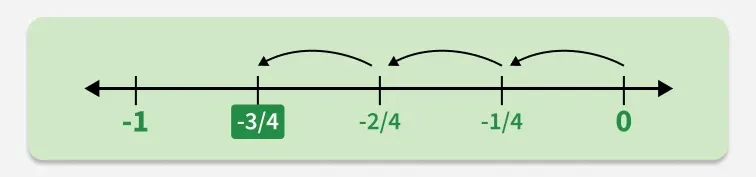
**Example 2: Representation of -3/4 on the number line.
**Solution:
- First, we mark 0 (the origin) and 1 on the number line because proper rational numbers always lie between 0 and - 1.
- Next, we divide the space between 0 and -1 into equal parts, and the number of parts should be the same as the denominator of the fraction.
- To mark -3 / 4, move three parts on the left-side of zero.
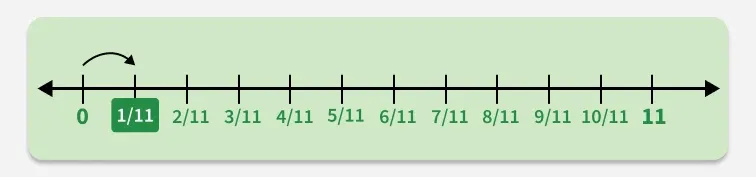
**Example 3: Representation of 1/11 on the number line
**Solution:
- First, we mark the origin and integer value 1 on the number line, since proper rational numbers lie between 0 and 1.
- Next, we divide this region into 11 equal parts.
- To mark 1/11, move one part on the right-side of zero.
**Improper Fractions
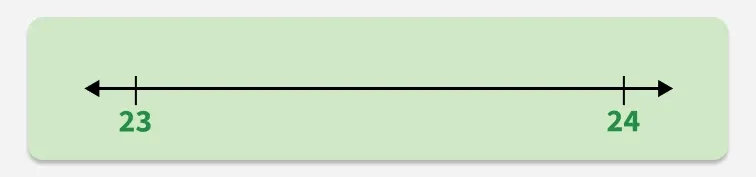
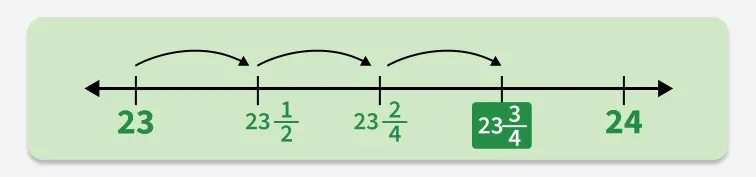
Given an improper fraction p/q, the numerator (p) > denomination (q), such that the ratio p/q>1. Improper fractions are first converted into mixed fractions, that is, 11/2 ⇢ 51/2, here 5 is whole number part, 1/2 is fraction part.
**Example 1: Represent 95/4 on a number line.
**Solution:
Converting to a mixed fraction we get,
The mixed fraction is then plotted on the number line, which lies in the range of the whole number part and whole number part +1. This region is then divided into equal parts, corresponding to the denominator of the fraction part and marking the pth (that is, numerator) part.
95/4 = 23\frac{3}{4}
**Step 1:
**Step 2:
Rational Number Representation using Successive Magnification
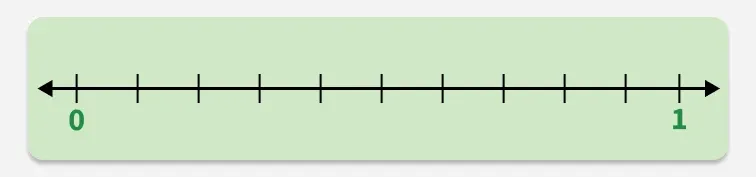
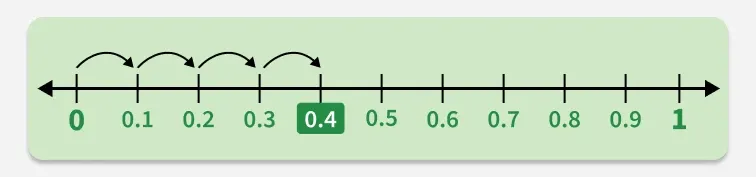
We can represent We can represent this decimal expansion on the number line through the process of successive magnification.
We know every rational number can be expressed as decimal expansions. Here,
2/5 = 0.4
Step 1 : 0.4 lies between: 0 and 1
Step 2:
Unsolved Questions on Representation of Rational Numbers on the Number Line
**Question 1: Represent 7/8 on the number line.
**Question 2: Represent –5/6 on the number line.
**Question 3: Represent 13/5 on the number line.
**Question 4: Using successive magnification, represent 0.37 on the number line.
**Question 5: Represent –9/4 on the number line.
**Question 6: Convert 47/6 into mixed form and represent it on the number line.