Rhombus Formula (original) (raw)
Last Updated : 23 Jul, 2025
Understanding the **rhombus formula is essential for anyone studying geometry. Mensuration is a branch of geometry that studies or measures the area, perimeter, and volume of two-dimensional or three-dimensional objects and constructions. Mensuration comprises fundamental mathematical formulae and, in certain circumstances, algebraic expressions. One of the easiest 2-mark or 3-mark questions in the CBSE Exams. But when the question related to rhombus is ****"PROVE THAT..."** it is quite tricky.
Rhombus
A rhombus is a diamond-shaped quadrilateral with equal sides but unequal angles of inclination between these two sides. It has four sides that are all the same length since it is a quadrilateral.
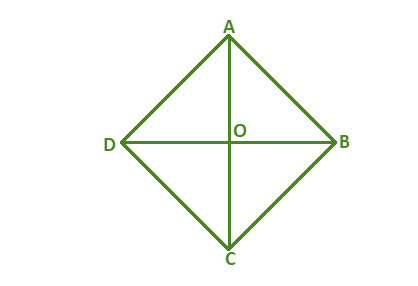
Rhombus shape
**Properties of a rhombus
- All of the sides are the same length, and opposite sides are parallel to one another.
- Adjacent angles add up to 180°, but opposed angles remain constant.
- The diagonals are perpendicular to each other and bisect the angles between the sides, i.e. the vertex angles.
- The total of the angles in the Rhombus is 360°.
- If each vertex angle is 90°, the rhombus is a square.
Formulae of Rhombus
The formulae of the rhombus include the formula for the area in different ways consisting of different formulas, the formula also includes the perimeter of the rhombus. Let's take a look at these formulae,
**Area of Rhombus
The entire space covered or encompassed by a rhombus on a two-dimensional plane is defined as area of Rhombus. The area of a rhombus may be computed using three distinct methods: diagonal, base and height, and trigonometry.
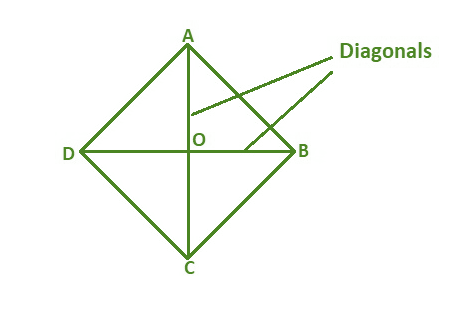
- **I st Case By using Diagonal: It is half of the product of the diagonal lengths.
Rhombus for calculating area when only 2 diagonals are given
**Area of Rhombus = (d 1 × d 2 )/2 sq. units
Where, d1 is the length of diagonal 1 and d2 is the length of diagonal 2.
- **2 nd Case By using Base and Height: The base of a rhombus is one of its sides, and the height is the perpendicular distance from the chosen base to the opposing side.
Rhombus shape, describing features Height and Base
**Area of a Rhombus = base × height sq units
Where, b is the length of any side of the rhombus and h is the height of the rhombus .

- **3 rd case By using Trigonometry
**Area of Rhombus: (side ) 2 **× sin(A) sq. units
Here square the side of Rhombus
And Sin (A) is the interior angle.
**Perimeter of Rhombus
A rhombus' perimeter is the sum of its four sides or It is the product of the length of one side by 4.
Hence theperimeter of the rhombus formula = 4a, where 'a' is the side.
**Perimeter of Rhombus = side + side + side + side = 4s.
- **Rhombus Perimeter Using Diagonal Lengths
Given a horizontal diagonal length of a and a vertical diagonal length of b, the perimeter is calculated as follows:
**P = √(a 2 + b 2 ) × 2
Sample Questions on Rhombus Formula
**Question 1: What is the area of the rhombus for which the length of diagonals is 6 cm, 8 cm.
**Solution:
Given lengths of diagonals,
Diagonal (D1) = 6cm
Diagonal (D2) = 8cm
By using Diagonal formula : Area of rhombus = (d1 × d2)/2 sq. units
= (1/2) × 6 × 8
= (1/2) × 48
= 24
So the area of rhombus is 24 cm2.
**Question 2: Calculate the area of a rhombus (using base and height) if its base is 6 cm and height is 2 cm.
**Solution:
Given,
Base (b) = 6 cm
height of rhombus(h) = 2 cm
Now,
Area of the rhombus(A) = base × height
= 6 × 2
= 12 cm2
**Question 3: Find the **diagonal of a rhombus if its area is 120 cm 2 **and the length measure of the longest diagonal is 12 cm.
**Solution:
Given: Area of rhombus = 120 cm2 and Diagonal d1 = 12 cm.
Hence, Area of the rhombus formula, A = (d1 × d2)/2 square units, we get
120 = (12 × d2)/2
120 = 6 × d2
Or d2 = 120/6
d2 = 20
Therefore, the Length of another diagonal is 20 cm.
**Question 4: Find the perimeter of a rhombus whose side is 7 cm.
**Solution:
Given side s = 7 cm
Therefore, Perimeter of Rhombus: 4 × s
So, Perimeter (P) = 4 × 7 cm = 28 cm
**Question 5: Find the side length of a rhombus whose perimeter is given as 60cm.
**Solution:
Given Perimeter(P) = 60 cm
Perimeter = 4 × side
Side = P/4
So, side = 60/4
= 15 cm
Hence, the length of rhombus is 15 cm.
**Question 6: Find the perimeter of the rhombus given the diagonal lengths are 3 cm and 4 cm respectively.
**Solution:
When diagonal lengths are Given a = 3 cm, b = 4 cm
Perimeter(P) = 2 × √(a2 + b2)
= 2 × √(32 + 42)
= 2 × √(9 + 16)
= 2 × 5
= 10 cm
**Question 7: Find the perimeter of a rhombus whose side is 3.5 cm.
**Solution:
Given that side s = 3.5 cm
Perimeter of Rhombus is given by: 4 × s
So, Perimeter (P) = 4 × (3.5) cm
= 14 cm
**Question 8: Find the area of an isosceles trapezoid with bases 8 cm and 6 cm and height 5 cm.
**Solution: Exact steps which can get you full marks as the teacher expects. Also don't forget to consult your teacher for writing conclusion
The formula for the area of an isosceles trapezoid is:
Area = ((b1+b2)*h)/2
b1 = 8cm
b2 = 6cm
h = 5 cm
Area = (14*5)/2 => 7 *5 => 35 cm2.
**Question 9: Find the height of an isosceles trapezoid if the lengths of the bases are 10 cm and 6 cm, and the area is 32 cm².
**Solution: Exact steps which can get you full marks as the teacher expects.
Area = 32 cm2
b1 = 10 cm
b2 = 6 cm
Area = ((b1+b2)*h) / 2
32 = ((10 + 6)*h)/2
multiply 2 across,
64 = (16*h) => h = 64/16 => 4 cm
Hence h is 4 cm.
**Question 10: Find the perimeter of an isosceles trapezoid with bases 12 cm and 8 cm, and non-parallel sides 5 cm each.
**Solution:
**The formula for the perimeter of an isosceles trapezoid is:
**Perimeter = b1 + b2 + 2a
Given,
b1 = 12 cm
b2 = 8 cm
a = 5 cm
Perimeter = 12 + 8 + 2*5 => 20 + 10 => 30 cm.
Hence Perimeter is 30 cm.
Practice Problem
**Q1. A rhombus has diagonals of lengths 10 cm and 24 cm. What is the area of the rhombus?
**Q2. If the side of a rhombus is 15 cm, what is its perimeter?
**Q3. A rhombus has diagonals of lengths 14 cm and 48 cm. What is the length of each side?
**Q4. The area of a rhombus is 96 cm², and one of its diagonals is 16 cm. Find the length of the other diagonal.
**Q5. If the diagonals of a rhombus are 30 cm and 40 cm, what are the angles formed between them?
**Q6. The diagonals of a rhombus intersect at an angle of 60°. If one diagonal is 10 cm, find the length of the other diagonal.
**Q7. Prove that the diagonals of a rhombus bisect each other at right angles.
**Q8. Is it possible to inscribe a rhombus in a circle? If yes, what condition must be satisfied?
**Q9. The perimeter of a rhombus is 40 cm. What is the length of one side?
**Q10. The side length of a rhombus is 13 cm, and one of the interior angles is 120°. Find the area of the rhombus.
Conclusion
The rhombus is a stylish geometric shape that showcases the beauty of symmetry and the relationship between angles and sides. With equal-length sides and diagonals that intersect at right angles, filling the gap between basic quadrilaterals and more complex polygons. Its properties, such as the bisecting diagonals and the ability to calculate area through diagonal lengths, make it a vital concept in mathematical studies. Whether used in art, or advanced geometry, the rhombus continues to be a symbol of balance and precision.