Rhombus: Definition, Properties, Formula and Examples (original) (raw)
Last Updated : 21 Aug, 2025
A **rhombus is a type of quadrilateral with the following additional properties.
- All four sides are of equal length and opposite sides parallel.
- The opposite angles are equal, and the diagonals bisect each other at right angles.
- A **rhombus is a special case of a parallelogram, and if all its angles are 90 degrees, it becomes a square.
A Rhombus is also known as a **Rhomb, a **Lozenge, and a **Diamond.

Diagram of a Rhombus
A rhombus exhibits symmetry across its diagonals. This means that if you fold a rhombus along one of its diagonals, the two resulting halves will perfectly overlap each other.
The figure above shows a rhombus shape where AB = BC = CD = DA and the diagonals AC and BD bisect each other at a right angle. This confirms its classification as a quadrilateral.
**Related Reads,
**Rhombus Examples
Rhombus is a very common shape and can be seen in a variety of objects that we use in our daily lives. Various Rhombus-shaped objects are Jewelry, Kites, Sweets, Furniture, etc.

Rhombus Examples
**Note: All squares are rhombuses, but not all rhombuses are **squares. This is because a square is a special type of rhombus that has all four sides equal in length and all four angles equal to 90 degrees. However, a rhombus can have angles that are not equal to 90 degrees.
Similarly, Every Rhombus is a **Parallelogram but nit vice versa.
**Read:**Rhombus Is Not A Square
Area of a Rhombus
The area of the Rhombus is the space enclosed by all four boundaries of the Rhombus it is measured in unit squares. There are two ways of finding Areas of a Rhombus which are discussed below:
Area of Rhombus when both Diagonals are given
The area of the rhombus is the region covered by it in a two-dimensional plane. The formula for the area is equal to the product of the diagonals of the rhombus divided by 2. Given below is a rhombus with two diagonals d1 and d2:

The formula for the area of a Rhombus is:
**Area of Rhombus = 1/2(d 1 × d 2 ) Sq. unit
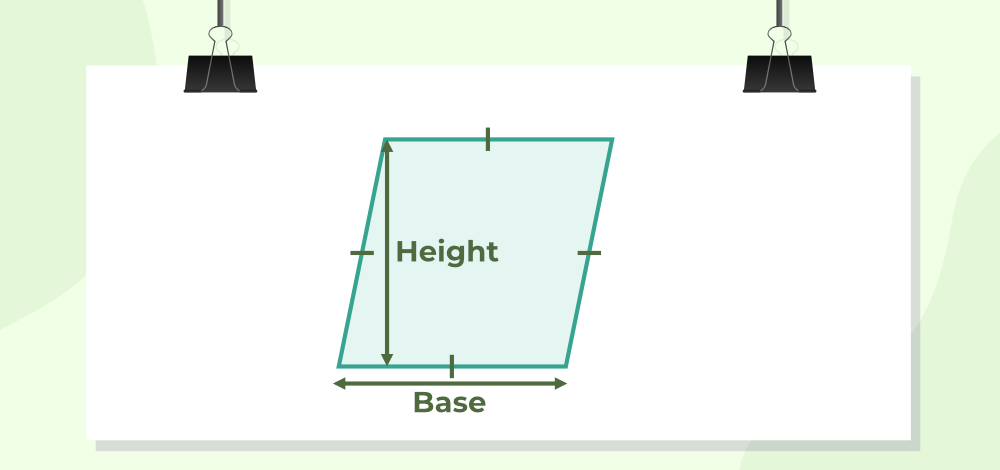
Area of Rhombus when Base and Altitude are given
When the Base and Altitude of a Rhombus are given then the formula calculates its area:
**Area of Rhombus = Base × Height
Perimeter of Rhombus
The perimeter of a rhombus is defined as the sum of all its sides. Since all the sides of a rhombus are equal in length, it can be said that the Perimeter of a Rhombus is four times the length of one side.
Thus, if s denotes the length of a side of a rhombus,
**Perimeter of Rhombus = 4 × s
Where s is the side of Rhombus
For instance, if each side of a rhombus measures 5 cm, its perimeter would be 4×5 cm, equating to 20 cm.
**Read More: **Formulas for Rhombus
**Diagonals of a Rhombus
The diagonals of a rhombus bisect each other at right angles. It means that they intersect at a 90-degree angle, a property not shared by all quadrilaterals.
- This perpendicular intersection results in the diagonals dividing the rhombus into four congruent right-angled triangles.
- While the sides of a rhombus are of equal length, its diagonals are generally of different lengths and they bisect the internal angles of the rhombus.
- Each diagonal cuts an angle of the rhombus into two equal parts.
- The lengths of the diagonals can be used to calculate the area of the rhombus, with the formula.
**Area = d 1 **× **d **2
Where, d1 and _d 2 are the lengths of the diagonals.
Properties of Rhombus
The properties of a rhombus are:
- All the sides of a rhombus are equal. It is just a parallelogram with equal adjacent sides.
- All Rhombus has two diagonals, which connect the pairs of opposite vertices. A rhombus is symmetrical along both its diagonals. The diagonals of a rhombus are perpendicular bisectors to each other.
- If all the angles of a rhombus are equal, it is called a square.
- The diagonals of a rhombus would always bisect each other at a 90-degree angle.
- The sum of interior angles is 360°.
- Not only do the diagonals bisect each other, but they also bisect the angles of a rhombus.
- The two diagonals of a rhombus divide it into four right-angled congruent triangles.
- There cannot be a circumscribing circle around a Rhombus.
- It is impossible to have an inscribing circle inside a rhombus.
**Rhombus vs Other Quadrilaterals
Let's see the comparison of rhombus with other common quadrilaterals in the table below.
| **Difference between Rhombus and Other Quadrilaterals | |||||
|---|---|---|---|---|---|
| Features | **Rhombus | **Square | **Rectangle | **Parallelogram | **Trapezoid |
| Sides | All sides have equal length | All sides have equal length | Opposite sides equal | Opposite sides equal | Only one pair of opposite sides parallel |
| Angles | Opposite angles equal | All angles are 90° | All angles are 90° | Opposite angles equal | No specific angle properties |
| Diagonals | Bisect each other at right angles and are not equal | Bisect each other at right angles and are equal | Bisect each other but not at right angles and are equal | Bisect each other but not at right angles and are not equal | No specific diagonal properties |
| Symmetry | Both line and rotational symmetry | Both line and rotational symmetry | Line symmetry | Line symmetry | Typically no line or rotational symmetry |
| Parallel Sides | The opposite sides are parallel | All sides are parallel | The opposite sides are parallel | The opposite sides are parallel | Only one pair of opposite sides parallel |
| Area Formula | Base × Height or ½ (Product of diagonals) | Side² | Length × Width | Base × Height | A = (a + b) (h)/2 |
| Special Properties | All sides are equal and it is a parallelogram | All properties of a rectangle and a rhombus | Diagonals are equal and bisect each other | Opposite sides are equal and parallel, opposite angles are equal | Only one pair of opposite sides is required to be parallel |
**Also Read
- **Difference between Rhombus Diamond and Trapezoid
- **Rhomboid
Rhombus Example Questions
Some solved example questions on Rhombus:
**Example 1: MNOP is a rhombus. If diagonal MO =29 cm and diagonal NP = 14cm, What is the area of rhombus MNOP?
**Solution:
Area of a rhombus = (d1)(d2)/2
Substituting the lengths of diagonals in the above formula, we have:
A = (29)(14)/2 = 406/2 = 203cm2Area of rhombus MNOP = 203cm2
**Example 2: ABCD is a rhombus. The perimeter of ABCD is 40, and the height of the rhombus is 12. What is the area of ABCD?
**Solution:
Perimeter = 40cm
Perimeter = 4 × side
40 = 4×side
⇒ side(base) = 10cm and height = 12cm (given)Now, Area of Rhombus = base × height
⇒ Area = 10 × 12 = 120 cm2
**Thus, Area of rhombus ABCD is equal to 120cm 2