SetBuilder Notation (original) (raw)
Set-Builder Notation
Last Updated : 17 Apr, 2026
Set-builder notation is a mathematical notation used to describe a set by specifying a property that its elements must satisfy. A set is written in the form
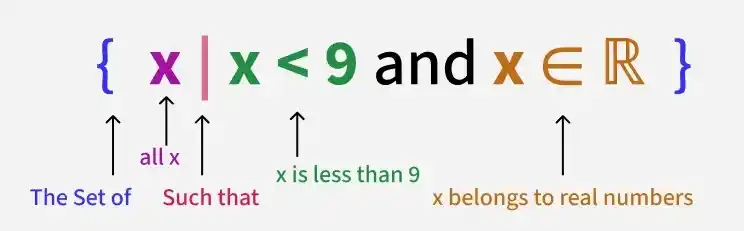
The notation is read as "the set of all x such that x<9 and x belongs to the set of real numbers." The condition completely describes the elements of the set.
Some other examples are.
**Example 1: The given set: A = {2, 4, 6, 8, 10}
In the set-builder form is represented as: A = {x ∈ ℕ ∣ x is even and x < 12}
**Example 2: The set of all natural numbers greater than 5:
In set-builder form, it is written as: {x ∈ N ∣ x > 5}
Symbols Used
The elements of the set are represented by a variety of symbols in the set builder form.
- | stands for "such that" and is often inserted after the variable in the set builder form. The set condition is then written after this symbol.
- ∈ When translated as "belongs to," or in other words "is an element of".
- The word, ∉ when translated as "does not belong to," implies "is not a part of."
- The letter N stands for all positive integers or natural numbers.
- W stands for whole numbers.
- Z stands for integers.
- Any number that may be stated as a fraction of integers or as a rational number is represented by Q.
- Any number which is not rational is called Irrational Number and is represented by P.
- R stands for real numbers or any non-imaginary number.
- C stands for Complex Numbers.
Need for Set-Builder Notation
Set-builder notation is used when a set contains a large number of elements or infinitely many elements, making it difficult or impossible to list all elements using the roster form. For small and finite sets, roster notation works well. For example, the set of numbers from 1 to 8 can be written as: {1,2,3,4,5,6,7,8}
However, problems arise when we try to list sets with infinitely many elements. Consider the set of all real numbers. It is impossible to list them in roster form, such as
{...1, 1.1 ,1.01 ,1.001 ,1.0001 ,......}
Since real numbers are infinite and continuously spread over the number line, roster notation is not practical in this case.
Instead, we use set-builder notation: {x ∣ x is a real number}
This can also be written as: {x ∣ x is rational or irrational}
Thus, set-builder notation makes it easier to represent:
- Infinite sets (like integers, natural numbers, real numbers)
- Sets defined by intervals
- Sets defined by equations or conditions