Square 1 to 50 (original) (raw)
Last Updated : 8 Jan, 2026
A square of a number n is obtained after multiplying n by itself. The square of a number is represented as:
**Square of n: n2 = n × n
Below is a table of squares for all numbers from 1 to 50:
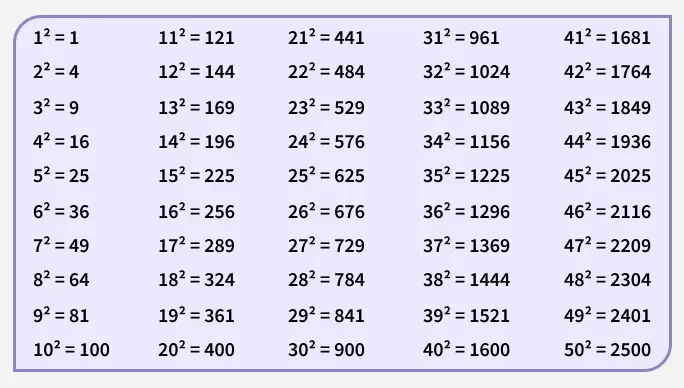
Squares from 1 to 50 (Even Numbers)
Even numbers are those numbers that are completely divisible by 2 without leaving any remainder.
| Number | Square | Number | Square | Number | Square | Number | Square | Number | Square |
|---|---|---|---|---|---|---|---|---|---|
| 2 | 4 | 12 | 144 | 22 | 484 | 32 | 1024 | 42 | 1764 |
| 4 | 16 | 14 | 196 | 24 | 576 | 34 | 1156 | 44 | 1936 |
| 6 | 36 | 16 | 256 | 26 | 676 | 36 | 1296 | 46 | 2116 |
| 8 | 64 | 18 | 324 | 28 | 784 | 38 | 1444 | 48 | 2304 |
| 10 | 100 | 20 | 400 | 30 | 900 | 40 | 1600 | 50 | 2500 |
Squares from 1 to 50 (Odd Numbers)
Odd numbers are those numbers which are not completely divisible by 2 i.e. leaves a remainder when divided by 2.
| Number | Square | Number | Square | Number | Square | Number | Square | Number | Square |
|---|---|---|---|---|---|---|---|---|---|
| 1 | 1 | 11 | 121 | 21 | 441 | 31 | 961 | 41 | 1681 |
| 3 | 9 | 13 | 169 | 23 | 529 | 33 | 1089 | 43 | 1849 |
| 5 | 25 | 15 | 225 | 25 | 625 | 35 | 1225 | 45 | 2025 |
| 7 | 49 | 17 | 289 | 27 | 729 | 37 | 1369 | 47 | 2209 |
| 9 | 81 | 19 | 361 | 29 | 841 | 39 | 1521 | 49 | 2401 |
Also Check
How to Calculate Values of Squares 1 to 50?
To calculate the squares of numbers from 1 to 50, you can use either of the following methods:
Method 1: Direct Multiplication
- Simply multiply the number by itself. For example, to find 342, compute 34×34.
Method 2: Using Basic Algebraic Identities
To find the square of a number n, express n in terms of a sum or difference, then use the algebraic identities:
**Using Sum:
Express n as (a + b) where a and b are numbers that make the calculation simpler.
Apply the identity: ****(a + b)** 2 = a 2 + b 2 + 2ab
**Example: To find 342 express 34 as (30 + 4)
(30 + 4)2 = 302 + 42 + 2.(30).(4)
= 900 + 16 + 240 = 1156
**Using Difference:
Express n as (a - b) where a and b are numbers that make the calculation simpler.
Apply the identity: ****(a - b)** 2 = a 2 + b 2 - 2ab
**Example: To find 292 express 29 as (30 - 1)
(30 - 1)2 = 302 + 12 - 2.(30).(1)
= 900 + 1 - 60 = 841
Tips and Tricks to Remember Square
Remebering square of numbers from 1 to 50 is a quite difficult task. There are some patterns present in numbthathich help us to memorize squares easiverifyifying that our answer is correct.
Understanding Patterns
The square of a number shows significant pattern which make it easier to remember it. for example, when we whether the difference between consecutive square numbers it increases by 2 each time:
**Example:
22 - 12 = 4 - 1 = 3
32 - 22 = 9 - 4 = 5
42 - 32 = 16 - 9 = 7
52 - 42 = 25 - 16 = 9
Notice the difference of 2.
Breaking down Large Numbers
We can find square of large numbers by breaking down them into smaller components. Then, using identity to solve them such as (a - b)2 and (a +b)2.
**Example:
232 = (20 + 3)2 = 202 + 2 × 20 × 3 + 32
= 400 + 120 + 9
= 400 + 129
= 529
Practice Questions
**Questions 1: What is the square of 18?
**Solution:
Square of 18:
18 = 18 × 18 = 324
**Questions 2: Find the area of the square, if side of a square is 13 cm.
**Solution:
We know, Area of Square = (Side)2
Area of Square = (13)2 = 169 cm2
**Questions 3: Find the square of 48 using the identity (a - b)2 = a2 - 2ab + b2
**Solution:
Using the identity (a - b)2= a2 - 2ab + b2
48 = 50 - 2
(50 - 2)2= 502 - 2 × 50 × 2 + 22
= 2500 − 200 + 4
= 2304
**Questions 4: What is the square of 50?
**Solution:
502 = 50 × 50
= 2500
**Questions 5: What is the difference between the squares of 14 and 13?
**Solution:
We know by the by formula:
a2 - b2 = (a + b) ( a - b)
142 - 132 = (14 + 13) (14 − 13)
= 27 × 1 = 27
**Questions 6: If x2 = 400, find the value of x.
**Solution:
Given: x2= 400
x = √400 = √(20×20)
x = 20
**Questions 7: Find the area of rectangle,the if both length and breadth of rectangle is equal to 20 cm?
**Solution:
Area of Rectangle = length × breadth
= 20 × 20
= 400 cm2
Area of rectangle is 400 cm2
**Questions 8: If a square has an area of 784 square units, what is the length of its side?
**Solution:
Area of square = 784 sq. units
Side length = √784
= 28 unit.
Thus, length of squareunits28 unit.
**Questions 9: Find the square of 9 using the trick for squares close to 10.
**Solution:
92 = (10−1)2
= 102 - 2 × 10 × 1 + 12
= 100 − 20 + 1
= 81